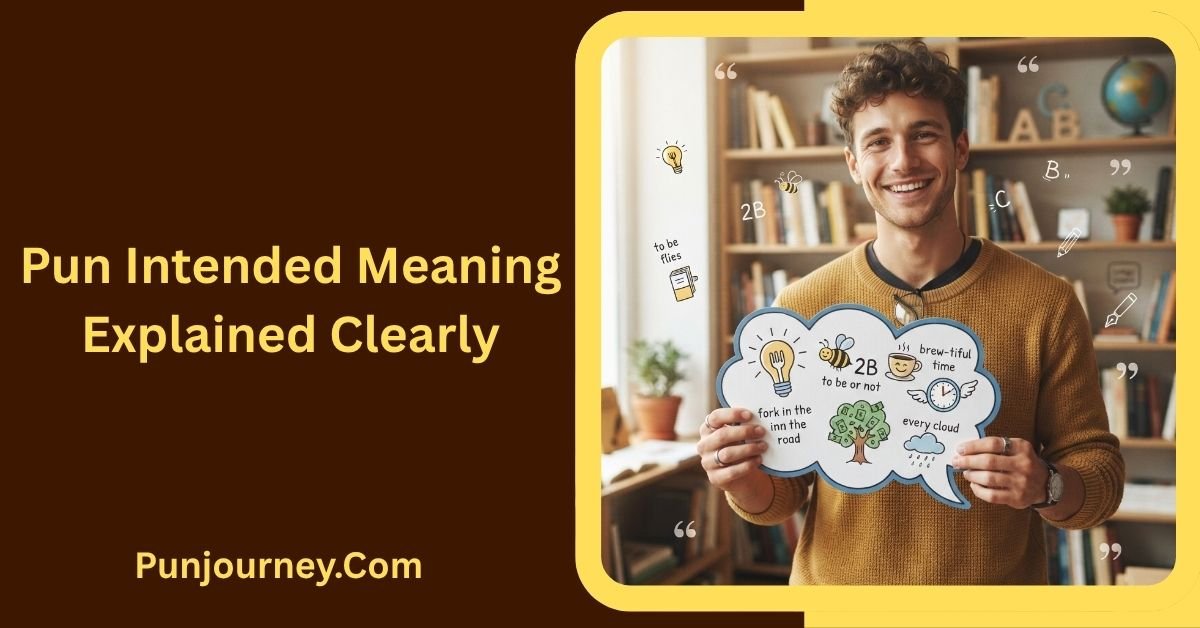
Pun Intended Meaning Explained Clearly 20 Examples & Usage Tips
You’ve probably heard someone say “pun intended” right after a joke and wondered what it really means. Pun Intended Meaning Explained Clearly It’s a tiny phrase with a big job. This guide gives you the pun intended meaning in plain English, so you’ll never feel lost again.
Here, you’ll get the pun intended meaning explained clearly, along with its origin, grammar, and real examples. You’ll also learn how “pun intended” differs from “no pun intended.” It’s handy for texts, captions, birthday cards, party chats, and everyday conversation. If you’ve ever stared at a caption and thought, “Was that on purpose?”, this article is for you.
By the end, you’ll know exactly what does pun intended mean, how to use it without sounding awkward, and which 20 examples are worth borrowing. Ready to get started? Let’s go.
What Does “Pun Intended” Mean?
Let’s start with the meaning of pun intended. When someone says it, they’re pointing at a joke they just made and admitting it was on purpose. This section explains the pun intended meaning in two quick ways.
Simple Definition
“Pun intended” is a short tag added after a sentence that contains wordplay. It tells the listener, “Yes, I meant that double meaning.” The pun intended definition boils down to one idea: the play on words was deliberate. Dictionaries treat it as a casual remark, not a formal grammar term. Think of it as a signpost. The joke is the road, and the phrase tells your listener where to look. When you search for the pun intended meaning, this is the heart of the answer: a pun, plus a wink that says you planned it. People use it in texts, speeches, and posts because it’s short, clear, and friendly.
Quick Meaning in Plain English
In plain English, it means, “I did that on purpose, and I’m proud of it.” Say your friend bakes a cake, and you tell her it was “a piece of cake, pun intended.” You’re not just describing the job. You’re winking at the joke. That’s the pun intended meaning in real life. Or imagine a friend who plays drums, and you say, “You’re really beating the competition, pun intended.” Everyone laughs because the meaning is obvious. Once you understand the pun intended meaning, you’ll start hearing it everywhere.
What Is a Pun Understanding Wordplay First
You can’t fully grasp the pun intended meaning without knowing what a pun is. A pun is a humorous expression that uses one word with two meanings, or two words that sound alike, to make you smile. It’s a classic form of verbal humor and shows up in jokes, headlines, and greeting cards. Puns aren’t new, and they aren’t just for dads. Teachers, writers, and advertisers use them to grab attention and make ideas stick.
Common Types of Puns
Puns come in a few main flavors. Pun Intended Meaning Explained Clearly Knowing the types of puns helps you spot clever wordplay faster, and it makes the pun phrase meaning easier to remember.
- Homophonic puns use words that sound alike, like “flour” and “flower.”
- Homographic puns use one spelling with two meanings, like “bat.”
- Compound puns pack several jokes into one sentence.
- Visual puns use a picture or sign to carry the joke.
Simple Pun Examples
Short, easy puns show how the trick works. Notice how each line leans on a double meaning, which is the heart of the pun intended meaning.
- Lettuce celebrate.
- Time flies like an arrow; fruit flies like a banana.
- I used to be a baker, but I couldn’t make enough dough.
- The scarecrow won an award because he was outstanding in his field.
- Soy funny.
- I’m on a seafood diet. I see food and I eat it.
- I wondered why the baseball kept getting bigger. Then it hit me.
- Sleeping comes naturally to me. I can do it with my eyes closed.
See Also: 92+ Amazing Music Puns That Totally Rock and Hit All the Right Notes
Where Did “Pun Intended” Come From?
Many people use the phrase without knowing its roots. The story is short, and it helps explain the history of the phrase pun intended. Here’s what we know about the word and the habit.
Origin of the Word “Pun”
The word “pun” first appeared in English in the 1600s. Its exact source isn’t certain. Some language experts link it to the Italian word “puntiglio,” meaning a fine point. Whatever the root, the word has meant a joke built on wordplay for more than 300 years. Over time, “pun” settled into everyday speech, and people began naming the joke out loud when they made one. The word “intended” simply means planned. Put together, the pun intended meaning is a “planned pun.”
How the Phrase Became Common
“Pun intended” is a newer habit. As spoken English grew more casual, people began tagging their jokes with short asides. Radio, TV, and later the internet helped the phrase spread. Pun Intended Meaning Explained Clearly No one can name the very first use, so be careful with any “first ever” claim you read online. Today, you’ll see it in comment sections, group chats, and captions. It spreads easily because it’s short, friendly, and fits any topic from food to sports. Many people also like that it lets them enjoy the joke before anyone else points it out.
How to Use “Pun Intended” in a Sentence
Using it is easy once you know the pattern. The pun intended meaning works best when the tag follows the joke right away. Here’s how it fits into written English and spoken English.
Where to Place “Pun Intended”
Put it right after the punny word or at the end of the sentence. Both spots work well. Placement changes the rhythm of the joke, so try each version and see which one sounds best to you.
- End of a sentence: “That movie was a real blast, pun intended.”
- Mid-sentence with dashes: “The soup was—pun intended—a hot mess.”
- As its own short line: “Pun intended.”
Using It in Written English
In writing, set the phrase off with a comma, dash, or parentheses. Texts and captions often add an emoji for tone. Keep it short, and don’t explain the joke afterward. That’s what makes pun usage feel smooth instead of forced. Pun Intended Meaning Explained Clearly For example: “Our road trip was a real journey, pun intended.” In a text, you might add a smiley or a wink emoji. In a formal essay, though, skip the phrase and let the wordplay speak for itself.
Using It in Spoken English
Out loud, your tone does most of the work. Pause for a beat, smile, and say the phrase lightly. That small pause helps your listener catch the double meaning, and the pun intended meaning lands without any extra explaining. Don’t rush, either. Comedians and teachers know that timing is half the joke. Practice with a friend, and you’ll quickly find your natural rhythm.
Is “Pun Intended” Grammatically Correct?
Yes, it is. It’s a casual shortened phrase, much like “none intended.” Strict grammar rules don’t treat it as a full sentence, but it’s perfectly accepted in speech and informal writing. Just don’t change it to “puns intended” unless you really made more than one. Think of it as shorthand for “I intended the pun.” We drop the extra words because the meaning is already clear. English is full of these shortcuts, and this one is easy to understand.
20 Pun Intended Examples You Can Use

These are ready-to-use lines you can borrow. Each one shows the pun intended meaning in action, with a light, friendly tone that’s safe for most audiences. Feel free to tweak the words to match your own style.
Funny Everyday Examples
These everyday lines suit chats with friends, family, and coworkers. Pun Intended Meaning Explained Clearly They’re short, silly, and easy to say out loud.
- “My plant died, so it’s time to turn over a new leaf, pun intended.”
- “I’m so tired. Time to hit the hay, pun intended.”
- “I’m a big dill, pun intended.”
- “That diet was a waist of time, pun intended.”
- “I took a job at the bakery. It’s a great way to rise, pun intended.”
- “The elevator’s broken, so today has its ups and downs, pun intended.”
- “The dog was pawsitively proud, pun intended.”
Clever Conversation Examples
Here’s a mix of quick comebacks and witty replies. They work best when you say them with a straight face and a small smile.
- “She’s a pilot, and her career is really taking off, pun intended.”
- “The bank teller quit because there was no interest, pun intended.”
- “That band really knows how to strike a chord, pun intended.”
- “He’s reading a book about glue and can’t put it down, pun intended.”
- “I’d tell you a chemistry joke, but all the good ones Argon, pun intended.”
- “It was a sound idea, pun intended.”
- “We’re in the dark about the power cut, pun intended.”
Examples in Writing and Social Media
Captions, headlines, and posts love a good pun. These lines fit written English and quick social updates.
- “Coffee first. Everything else is a latte, pun intended.”
- “Beach day? Shore thing, pun intended.”
- “New bakery opens, and locals can’t loaf it, pun intended.”
- “Monday has me feeling grounded, pun intended.”
- “This post is nuts, pun intended.”
- “Fall for autumn, pun intended.”
See Also: 44+ Funny Trivia Team Names Clever Punny & Hilarious Ideas
“Pun Intended” vs. “No Pun Intended”: What’s the Difference?
People mix these two up all the time. The pun intended vs no pun intended question comes down to whether the joke was planned or accidental. Getting the pun intended meaning right will make your jokes sound confident instead of confusing. Let’s clear it up.
When to Say “Pun Intended”
Say it when you made the joke on purpose and want your listener to notice it. It’s like a friendly nudge, and it invites your listener to enjoy the joke with you. For example, “Our team really hit the nail on the head, pun intended.” Pun Intended Meaning Explained Clearly You’re showing that the pun intended meaning applies and the humor was planned.
When to Say “No Pun Intended”
Use it when a pun slipped out by accident. The no pun intended meaning is basically, “Oops, I didn’t mean to be funny.” People also use it playfully, even when the joke was planned, as a sly wink. It’s an easy way to keep the tone light and polite.
Quick Comparison
This quick table shows the key twist in each phrase. Use it as a cheat sheet whenever you’re unsure which one fits.
| Phrase | Meaning/Twist | Example |
| Pun intended | The joke was made on purpose | “They knead the money, pun intended.” |
| No pun intended | The pun was accidental, or a playful wink | “The lamp store closed after sales dimmed, no pun intended.” |
| Pun intended, perhaps | A teasing maybe, often sarcastic | “That deal sounds sweet, pun intended, perhaps.” |
What Does “Pun Intended, Perhaps” Mean?
This version adds a teasing twist. The word “perhaps” suggests the speaker might have meant the joke, or might be pretending not to. It’s a playful, slightly sarcasm-flavored spin on the pun intended phrase.
You’ll hear it in banter among friends, where people enjoy being coy about their intended joke. Pun Intended Meaning Explained Clearly For example, a friend might say, “The new coffee shop is brewing up a storm, pun intended, perhaps.” Everyone knows the joke was planned, but the speaker adds a sly grin anyway. In short, it’s a playful cousin of the main phrase. It keeps the pun intended meaning but adds a shrug. Use it sparingly, since it can confuse people who don’t know the expression well.
Why Do People Say “Pun Intended”?
There are a few good reasons. The pun intended meaning isn’t only about the joke itself. It also shapes how people react. Let’s look at the three main reasons.
Highlighting Wordplay
Some puns are subtle. Saying the phrase points straight at the wordplay so nobody misses it. It’s like putting a spotlight on your pun intended meaning, and it works well in sentence meaning that has hidden layers. Think of a mystery novel with a hidden clue. Pun Intended Meaning Explained Clearly The phrase is the arrow pointing to it.
Adding Humor to Conversation
A well-timed tag makes people groan, laugh, or both. It adds a bit of humor and personality to a plain chat. A groan is often the sign of a successful pun, so don’t worry if you get one. It also builds a friendly mood, because people love sharing a laugh. Even a small groan connects you with the group.
Making the Intended Meaning Clear
Sometimes context isn’t enough, and a listener might think you’re being serious. Adding the phrase removes doubt. This is especially useful in text messages, where tone is easy to misread. It also protects you from awkward moments. If your sentence could sound odd without the joke, the tag explains your pun intended meaning in three words.
Can a Pun Be Unintentional?
Absolutely. Speakers slip into unintentional pun moments all the time, like saying “I’m feeling under the weather” about a rainy-day event. That’s exactly when people say “no pun intended.” So the answer is yes, a pun can happen by accident, but “pun intended” always signals a planned joke. That’s the key pun intended meaning to remember. Pun Intended Meaning Explained Clearly Here’s another example. Someone describes a flood and says the town was “swamped with work.” If they didn’t plan the water link, they’d add “no pun intended.” Spotting these moments is a fun way to learn how language humor really works.
“Pun Intended” vs. Double Entendre and Other Wordplay
Puns have some close cousins. Understanding them keeps the pun intended meaning from getting mixed up with other types of figurative language. Here are the two biggest look-alikes.
Pun vs. Double Entendre
A pun plays with a word’s meaning or sound, and it’s usually clean and silly. A double entendre has a second meaning that is often suggestive or adult. Many puns are family-friendly, while a double entendre may not be. For example, a pun might be “I’m reading a book on anti-gravity; it’s impossible to put down.” A double entendre would hint at something else entirely, usually in a cheeky way. Pun Intended Meaning Explained Clearly Always think about your audience before choosing one.
Pun vs. Malapropism
A malapropism is a mistaken word used by accident, such as saying “pineapple of politeness” instead of “pinnacle of politeness.” A pun is deliberate and clever. One is a slip, and the other is a joke on purpose. Malapropisms often sound funny, but the speaker isn’t in on the joke. With a pun, the speaker always is. That’s why the pun intended meaning never applies to a malapropism.
See Also: 41+ Electricity Puns Blow your Mind Shockingly Funny Wordplay
Alternatives to Saying Pun Intended

Want to switch things up? The pun intended meaning can be shared in many fresh ways. Pun Intended Meaning Explained Clearly Try one of these synonym for pun intended options.
- Pun totally intended
- Pardon the pun
- Yes, that was on purpose
- Wordplay intended
- You see what I did there?
- Did you catch that pun?
- I couldn’t resist
- Joke fully intended
- Play on words, yes
- Thought you’d like that one
Pick the one that matches your tone. Casual phrases work best with friends, while “pardon the pun” sounds a bit more polished.
Is “Pun Intended” Rude, Clever, or Sarcastic?
Most of the time it’s clever and friendly. It can sound sarcasm-heavy if your tone is dry, and it can feel unkind if the joke targets someone’s bad news. The pun intended meaning stays harmless when you read the room. Here’s when it fits and when it doesn’t.
Appropriate Situations
It works well in relaxed settings.
- Casual chats with friends and family
- Social media captions and group chats
- Birthday cards and party toasts
- Light classroom or workplace banter
When to Avoid It
Skip it when the mood is serious. Serious moments call for kind words, not wordplay.
- Sad news, illness, or loss
- Formal business emails and reports
- Moments when someone is upset
- Jokes that might embarrass another person
Common Mistakes to Avoid
A few small slips can weaken your joke. Avoiding them keeps the pun intended meaning crisp and your humor sharp. Pun Intended Meaning Explained Clearly Here’s what to watch for.
- Explaining the pun after saying the phrase
- Using it when there’s no pun at all
- Saying “puns intended” when it should be singular
- Using it too often in one conversation
- Mixing it up with “no pun intended”
“Pun Intended” in Everyday Media and Pop Culture
You’ll spot the phrase all over everyday conversation and media. Pun Intended Meaning Explained Clearly TV hosts use it to tease a joke, sports commentators drop it after a punny remark, and news headlines love a clever play on words. Memes and social posts use it as a punchline. Sitcoms often use it for a quick laugh, and game show hosts love a good groaner. Even brands use punny slogans, then nod to the joke in the comments. Its popularity proves the pun intended meaning is understood across the USA, which is why it fits so well in captions and comments.
Frequently Asked Questions
What does “pun intended” mean?
It means the speaker made a joke with wordplay on purpose. The pun intended meaning is basically, “I meant that double meaning.” It’s a light, friendly way to point out your own pun.
How do you use “pun intended” in a sentence?
Add it after the joke, as in “The bakery is on a roll, pun intended.” Use commas or dashes in writing. Out loud, pause briefly before saying it.
Is “pun intended” grammatically correct?
Yes. It’s a casual shortened phrase that’s accepted in speech and informal writing, and nobody will correct you for using it. The pun intended meaning stays clear even though it isn’t a full sentence.
What is the opposite of “pun intended”?
The closest opposite is “no pun intended,” which signals an accidental pun. It’s not a true opposite, but it’s the phrase people use when the joke wasn’t planned.
What does the expression “pun intended” mean?
The expression marks a deliberate joke. Anytime you see it, the pun intended meaning is that the writer or speaker chose the wordplay on purpose.
What does the word pun mean?
A pun is a joke that plays on a word’s double meaning or on similar-sounding words. It’s a common form of wordplay meaning a clever twist in language.
How do you say “no pun intended”?
Say it right after an accidental pun, with a light tone. You can also write it in parentheses. Pun Intended Meaning Explained Clearly It simply tells people you didn’t plan the joke.
Why do we say “no pun intended”?
We say it to show politeness or humor when a pun happens by accident. It softens the moment and keeps the chat friendly. It also shows that you know the pun intended meaning and are aware of the wordplay.
Final Thoughts
Now you’ve got the pun intended meaning explained clearly, from simple definition to real-life examples. You know where the phrase came from, how to place it, and when to skip it. You also know how “pun intended” differs from “no pun intended.”
Try a few of the 20 examples in your next text, caption, or chat. Remember, the best pun intended meaning is one that makes people smile without confusing them. Keep it light, keep it clever, and have fun with your wordplay.
Whether you’re writing a birthday card, a social post, or a quick text, a well-placed pun adds charm. Keep this guide handy the next time you want to explain the pun intended meaning to a friend. Every great pun deserves a great delivery.