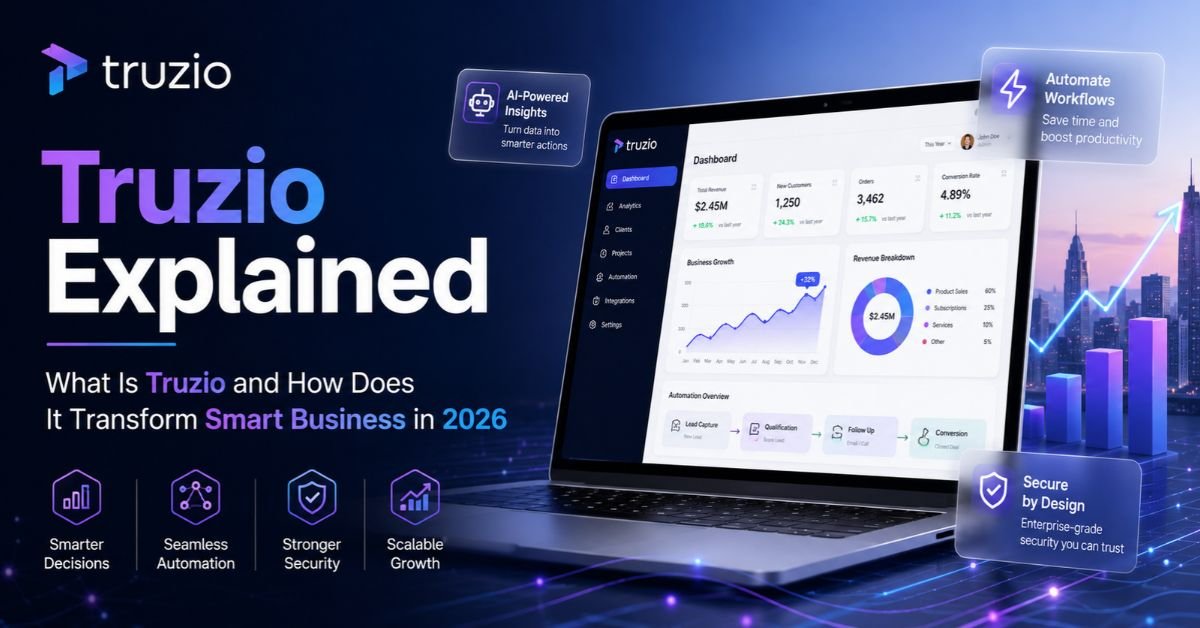
Truzio Explained What Is Truzio and How Does It Transform Smart Business in 2026
Picture a manager at 9 a.m. Sales sit in one app. Stock lives in another. Customer chats hide somewhere else. Nothing talks to anything.
That mess explains why Truzio digital transformation talk keeps growing. Truzio Explained This guide shows you what is Truzio, how Truzio works, and where it fits among smart business solutions. One honest note first. Truzio isn’t a single, widely documented product. People use the name in several ways. So this guide explains the idea behind it and flags the spots where details stay general.
What Is Truzio A Complete Overview
Digital business moves fast now. You face live data, sharper rivals, and customers who want instant answers. In that world, the name Truzio keeps popping up in searches about smart operations and digital business transformation.
This section breaks the topic into four parts. You’ll get a quick answer, a look at the name itself, a view of the technology side, and a clear line between what Truzio is and what it isn’t.
Quick Answer: What Is Truzio?
Truzio is a name linked to Truzio business solutions that pull data, workflows, and analytics into one connected system. It points to a digital transformation platforms style of working. Instead of juggling separate tools, you run daily tasks from one shared layer. Think of it as a control room for your company. Orders, stock, finance, and customer details all feed it. Smart rules and reports then flow back out to every team that needs them.
Understanding the Truzio Name and Its Different Uses
The Truzio meaning shifts with the place you meet it. Some pages use it for an ERP. Others use it for a tech services brand or a general platform idea. Public documentation stays thin. That’s why you should check any vendor claim yourself. Ask for a live demo. Read the contract terms. Request customer references. This guide treats Truzio as a model of modern business technology. You can use that model to judge any similar product on the market.
Truzio Technologies and Digital Business Solutions
Truzio Technologies often serves as the label for the tech side of the story. When people describe Truzio Technologies services, they usually mention cloud hosting, automation, analytics, and system links. Together these form Truzio digital solutions for mid-size and large firms. An analogy helps here. Your body has a nervous system that carries signals between organs. A good platform does the same job for your departments. It moves data fast and triggers the right action at the right moment. That’s the heart of enterprise technology solutions.
What Truzio Is and What It Is Not
Confusion causes bad buying decisions. So here’s a clean comparison. Truzio-style platforms connect many tools. They don’t replace every tool you own overnight. They also won’t fix poor data or weak habits on their own.
| Truzio-style platform is | Truzio-style platform is not |
| A multi-layer system for business management systems | Just a CRM |
| A source of live dashboards and insight | Just a pretty cloud dashboard |
| A bridge between old and new software | A guaranteed cure for messy processes |
| A tool for technology-driven business growth | A plug-and-play miracle with zero setup |
How Truzio Works Core Technology and Architecture
You don’t need an engineering degree to grasp this. Most platforms of this type follow a layered design. Each layer does one job well. Together they turn raw facts into action.
The table below shows the four layers. Read it from the bottom up. Data feeds the process layer. The process layer feeds the intelligence layer. The integration layer ties everything to the outside world. Strong digital business infrastructure depends on all four working in sync.
| Layer | Main job | What you gain |
| Data layer | Collects and cleans information | One trusted source of truth |
| Process layer | Runs workflows | Faster daily operations |
| Intelligence layer | Applies AI and analytics | Sharper decisions |
| Integration layer | Links outside systems | A unified ecosystem |
Data and Information Management
Everything starts with data. Data management systems pull facts from ERP tools, CRM apps, IoT sensors, and internal databases. They remove duplicates and fix errors. Then they store the clean result in one place. Why does that matter? Because two versions of the same customer record cause real trouble. Invoices go to the wrong address. Sales teams call twice. Good secure business data management stops those slips and gives every team the same trusted numbers. It also supports enterprise data integration across departments.
Business Process Automation
Next comes action. Business process automation takes repeat tasks off human desks. Take an order as an example. A customer clicks buy. The system checks stock, updates the count, books a courier, and sends a receipt. Nobody types a thing. Workflow management software guides each step and flags delays. This kind of business workflow automation cuts errors and frees staff for creative work. It also supports business process digitalization, which means moving paper and email chains into clear digital flows.
AI-Powered Intelligence and Decision Support
The intelligence layer turns data into advice. Artificial intelligence (AI) spots patterns that people miss. Machine learning (ML) improves its guesses as new data arrives. Together they power predictive business analytics such as demand forecasts and risk alerts. For example, the system may warn you that a key supplier will run late. You can then switch orders before customers feel any pain. This is AI-powered decision support at its best. It backs your judgment without replacing it.
System Integration and Connectivity
No company runs on one tool. You likely use finance software, a CRM, a warehouse app, and more. Enterprise application integration links them through APIs. Data then moves freely instead of getting trapped in silos. Strong enterprise system integration also protects your past investments. You keep the older tools that still work. You add new ones where they help. This approach supports digital ecosystem integration with partners and suppliers too.
What Is Truzio ERP and How Does It Support Business Operations?

Enterprise resource planning (ERP) brings core business functions under one roof. Finance, stock, buying, people, and sales all share one database. Large firms have used this model for decades. For a deeper primer, see IBM’s guide to ERP.
A Truzio ERP system follows that same idea. Details vary by source, so treat the points below as a general model. The goal is simple. You see the whole business at once. You manage it with less friction and fewer surprises.
Key Features of Truzio ERP
Strong Truzio ERP features usually cover finance and accounting, inventory control, purchasing, human resources, and reporting. Good enterprise resource planning software also adds role-based dashboards and audit trails. Each module talks to the others. A purchase order, for instance, updates stock and budget at once. That link saves hours every month. It also supports enterprise resource management by showing where money and materials actually go. Look for flexible reports and clean screens when you compare vendors.
Cloud-Based and On-Premise Deployment
You can run ERP in two main ways. Cloud-based ERP deployment puts the software on remote servers. On-premise software deployment keeps it on machines you own. Each path has trade-offs. Cloud setups launch faster and need less upkeep. On-premise setups give you tighter control over data and tuning. Some firms blend both. This mix suits companies with strict rules or older hardware. Many buyers now favor cloud-based business solutions for their speed and cloud-based enterprise systems for their reach.
| Factor | Cloud-based | On-premise |
| Setup speed | Fast | Slower |
| Upfront cost | Lower | Higher |
| Control over data | Shared with provider | Full control |
| Maintenance | Handled by vendor | Handled by your team |
| Scaling | Easy | Needs new hardware |
Mobile and Remote Business Operations
Work no longer stays at one desk. Mobile enterprise applications let managers approve orders from a train. Warehouse staff scan items with a phone. Field agents update jobs on the spot. Truzio Explained This shift powers mobile business operations and remote business management. It also helps teams react faster. A delayed shipment can trigger a fix within minutes instead of days. Just make sure strong login rules protect every device that touches company data.
ERP Integration With Existing Business Systems
Few firms start from a blank slate. You probably run older tools that still do useful work. Smart enterprise software solutions connect to them instead of forcing a full swap. Middleware and APIs make the bridge. This path lowers cost and risk. It also keeps staff comfortable with familiar screens. Plan the links early. Map which system owns which data. A clear map prevents the clashes that plague many ERP rollouts.
Core Features of Truzio-Style Digital Business Solutions
Features matter only when they solve real problems. A flashy tool that nobody uses wastes money. So judge each capability by the pain it removes.
Below you’ll find the five capabilities that appear most often in digital transformation solutions for enterprises. Together they form a solid base for scalable business technology.
Business Process Automation and Workflow Management
Think about invoices, onboarding, and approvals. These tasks eat time and invite mistakes. Business process management maps each step and assigns an owner. Automated business workflows then move the work along without nudging. Research firms such as McKinsey regularly publish studies on automation gains. Results vary by company and process. Still, the pattern holds. Clear rules plus smart enterprise automation tools reduce delays and rework.
Real-Time Business Analytics and Reporting
Monthly reports arrive too late to help. Real-time business analytics show sales, costs, and customer activity as they happen. Real-time data analytics lets you catch a dip before it grows. Business intelligence tools turn the numbers into charts that anyone can read. Automated reporting systems send those charts to the right people on schedule. The result is data-driven decision-making rather than gut feeling. It also gives you real-time operational insights across every team.
Cloud Computing and Scalability
Demand rises and falls. A holiday sale can triple your traffic overnight. Cloud computing infrastructure stretches to meet that spike and shrinks when it passes. You pay for what you use. This model supports scalable digital infrastructure without big hardware bills. It also fuels business agility and scalability. You can open a new branch or launch a new product line without rebuilding your tech from scratch.
Enterprise System Integration
Disconnected tools create blind spots. A sales team may promise stock that the warehouse doesn’t hold. Strong enterprise system integration closes that gap. Every platform shares the same facts at the same time. Teams stop emailing spreadsheets back and forth. They also stop arguing over whose numbers are right. Integrated integrated business management platforms give leaders one clear picture of the whole company.
Customer Experience Optimization
Customers notice slow replies and clumsy handoffs. Customer experience optimization uses data to fix both. The platform tracks behavior and suggests tailored offers. It routes support tickets to the right agent. Truzio Explained It keeps messages consistent across email, chat, and phone. Linking customer relationship management data to stock and billing helps too. An agent can see an order status in seconds. That small speed boost builds trust fast.
Technologies Behind Truzio Digital Transformation Solutions
Several technologies work together under the hood. None of them works well alone. Their strength comes from the way they combine.
Let’s look at the four big ones. Each plays a distinct role in digital innovation strategies. Understanding them helps you ask sharper questions when vendors pitch their products.
Artificial Intelligence and Machine Learning
AI and ML turn stored data into foresight. Models learn from past orders to forecast next month’s demand. They flag odd payments that may signal fraud. They also tune routes and schedules to save time and fuel. Truzio Explained You don’t need a team of scientists to benefit. Many platforms ship these features built in. Just remember that models need clean, steady data. Weak inputs lead to weak predictions.
Cloud Computing Infrastructure
The cloud gives you flexible power on demand. Teams reach apps from any location. Updates roll out without long downtime. Backups run automatically. This setup also drives IT infrastructure modernization, which means replacing aging servers with leaner, faster systems. Costs shift from big one-time purchases to steady monthly fees. That change helps cash flow. Review provider uptime promises and data location rules before you sign.
Internet of Things (IoT) Connectivity
The Internet of Things (IoT) links physical gear to digital systems. Sensors on a machine report heat and vibration. Trackers on a truck report location. The platform reads those signals in real time. IBM’s overview of IoT explains the basics well. In factories and fleets, this data powers predictive repairs. You fix a part before it fails. That saves money and avoids angry customers.
Cybersecurity and Data Protection
More connected tools mean more doors for attackers. Strong cybersecurity frameworks guide how you lock those doors. The NIST Cybersecurity Framework offers a respected starting point. Core steps include encryption, identity checks, and threat monitoring. Truzio Explained Solid enterprise data security also needs staff training. A single careless click can undo costly tools. Treat security as a daily habit and not a one-time project.
Why Digital Transformation Matters for Businesses in 2026
The pace of change keeps rising. Products now evolve in months. Customers switch brands with one tap. Firms that cling to old habits fall behind quietly and then suddenly.
A clear digital transformation strategy helps you stay ahead. It ties technology choices to real goals. Let’s look at four forces that make action urgent this year.
Adapting to Changing Market Demands
Markets shift quickly. Tastes change. New rivals appear from nowhere. Rules shift across regions. Flexible modern business technology lets you respond without chaos. You can test a new offer in weeks. Truzio Explained You can drop what fails and double down on what works. Firms using intelligent workflow solutions adjust steps on the fly. Slow, rigid systems can’t match that speed. Gartner tracks many of these shifts in its yearly technology research.
Making Faster, Data-Driven Decisions
Leaders once waited weeks for a report. Today they expect answers in seconds. Live dashboards make that possible. A manager can spot a stock shortage at noon and fix it by two. Business performance monitoring keeps every key number in sight. Quick choices also need good data. A fast decision built on bad facts only speeds up mistakes. So invest in clean inputs first.
Managing Growing Business Data
Data volume climbs every year. Every click, scan, and sensor adds more. Without a plan this pile turns into noise. Data management systems sort it, label it, and guard it. They help you find what matters. They also support digital workplace solutions by giving staff easy access to the right files. Tools like spreadsheets simply can’t keep up at scale. Modern platforms can.
Improving Productivity Through Automation
Manual work doesn’t scale. Hire more people for every new task and costs balloon. Truzio Explained Automation breaks that link. Software handles the dull chores. Your team focuses on service, ideas, and growth. This shift drives operational cost optimization and lifts morale. Nobody enjoys copying numbers between screens all day. Smart operational efficiency solutions let people do the work only humans can do.
Key Business Benefits of Truzio-Style Solutions
Benefits sound great on paper. Real gains depend on setup, data quality, and team buy-in. So set fair expectations from day one.
The table below sums up the main upsides. The five subsections that follow explain each one in plain words.
| Benefit | What it looks like in daily work |
| Efficiency | Fewer steps and fewer errors |
| Lower cost | Less manual labor and waste |
| Speed | Decisions in hours instead of weeks |
| Customer joy | Quicker answers and personal touches |
| Agility | Fast pivots when markets move |
Improving Operational Efficiency
Efficiency means doing more with the same effort. Truzio Explained Connected systems remove repeated data entry. Teams coordinate through shared views. Errors drop because fewer hands touch each record. Business process optimization goes one step further. It studies each workflow, finds the slow spots, and redesigns them. Even small fixes add up. Shaving five minutes from a task done a thousand times a month frees dozens of hours.
Reducing Business and Operating Costs
Costs fall in several places. Automation trims labor hours spent on routine work. Better forecasts cut overstock and waste. Cloud pricing replaces large hardware purchases. Together these shifts support operational cost optimization across the company. Be realistic though. Setup and training cost money up front. Most firms see savings build over time and not overnight. Track spending before and after so you can prove the gain.
Enabling Faster Decision-Making
Speed wins deals. A sales lead who sees live stock can promise delivery with confidence. A finance chief who sees cash flow today can act today. Data-driven decision-making replaces long meetings full of guesses. Truzio Explained Real-time operational insights keep everyone aligned. Teams stop debating whose spreadsheet is right. They start debating what to do next. That’s a much better use of time.
Enhancing Customer Experience
Happy customers stay and spread the word. Fast support, accurate orders, and relevant offers all help. The platform makes these things routine instead of heroic. Shared records mean you never ask a customer to repeat their story. Strong customer experience optimization also reveals what buyers want next. You can shape products around real needs. Loyalty grows when people feel known.
Increasing Business Agility and Scalability
Agile firms bend without breaking. They launch in new regions with less pain. They add services as demand grows. Business agility and scalability come from flexible architecture. Modular tools let you plug in new pieces. Truzio Explained This approach also supports future of enterprise technology plans such as new AI features. You avoid being locked into a rigid system that blocks progress.
Industry Applications of Truzio Style Business Platforms

Every sector faces its own puzzles. Still, the same building blocks apply. Data, automation, and analytics solve problems in very different settings.
The table gives a quick map. Then each subsection dives into a real-world angle. These examples show Truzio business applications in action as a general model.
| Industry | Common use cases |
| Healthcare | Record automation, scheduling, privacy controls |
| Financial services | Fraud checks, risk scoring, compliance |
| Retail | Personal offers, stock forecasts, segments |
| Manufacturing | Predictive repairs, production tracking |
| Logistics | Route planning, shipment visibility |
Healthcare and Medical Administration
Clinics drown in paperwork. Automation helps with patient records, appointment slots, and billing. Smart scheduling cuts waiting time. Analytics can flag patients at higher risk so staff can follow up early. Privacy matters more here than almost anywhere. Strong digital governance and compliance rules protect sensitive files. Any platform in this field must meet local health data laws. Always confirm that before rollout.
Financial Services and Banking
Banks move money and trust. Platforms here run fraud checks in real time. They score risk using many data points. They also automate compliance reports that once took weeks. Enterprise data security stays front and center. A breach destroys reputation fast. Banks also need clear audit trails for every action. Look for tools that log who did what and when.
Retail and E-Commerce
Shoppers want the right product at the right moment. Retail platforms predict which items will sell and where. They group customers by habits and send fitting offers. Live stock counts stop the dreaded “sold out” message after checkout. Supply chain digitalization keeps shelves full without piling up excess. Online and in-store data merge into one view. That makes every campaign sharper.
Manufacturing and Production
Factories hate surprise downtime. Sensors track machine health and send alerts before a breakdown. Dashboards show output line by line. Planners adjust schedules when a part runs short. This blend of Internet of Things (IoT) data and analytics forms the core of smart factories. It supports smart business operations on the shop floor. Waste drops and quality rises.
Logistics and Supply Chain Management
Goods must arrive on time. Route tools pick faster paths and cut fuel use. Tracking shows each parcel’s location. Planners see delays early and reroute. Supply chain digitalization gives customers honest delivery windows. It also helps you spot weak links among suppliers. Shared data with partners builds trust. Everyone works from the same facts.
Truzio and Mobile Business Operations
Teams now work from homes, cafés, and job sites. Your systems must follow them. Mobile access has moved from nice-to-have to must-have.
This section explores three angles. You’ll see how access, teamwork, and device variety shape modern work. Strong mobile business operations depend on all three.
Supporting Remote Access and Flexible Work
Remote work needs safe, simple access. Cloud tools let staff log in from any place with an internet link. Multi-step login keeps intruders out. Role rules limit who sees what. Remote business management also improves hiring. You can recruit talent in any city. Flexible hours often lift morale and retention. Just set clear rules for device safety and data handling.
Connecting Teams Across Business Systems
Silos hurt teams. Sales doesn’t see support notes. Finance can’t see project status. A connected platform fixes that. Shared dashboards show the same live facts to everyone. Comments and alerts travel with the data. Digital workplace solutions bring chat, files, and tasks into one flow. Projects move faster because nobody waits for an email reply. Clear ownership still matters. Name a lead for every process.
Managing Operations Across Devices
People switch between phone, tablet, and laptop all day. A good platform feels consistent on each one. Screens adapt to size. Data syncs in seconds. A manager can start an approval on a laptop and finish it on a phone. Offline modes help field crews in weak signal zones. Test every key task on every device before launch. Small glitches on mobile can frustrate users and kill adoption.
Practical Case Study A Digital Transformation Model
Real stories teach better than theory. The example below is an illustrative model and not a verified customer story. Its numbers show what a well-run project might aim for.
Imagine a mid-size retail firm with several stores and one online shop. It struggled with stock mismatches and slow reports. Let’s walk through what changed.
Business Challenges Before Implementation
Staff updated stock by hand at day’s end. Reports arrived days late. Online orders sometimes sold items already gone. Returns piled up. Managers argued over which spreadsheet held the truth. Waste grew because the firm over-ordered slow items and under-ordered fast ones. Morale slipped as workers fixed the same mistakes again and again. Leaders knew the old setup couldn’t support growth.
Digital Transformation and Implementation Process
The team began with clear goals. They chose two pain points first: stock accuracy and reporting speed. A small pilot ran in two stores. Business technology implementation followed a phased plan. Staff trained early and gave feedback. Old tools stayed connected through APIs during the shift. After the pilot worked, the rollout spread to all stores. Weekly check-ins caught problems fast. This steady pace kept organizational change management smooth.
Measurable Outcomes and Key Lessons
The firm tracked results against its starting numbers. The illustrative gains appear below.
| Metric | Before | After (illustrative) |
| Stock updates | Manual, daily | Real-time |
| Reporting time | Days | Cut by about 60% |
| Order fulfillment speed | Baseline | About 32% faster in six months |
Three lessons stand out. Start small and measure. Train people before launch. Fix data quality early. As one common saying among operations teams goes:
“What you can’t see, you can’t fix.”
Common Digital Transformation Challenges
Every big change has bumps. Knowing them in advance helps you dodge the worst. Most digital transformation challenges are people problems wearing technical clothes.
The four subsections below cover the usual suspects. Each comes with a practical way to ease the pain.
Integrating Legacy Systems
Old systems carry years of data and habits. They often lack modern links. This creates technical debt. Connecting them takes planning. Middleware can translate between old and new formats. Sometimes you retire a system in stages. Other times you wrap it with a new front end. Audit what you own first. Decide which tools to keep, link, or replace. That map saves cost and stress.
Overcoming Employee Resistance to Change
People fear what they don’t understand. Some worry about their jobs. Others dislike learning new screens. Open talk helps. Explain why the change matters and how it helps daily work. Pick friendly champions in each team. Offer hands-on training and quick help. Celebrate early wins. Strong technology adoption strategies treat staff as partners and not as obstacles.
Addressing Data Security and Privacy Risks
More connected tools mean more entry points. Attackers hunt weak passwords and unpatched software. Privacy laws add pressure. Fines for slips can be steep. Set strong access rules and encrypt sensitive data. Patch systems on time. Test your defenses often. Also vet every vendor’s security record. A chain is only as strong as its weakest link.
Managing Implementation Complexity
Large projects tend to sprawl. Scope creeps. Budgets swell. Deadlines slide. Break the work into small phases with clear goals. Assign one owner per phase. Review progress often. Say no to nice-to-have extras that delay core needs. Good enterprise software implementation values focus over flash. A smaller launch that works beats a grand plan that stalls.
Best Practices for Implementing Digital Business Solutions
Smart habits raise your odds of success. None of them is flashy. Yet together they separate smooth projects from messy ones.
The table lists the four core habits and a sample metric for each. The subsections explain how to apply them step by step.
| Practice | Sample metric to track |
| Clear goals | Target vs actual results |
| High-impact focus | Hours saved on key tasks |
| Training | User adoption rate |
| Continuous monitoring | Process speed and cost savings |
Define Clear Business Goals and KPIs
Start with the why. Pick goals you can measure, such as faster order handling or fewer billing errors. Turn each goal into a key performance indicator. Record today’s baseline. Then set a target and a date. Without numbers you can’t prove success. Share the goals with every team. When people know the finish line they pull in the same direction.
Prioritize High-Impact Business Processes
You can’t fix everything at once. Rank your processes by pain and payoff. Which tasks waste the most time? Which errors cost the most money? Begin there. Quick wins build trust and fund later steps. This focus also tests your tools on real work early. Tackle the rest in waves. A steady digital transformation strategy beats a risky big bang.
Train Employees and Support Adoption
Tools only work when people use them. Train staff before launch and again after. Mix short lessons with hands-on practice. Create simple guides and quick videos. Name helpers in each team. Gather feedback and act on it. People feel heard when you fix their pet peeves. High adoption turns a purchase into a real gain. Low adoption turns it into expensive shelfware.
Monitor Performance and Optimize Continuously
Launch day isn’t the finish line. Track your KPIs every week. Watch process speed, savings, and user activity. Compare them with your baseline. Spot drift early. Tune workflows as needs change. Add features when teams are ready. Business performance monitoring keeps the platform healthy for years. Treat it like a garden. It needs regular care to bear fruit.
Security and Governance in Digital Business Systems
Security protects your assets. Governance sets the rules for using them. You need both. One without the other leaves gaps.
Standards such as ISO/IEC 27001 and the GDPR give useful guardrails. They shape how many global firms manage risk and privacy.
Data Protection and Privacy Controls
Protect data at every stage. Encrypt it in storage and in transit. Collect only what you truly need. Delete what you no longer use. Mask sensitive fields in reports. Give customers clear choices over their information. Strong secure business data management builds trust. It also cuts the damage if a breach ever happens. Back up everything and test your recovery plan.
User Access Management
Not everyone needs every file. Role-based access gives each person only what their job requires. Multi-factor login adds a second lock. Review permissions often. Remove access when people change roles or leave. Log every sensitive action. These records help you trace problems fast. Good access habits stop most insider slips and many outside attacks too.
Regulatory Compliance and Governance
Rules differ by country and industry. Europe has GDPR. Other regions have their own laws. Banks and hospitals face extra rules. Digital governance and compliance programs track these duties. They assign owners, set policies, and schedule audits. Automated alerts catch problems early. For a worldwide business, ask vendors where data lives and which laws apply. Get answers in writing.
Cybersecurity Best Practices
Good habits beat fancy gadgets. Patch software promptly. Use strong, unique passwords with a manager. Run regular phishing drills. Monitor networks for odd behavior. Segment systems so one breach can’t spread everywhere. Keep offline backups. Follow trusted cybersecurity frameworks to structure your plan. Assume an attack will come someday. Prepare a clear response plan so your team acts calmly.
Is Truzio Right for Your Organization?
Not every company needs a big platform. Some thrive with a few simple tools. Honest self-checks save money and headaches.
Use this section as a quick guide. Ask hard questions about your needs, budget, and readiness before you commit.
Businesses That May Benefit From Digital Transformation
You might gain a lot if you juggle disconnected tools. The same goes if staff spend hours on copy-and-paste tasks. Slow reports and frequent errors are red flags. Growing firms often hit this wall. So do companies with many locations. If you nodded at two or more of these signs, enterprise technology solutions deserve a close look. Smaller teams should weigh cost against complexity first.
Key Factors to Evaluate Before Implementation
Check the basics before you buy. What’s your budget for setup and training? Does your team have the skills or a partner to help? How clean is your data? What security and support does the vendor offer? Can the system link with your current tools? Ask for trials and references. Compare at least three options. Write down must-haves and nice-to-haves. Let facts drive your choice.
Potential Limitations and Considerations
Be honest about the downsides. Setup takes effort. Results depend on data quality. Older tools may resist integration. The system needs ongoing tuning. Costs can creep up through add-ons and training. Vendor lock-in is a risk too. Ask about export options and contract exits. None of these issues is a deal breaker. You just need to plan for them with open eyes.
Read More: Droven io Best Tech Tools for Developers in The Ultimate Guide 2026
Digital Transformation Trends Shaping 2026
Technology never sits still. Several trends now shape how firms build and run their systems. Spotting them early gives you an edge.
Here are four to watch. Each links to the others. Together they point toward faster, smarter, more connected operations. They also shape the future of enterprise technology for years ahead.
AI-Driven Business Operations
AI has moved from lab to daily use. It drafts reports, sorts tickets, and flags risks. It guides pricing and stock choices. Many teams now run pilots in every department. AI-powered decision support works best with human oversight. Let people review key calls. Track results and fix bias early. Firms that learn to pair people with AI tools often pull ahead.
Hyperautomation and Intelligent Workflows
Hyperautomation mixes AI, robotic process automation, and analytics. The goal is to automate as many steps as possible. Bots handle routine clicks. AI handles judgment calls. Analytics checks the outcome. Intelligent workflow solutions can then adapt on their own. A failed step may trigger a fix without a human. Start with stable, high-volume tasks. Expand once you trust the results.
Low-Code and No-Code Platforms
Low-code and no-code platforms let teams build apps with drag-and-drop tools. A finance analyst can design a simple approval form in an afternoon. IT stays involved to guard security and standards. This model speeds up digital innovation strategies and eases the load on busy developers. Set clear guardrails though. Unchecked apps can sprout everywhere and create new risks. Governance keeps the freedom safe.
Real-Time Data and Predictive Analytics
Looking back is useful. Looking ahead is better. Predictive business analytics estimates what comes next, such as demand, churn, or equipment failure. Real-time data analytics feeds those models fresh facts. Alerts reach you while there’s still time to act. Combine both and you shift from reacting to planning. Good forecasts still need good data. Keep your inputs clean and your models reviewed.
The Future of Smart Business Platforms Beyond 2026
The road ahead looks exciting. Platforms will grow smarter and more connected. Yet the basics will still matter. Clean data, clear goals, and trained people stay vital.
Expect a shift from managing tools to managing outcomes. Leaders will set targets. Systems will suggest the paths. The three trends below show where things may head.
AI-Powered Enterprise Systems
Future systems will predict more and ask for less input. They may draft plans, spot hidden risks, and explain their reasoning in plain language. Deeper AI-powered decision support will sit inside every screen. Trust will hinge on transparency. Users will want to know why a system made a call. Vendors that explain their models clearly will win loyalty. Human judgment will stay in charge of big choices.
Read More: Bobbilou05 Explained: 7 Key Facts About Digital Identity in 2026
Increasingly Automated Business Operations
Automation will cover more of the routine load. Self-healing workflows may fix small faults alone. Hand-offs between teams will shrink. Staff will spend more time on creative and strategic work. This trend supports business technology modernization in every sector. It also raises new duties. Firms must retrain workers and plan fair role changes. Smart leaders will invest in people as much as in software.
Connected Digital Business Ecosystems
Companies won’t work alone. Platforms will link suppliers, partners, and customers in shared networks. Data will flow across company lines with strict controls. Digital ecosystem integration will speed up deals and cut friction. A supplier might see your stock levels and ship before you ask. Trust and clear data rules will make or break these networks. Start building those habits now.
Read More: Money Better ThisWorld 15 Smart Strategies for Purposeful Wealth in 2026
Frequently Asked Questions
What Is Truzio?
Truzio is a name linked to smart business and digital transformation solutions. It describes a connected approach that joins data, workflows, and analytics. Sources use the name in different ways. Always check a vendor’s own documentation before you rely on any claim.
What Is Truzio Technologies?
Truzio Technologies is the label often tied to the technology side of the name. It usually points to cloud services, automation, analytics, and system integration. Public details remain limited. Ask for a demo and written specs before you buy anything.
What Is Truzio ERP?
Truzio ERP refers to an enterprise resource planning approach under the Truzio name. An ERP unites finance, stock, buying, people, and sales in one database. Features differ by source. Confirm exact modules and deployment options with the provider.
Does Truzio Support Cloud-Based Business Operations?
Platforms of this type commonly support cloud-based operations. They often offer cloud, on-premise, or mixed setups. Cloud options bring fast launches and easy scaling. Check the provider’s current documentation to confirm what’s offered and where your data would live.
Is Truzio a Digital Business Transformation Platform?
It’s often described that way. The idea fits the model of digital transformation platforms. These tools unify data, automate workflows, and support smarter choices. Treat the label as a starting point. Judge any product by its features, security, and proven results.
Are Truzio and Truzio Technologies the Same?
Not always. Some sources use the two names interchangeably. Others treat Truzio as the platform idea and Truzio Technologies as the tech or company side. Because usage varies, confirm which meaning a page intends before you draw conclusions.
Why Is Truzio Trending Online?
Interest in digital transformation keeps climbing. Firms want smarter, connected tools. Articles and searches about unified platforms spread quickly. The Truzio name rides that wave. Curiosity also grows when information stays scarce. People search to learn what it really means.
Conclusion
Truzio stands for a bigger shift in how companies work. It moves firms from scattered tools to one connected system. Data flows freely. Workflows run themselves. Leaders see what’s happening now. That’s the promise of Truzio digital transformation and of smart business solutions in general.