
Keine Karriere Subdomain Gefunden Ultimate Guide to Fix This Common Error 2026
You click “Keine Karriere Subdomain Gefunden company website. Instead of job listings, a German message appears. It says Keine Karriere-Subdomain Gefunden. Don’t worry. This message usually points to a setup problem on the website side and not to a fault on your device. This guide explains the meaning, the main causes, and the fixes. One honest note first: browsers don’t show this exact text on their own. A site, plugin, or hiring tool writes it, so the wording can change from place to place.
What Does “Keine Karriere-Subdomain Gefunden” Mean?
The phrase is German for “no career subdomain found.” It tells you that a website looked for a dedicated careers address and couldn’t find one. Think of a mall directory that lists a shop that has closed. The sign is still there, but the door leads nowhere. That is a career subdomain not found situation in plain words. The result is a missing career subdomain and a company career page not working.
Where does the message come from? It can appear on a custom error page, inside a website plugin, or in a hiring widget. Standard browser errors sound different. You might see “server not found” or a 404 Not Found page. So the Keine Karriere-Subdomain Gefunden error often signals a careers website error created by one specific system. Because the source varies, the fixes below cover every likely layer.
What Is a Career Subdomain and How Does It Work?
A subdomain is a front part added to your main web address. It works like a separate door in the same building. The main site might be company.com. The careers section might live at careers.company.com. Teams do this so the hiring pages can run apart from the marketing site. The Domain Name System (DNS) connects that name to the right server.
Here is how a visit works. Your browser asks DNS where the name lives. DNS replies with an address. The browser then contacts the server and loads the page. A break at any step can cause a job portal access problem. The table below shows the path.
| Step | What Happens | What Can Break |
| 1 | You type or click the careers page URL | Typos or a wrong link |
| 2 | DNS looks up the name (subdomain resolution) | Missing or wrong records |
| 3 | The browser connects over the HTTPS protocol | Expired or mismatched certificate |
| 4 | The server answers | Hosting or server problems |
| 5 | The page loads | Bad redirects or a broken ATS link |
Common Examples of Career Subdomains
Most companies pick a short and clear name. Common choices include careers.company.com, jobs.company.com, and work.company.com. Some firms use a regional version such as careers.company.co.uk. Others use a name from their hiring tool. A subdirectory looks different. It sits inside the main site, like company.com/careers. The table below compares the two styles.
| Style | Example | Typical Use |
| Subdomain | careers.company.com | Large firms with their own hiring system |
| Subdirectory | company.com/careers | Smaller sites with simple needs |
Benefits of Using a Separate Careers Website
A separate careers site often gives HR teams more freedom. It keeps hiring content apart from marketing pages. It can also make applicant tracking system integration easier. Some firms run it on a different server, which can help when traffic spikes. Others build regional or multilingual job pages with ease. These perks are real but not automatic. Each one depends on how well the team sets up the subdomain.
What Causes the “Keine Karriere-Subdomain Gefunden” Error?
A careers page rarely breaks for no reason. In most cases someone changed a setting and missed a side effect. A subdomain configuration error is far more common than a software bug. Small slips during updates, moves, or renewals cause most trouble. That is why careful career website troubleshooting starts with the setup and not with the visitor’s device.
Seven causes show up again and again. They include DNS, hosting, migrations, renewals, certificates, caching, and hiring tools. Each one is covered below. Later sections show how to tell them apart. Knowing the likely suspects saves hours of guessing. It also helps you talk clearly with your IT team or host.
Missing or Incorrect DNS Records
DNS records tell the internet where a name lives. A DNS A record points a name to a server address. A DNS CNAME record points a name to another name, such as a hiring platform’s address. If someone deletes or mistypes either record, you get subdomain not resolving. Browsers may then show a “server not found” message, often called an NXDOMAIN error. These DNS configuration issues sit at the top of most lists. Wrong nameservers at the domain registrar can cause the same trouble.
Subdomain and Hosting Configuration Issues
Even with perfect DNS, the server must know what to show. A renamed or deleted subdomain can leave the server confused. A missing virtual host entry does the same. Firewall rules can also block traffic by mistake. These website hosting issues often follow a quick edit on a busy day. The result is a broken careers page even though DNS looks fine.
Website Migration and Redesign Problems
Big site launches carry risk. Teams move the main pages and forget the side doors. The careers portal often has a different owner or host. So it slips off the checklist. These website migration errors are a top reason a company career page not working appears right after a redesign. A later section covers this topic in depth.
Expired Hosting or Domain Settings
Plans expire. It happens more often than most firms admit. If the host for the careers portal lapses, the pages vanish. A missed domain and hosting renewal has the same effect. The main site may stay online while only the jobs section fails. That makes the problem hard to spot at first.
SSL Certificate and HTTPS Errors
An SSL/TLS certificate protects the link between browser and server. If it expires or doesn’t cover the subdomain, you get an SSL certificate error. Browsers usually show a warning page that users can sometimes bypass. That is an HTTPS connection problem, but it isn’t the same as the German message. A certificate fault alone may not create the text in this article. Still, it can make a careers page unreachable in practice.
CDN, Cache, and Reverse Proxy Issues
A Content Delivery Network (CDN) stores copies of pages near visitors. Old copies or old routing data can send people to the wrong place. These are classic CDN cache problems. A faulty reverse proxy configuration can also fail to pass requests to the right server. Wrong host headers are a common culprit. The site owner may see no change at all until the cache clears.
Applicant Tracking System (ATS) Integration Failures
Many firms host job listings inside an Applicant Tracking System (ATS). The careers subdomain then points to that recruitment software. If the link breaks, the page may fail to load. Expired API keys can cause this. So can a changed custom domain setting at the vendor. A failed applicant tracking system integration often follows a migration or a contract change.
Who Is Affected by This Career Subdomain Error?
One broken link can ripple across a whole company. A candidate can’t apply. A recruiter loses leads. A developer gets an urgent ticket. Each group feels the pain in a different way. A recruitment website unavailable message hurts everyone involved in hiring.
The impact also reaches the brand. Candidates may think the firm is careless. Some may quietly move on to a rival. That is why fast action matters. The next three profiles show who gets hit and how.
Job Seekers Trying to Find Open Positions
For candidates, this is a job application website error that blocks the whole process. You can’t browse roles or upload a résumé. Many people assume the job has closed. Others waste time retyping the careers page URL. A calm approach helps. Try a different route to the same listing before you give up.
Recruiters and Human Resources Teams
Hiring teams feel the slowdown first. Fewer applications arrive. Candidates email to ask what went wrong. Managers lose time answering the same question again and again. A recruitment platform accessibility gap can also hurt diversity goals, since fewer people can reach the listings. Quick alerts to IT can shorten the outage.
Website Administrators and SEO Professionals
Admins must trace the fault across DNS, hosting, and certificates. SEO teams worry about visibility. They watch for crawl errors and dropped listings. Both groups need clear logs and a calm checklist. Shared notes between them speed up the repair.
How to Diagnose a Missing Career Subdomain
Guessing wastes time. A short process of elimination works better. Start with the easy checks and then move to technical ones. This approach helps with how to check whether a subdomain exists and with how to troubleshoot DNS resolution failures. Write down each result as you go. Those notes help your host or IT team.
A simple order works well. Check the link first. Test another browser or network next. Then look at DNS, certificates, status codes, and finally the dashboards. Each step rules out a group of causes. By the end you should know which layer failed. That focus makes the fix much faster.
Check the Career Page URL
Start with the basics. Look for typos, missing letters, and the wrong protocol. A link that begins with http:// may behave differently from one that begins with https://. Also check the subdomain prefix. Sometimes the correct address is jobs.company.com and not careers.company.com. Try the link from the main site’s footer as well.
Test the Website in Different Browsers
Open the same address in Chrome, Firefox, Edge, and Safari. Then try a phone on mobile data. If every device fails, the fault is likely on the server side. If only one fails, clear the browser cache and try again. This quick test splits user-side problems from site-side ones.
Verify DNS Records and Subdomain Resolution
Use a lookup tool to see if the name resolves. Command-line tools such as nslookup and dig work well. Online DNS checkers do the same job. Look for a DNS A record or a DNS CNAME record on the careers name. If nothing comes back, you have found a likely cause. This is the heart of DNS records troubleshooting and of how to verify a domain’s DNS records.
Check SSL Certificates and HTTPS Connectivity
Next, test the certificate. Check the expiry date. Confirm that it matches the subdomain name. A free scanner such as Qualys SSL Labs shows these details in minutes. A mismatch or expired date points to an SSL certificate error. Fixing it also clears the related HTTPS connection problem.
Inspect HTTP Status Codes and Server Responses
Status codes show how the server replied. You can see them in browser developer tools or with curl -I https://careers.company.com. The table below explains the common ones. Remember that a missing subdomain often fails before any code appears.
| HTTP Status Code | Meaning | Common Cause |
| 200 | Page works | No fault |
| 301 | Moved permanently | A redirect is active |
| 403 Forbidden | Access denied | Permissions or firewall rules |
| 404 Not Found | Page missing | Deleted or renamed page |
| 500 Internal Server Error | Server fault | Broken code or setup |
| 502 Bad Gateway | Bad reply from upstream | Proxy or backend failure |
| 503 Service Unavailable | Server can’t respond now | Overload or maintenance |
Review Hosting, CDN, and ATS Settings
If earlier checks pass, open the dashboards. Check the web hosting provider panel for active plans. Review CDN rules and cached entries. Look at the ATS vendor’s domain settings. Read the web server logs too. They often show the exact request that failed and why. This final pass catches the quiet faults that simple tests miss.
How to Fix the “Keine Karriere-Subdomain Gefunden” Error
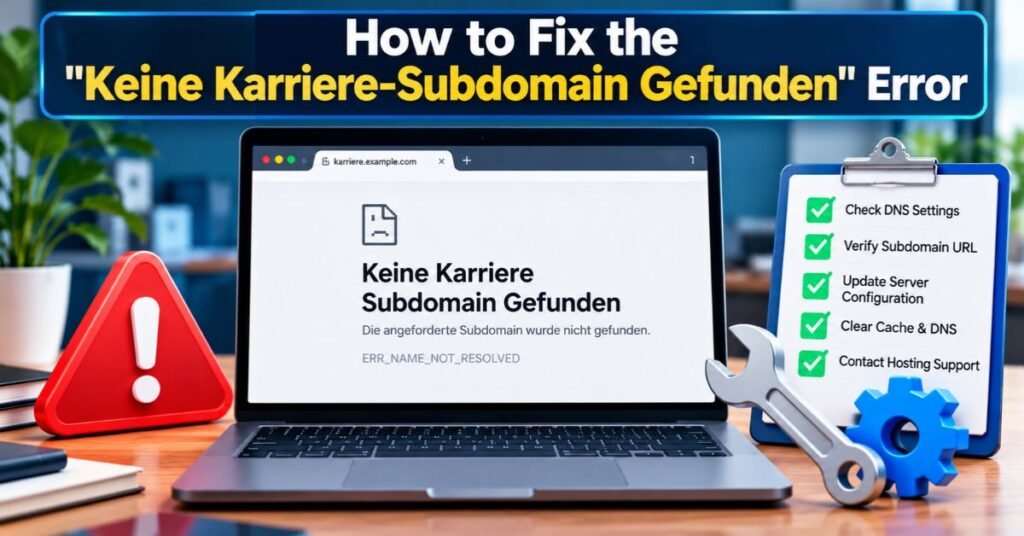
Good news: most fixes are small. Match each repair to the cause you found. This section covers how to fix a missing career subdomain step by step. Always back up current settings before you edit DNS or server files. A saved copy lets you undo a mistake in seconds.
The table below links each cause to its main fix. Use it as a quick map. The H3 sections that follow give more detail. Work through them in order if you don’t know the cause yet. Small, tested changes beat one big rush.
| Cause | Main Fix |
| Missing DNS record | Recreate the A or CNAME record |
| Subdomain deleted or renamed | Restore or recreate it |
| Expired certificate | Renew and cover the subdomain |
| Lapsed hosting or domain | Renew the plan |
| Stale CDN data | Purge the cache |
| Broken ATS link | Reconnect and update credentials |
| Moved page | Add a 301 redirect |
Confirm That the Career Subdomain Exists
First check that the name still exists. Open the DNS zone at your domain registrar or DNS host. Look for the careers entry. Then check the hosting panel for a matching site. If either is missing, you have found the gap. This is also the core of how to restore a broken careers website.
Correct or Restore DNS Records
Recreate the missing DNS A record or DNS CNAME record. Use the exact values your host or ATS vendor gives you. This step is the key to how to configure a recruitment subdomain the right way. Then wait for DNS propagation. Many updates show up within minutes to a few hours. Some can take up to 48 hours.
Fix SSL Certificate and HTTPS Configuration
Learn how to renew an SSL certificate with your host or certificate provider. Make sure the new SSL/TLS certificate covers the careers name. A wildcard certificate can cover many subdomains at once. Turn on auto-renewal to avoid a repeat. Then set up HTTP-to-HTTPS redirection so every visitor lands on the secure page.
Review Hosting and Web Server Settings
Check that the hosting plan is active. Confirm that a virtual host exists for the subdomain. Review server-side configuration files and firewall rules. This is career website hosting configuration at its simplest. Restart the web service after changes. Then test the page again.
Correct Reverse Proxy and CDN Configuration
Check the reverse proxy configuration for the right routing rules and host headers. Confirm that the load balancer sends traffic to a live server. Then purge the CDN cache. This clears CDN cache problems that can hide your fix. It is a vital step in how to fix a subdomain connection error.
Restore Applicant Tracking System Connections
Log in to the ATS dashboard. Check the custom domain setting. Refresh any API keys or tokens. Then confirm that the domain mapping matches the DNS record. This is the core of how to troubleshoot an ATS integration. Send a test application afterward to make sure the full flow works.
Configure Redirects for Moved or Renamed Career Pages
If the careers site moved, add permanent redirects. A 301 redirect tells browsers and search engines about the new home. This clears any career page redirect error and shows how to redirect an old careers URL. Set one canonical URL for each page too. Google explains the process in its guide to 301 redirects. Use website redirects with care to avoid loops.
How Website Migrations and Redesigns Cause Career Page Errors
Picture a house move. The movers carry the main rooms and forget the garage. Website launches work the same way. Teams move the homepage and key pages first. The careers portal sits in a corner with its own owner and host. That is how website migration affects subdomains in real life. It also explains many cases of website configuration errors after redesign.
Careers portals get skipped for a few reasons. HR often owns them. The ATS vendor may host them. DNS may sit with another team. No one person sees the whole picture. A written inventory of every subdomain fixes most of that risk. Add it to the launch plan before work begins.
Common Configuration Mistakes During Migration
Several slips show up again and again. Teams drop DNS records when they switch providers. They forget redirects from old paths to new ones. They change folder paths without updating links. They break the ATS connection by changing the domain. They deploy the SSL/TLS certificate for the main site but not for the subdomain. Any one of these can create a broken careers page within minutes of launch.
How to Prevent Career Subdomain Downtime
Prevention is simple and cheap. Build a full subdomain list before the move. Test every item on a staging site. Check each one again right after launch. Set up website uptime monitoring so alerts reach you fast. That is the best answer to how to monitor subdomain availability and how to prevent career page downtime. Turn on auto-renewal for certificates and for domain and hosting renewal too.
Does “Keine Karriere-Subdomain Gefunden” Affect SEO?

It can. The risk grows when the problem lasts. Search engines need to reach a page to keep it in their results. A short outage is usually recoverable. A long one can hurt. That makes career subdomain SEO a real concern for any company that hires online. Strong recruitment website technical SEO starts with a careers site that stays online.
Think about the job listings themselves. They bring in visitors who search for roles. If the pages fail for weeks, those visitors go elsewhere. Rankings may slip. Links from other sites may point to dead pages. So the cost goes beyond annoyed candidates. It touches traffic and brand trust.
See Also: Best Pasticho Venezuelan Lasagna Near Me Where to Find Authentic Pasticho in 2026
Impact on Search Engine Crawling and Indexing
Search bots visit pages to read them. When they hit repeated errors, they may crawl the site less often. Over time, search engine crawling problems can lead to listings dropping from website indexing. Google describes how it handles these cases in its documentation on network and DNS errors. Use Google Search Console to spot crawl errors early. This is a key part of SEO problems caused by broken subdomains.
Broken Links, Redirects, and Lost Organic Traffic
Broken pages create broken links. Visitors click and land on errors. Many leave at once. If old links have no redirects, their value can fade. Good redirects can pass visitors to the new page. The effect on traffic depends on how long the outage lasts and how big the site is. Fast repair keeps the loss small.
SEO Best Practices for Career Subdomains
A few habits protect your visibility. Keep an XML sitemap for the careers site and submit it in Google Search Console. Link to the careers pages from the main site. Set a clear canonical URL for each page. Use JobPosting markup as described in Google’s job posting guide. Watch crawl reports every week. These steps keep career subdomain SEO healthy over time.
How Long Does It Take to Fix a Missing Career Subdomain?
It depends on the cause. Some fixes take minutes. Others take days. The ranges below are typical estimates and not promises. Your host, vendor, and team size all change the pace. Treat the table as a guide for planning.
The repair itself is often fast. The waiting comes after. Caches need time to refresh. Search engines need time to crawl again. So a fixed page may still look broken for a while. Plan your messages to candidates with that delay in mind.
DNS Propagation and Common Repair Timelines
DNS propagation often finishes within minutes to a few hours. In some cases it takes up to 48 hours. This answers how long DNS changes take to propagate for most sites. The other repairs vary more. The table below gives rough guidance.
| Problem | Typical Timeline |
| DNS correction | Minutes to 48 hours |
| SSL/TLS renewal | Often minutes to a few hours |
| Server configuration | Varies from under an hour to several hours |
| Migration fix | Varies from hours to a few days |
| ATS reconnection | Varies by vendor support speed |
What Should Job Seekers Do When a Career Subdomain Is Missing?
Don’t give up on the job yet. Outages are often temporary. Try the link again in an hour or two. Check that you typed the address right. Many people find the listing through another route. That is the goal of alternative ways to access company job listings.
If the page stays down, take action. Use the company’s other channels. A few simple steps can save your application. Both options below work for most employers. They also show initiative, which hiring teams like to see.
Find Job Openings Through the Company’s Main Website
Visit the main homepage. Scroll to the footer and look for “Careers” or “Jobs.” Try the site search box too. This is a quick way to learn how to find a company’s job application page. You can also search the role on LinkedIn or other job boards. Many firms post the same listing in several places. Remember that a missing page may explain why a company careers page is unavailable. It may be a short outage and not a closed position.
Contact the Employer or Recruitment Team
Send a short email to HR or the recruiting team. Mention the role title and the link that failed. Attach your résumé if the email allows it. You can also message the company on a professional social network. Keep the tone polite and brief. Many teams will thank you for the heads-up. It also helps them fix career page accessibility issues faster.
Are Career Subdomains Necessary? Alternative Solutions
No. A subdomain is a choice and not a rule. Many small firms run careers pages inside the main site. Others use a page hosted by their ATS. Some post only on job boards. Each path works if the team keeps it stable. The best choice depends on size, budget, and skills.
Other options exist beyond the two main styles. An ATS-hosted page launches fast. A job board profile needs very little setup. A subdirectory keeps everything under one roof. Weigh the pros and cons before you commit. A simple setup that you can maintain beats a fancy one that breaks.
See Also: Team Aelftech com Review Services Legitimacy & SEO Growth Guide 2026
Using a Careers Subdirectory Instead
A subdirectory lives inside your main site, such as company.com/careers. Upkeep is easier because one system runs everything. Authority on the main domain can also support the careers pages. There is no separate DNS entry to lose. For small teams this can cut risk. It is a strong fit when you list only a few roles at a time.
Choosing Between a Subdomain and a Subdirectory
The careers subdomain vs subdirectory choice depends on your needs. Large firms with heavy ATS use often pick a subdomain. Small teams with simple pages often pick a subdirectory. The table below compares the two.
| Factor | Subdomain | Subdirectory |
| Best for | Large firms | Small and mid-size sites |
| Setup effort | Higher | Lower |
| ATS fit | Often easier | Possible with extra work |
| DNS dependence | Needs its own records | Uses main site records |
| Upkeep risk | More moving parts | Fewer moving parts |
Practical Example: Troubleshooting a Missing Company Careers Page
Here is a made-up scenario to show the steps. A company launches a redesigned website. The main pages work well. But careers.company.com shows the German message. Applications stop within a day. The HR lead alerts IT. This is a hypothetical case study and not a real report.
IT starts with the checks above. A DNS lookup shows no DNS CNAME record for the careers name. The team restores it with the ATS vendor’s value. Next they find an expired SSL/TLS certificate on that subdomain and renew it. Then they purge the CDN cache. After DNS propagation finishes, the page loads again. The team submits the XML sitemap in Google Search Console and watches for recrawling. Finally they add the subdomain to the launch checklist and turn on uptime alerts.
See Also: Voomixi com Is It Safe or a Scam The Truth Explained 2026
Career Subdomain Troubleshooting Checklist
Save this list and reuse it. It turns a stressful outage into a calm routine. Work from top to bottom. Tick each item as you go. Share it with your team so everyone follows the same path.
| Done | Check | What to Look For |
| ☐ | Careers page URL | Typos and wrong protocol |
| ☐ | Subdomain exists | Entry in DNS zone and hosting panel |
| ☐ | DNS records | A and CNAME records present |
| ☐ | SSL/TLS certificate | Valid date and matching name |
| ☐ | Redirects | 301 rules and HTTP-to-HTTPS redirection |
| ☐ | Hosting status | Active plan and live server |
| ☐ | ATS link | Domain mapping and API keys |
| ☐ | Browser cache | Cleared and retested |
| ☐ | CDN cache | Purged and refreshed |
| ☐ | Other network or device | Same result everywhere |
Frequently Asked Questions
What does “Keine Karriere-Subdomain Gefunden” mean?
It means “no career subdomain found.” A website or tool looked for a dedicated careers address and couldn’t locate it. The cause is usually a setup issue such as a missing DNS record, a hosting lapse, or a broken ATS link. The exact wording depends on the site that shows it.
Is a missing career subdomain the same as a 404 error?
Not quite. A 404 Not Found reply means the server answered but the page is missing. A missing subdomain often fails earlier, at the DNS stage. In that case no page request ever reaches a server. The two problems feel alike to visitors but have different fixes.
Can incorrect DNS records cause this error?
Yes. It is among the most common causes. A deleted or mistyped DNS A record or DNS CNAME record leads to subdomain not resolving. Fixing the record and waiting for DNS propagation usually solves it.
Can an SSL certificate problem make a career page inaccessible?
It can. An expired or mismatched certificate may trigger browser warnings or connection failures. However, it may not be the root cause of this specific German message. Check the certificate anyway, since it blocks many careers pages in practice.
Can a website migration cause a missing career subdomain?
Yes. Moves and redesigns often drop DNS records, redirects, or hosting settings. The careers portal is easy to forget. A subdomain inventory before launch prevents most of these problems.
How long does DNS propagation usually take?
Often it takes minutes to a few hours. In some cases it can take up to 48 hours. The speed depends on your DNS provider and on cache settings around the world.
Does a missing career subdomain hurt SEO?
It can if the outage lasts. Search bots may crawl the pages less often and drop listings from results. Quick fixes and clean redirects reduce the damage. Monitoring helps you catch problems early.
Can I fix this error without technical experience?
You can do the basic checks. Verify the link, try another browser, and visit the main site. DNS, server, and certificate changes usually need an admin or your host. Share your notes with them to speed things up.
Conclusion
The Keine Karriere-Subdomain Gefunden error means a site couldn’t find its careers subdomain. Most causes are simple. Missing DNS records, expired plans, certificate faults, migration slips, and ATS link breaks top the list. A steady career website troubleshooting routine finds the cause fast. Check the link first and then DNS, certificates, status codes, and dashboards.
Site owners should audit every subdomain, renew certificates on autopilot, and set up uptime alerts. Job seekers should try the main website, search job boards, or email HR. With a little care you can restore access quickly. Then candidates can get back to what matters: finding their next role.