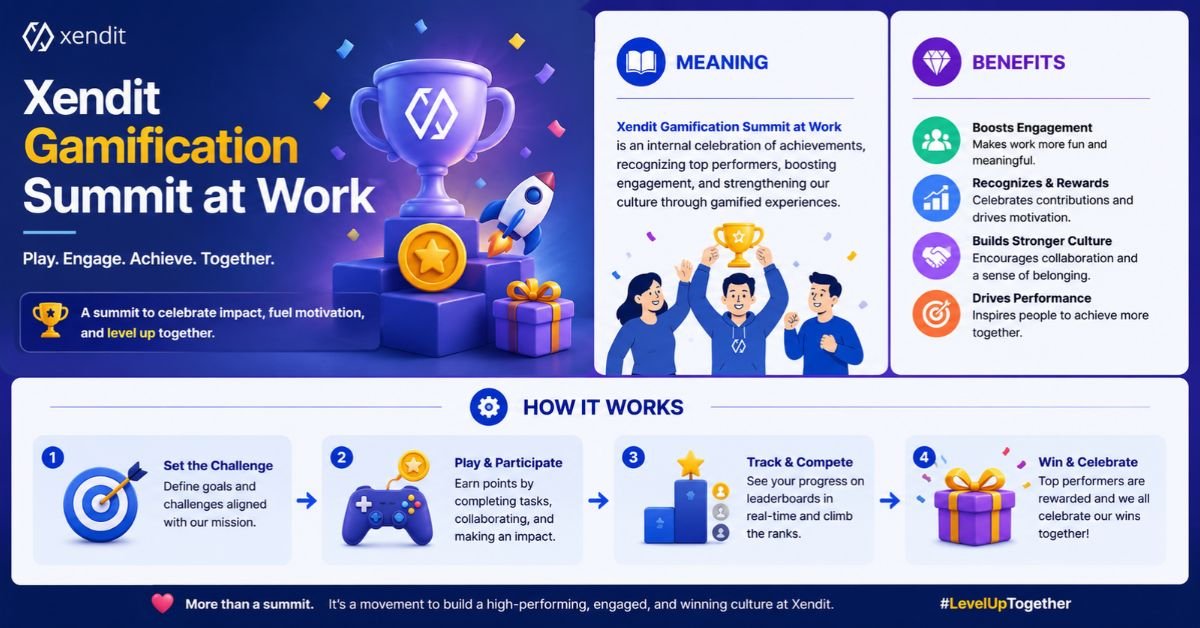
Xendit Gamification Summit at Work Complete Guide 2026
You’ve probably seen Xendit Gamification Summit at Work all over the web. But does the event really exist? That’s the big question. This guide gives you a straight answer. It also explains workplace gamification in plain words so you can use the ideas today.
Here’s the short version. Xendit is a real company. Workplace gamification is a real and useful practice. A summit with this exact name isn’t confirmed by public sources. Keep reading to see why. You’ll also learn how to build a gamification framework that fits your team.
What Is Xendit Gamification Summit at Work?
Search for it and you’ll find dozens of pages. Most describe the Xendit Gamification Summit as a big event about employee engagement. The phrase mixes three ideas. Xendit is a payments company. Gamification means adding game-style features to daily tasks. A summit is a large meeting of experts. Put them together and you get a phrase that sounds official.
The wording changes from site to site. You’ll see “gamification summit xendit work” and “xendit work gamification summit” too. So what does Xendit workplace gamification mean? It’s best seen as an online phrase, not a proven brand. It points to a bigger topic: gamification in the workplace and how it supports employee engagement strategies. That topic is worth your time.
Is Xendit Gamification Summit an Official Program?
Careful sources say no public proof exists. As of September 2026, Xendit’s public event pages don’t clearly list an event with this name. Nothing in primary sources shows an official product, conference, or employee platform under this title. You can read both write-ups at Startup Editor and Tycoon Story.
Other sites paint a bolder picture. They talk about yearly summits, famous speakers and award shows. However, those pages disagree with each other. None link to a Xendit source. So check the facts before you act. Look at Xendit’s own events page first. The table below shows how to sort claims from facts.
| Claim You See Online | What Public Evidence Shows | How to Check It |
| Xendit hosts an annual gamification summit | Not confirmed on public event pages | Visit Xendit’s official events page |
| Xendit sells an employee gamification tool | Not documented | Search Xendit’s product docs |
| Xendit is a payments company | Confirmed | Visit xendit.co |
| Famous speakers and awards exist | Appears only on third-party sites | Ask for an agenda and a ticket link |
What Xendit Actually Does and How Its Payment Platform Works
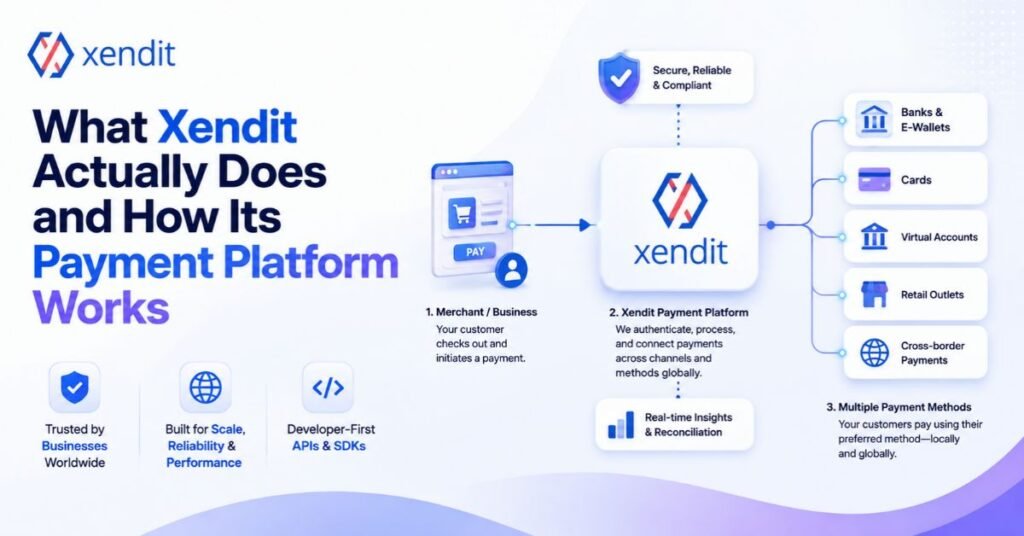
Let’s start with what’s real. The Xendit payment platform is a Xendit payment gateway built for Southeast Asia. It’s one of many fintech payment solutions. Businesses use it for digital payment processing. Customers can pay by card, e-wallet, bank transfer or virtual account. Its design suits the region’s mix of local payment habits.
Why does that matter? Credit cards are less common in many local markets. People prefer wallets and bank apps. So the online payment infrastructure must support many methods at once. Payhip lists Indonesia, Malaysia, the Philippines, Thailand and Vietnam as supported countries. Other directories list a few more. Always confirm current coverage on xendit.co.
Xendit’s Role in a Typical Payment Flow
Picture a simple online purchase. You pick an e-wallet at checkout. The shop sends your order to Xendit through payment API integration. Xendit asks your wallet to approve the charge. You confirm on your phone. Xendit then tells the shop that the money cleared. Later, the funds reach the shop’s bank account. The whole thing takes seconds. The table below shows each step.
| Step | What Happens |
| 1 | Customer chooses a payment method |
| 2 | Merchant’s site calls Xendit’s API |
| 3 | Xendit requests approval from the bank or wallet |
| 4 | Customer approves the payment |
| 5 | Xendit confirms the result to the merchant |
| 6 | Funds settle to the merchant’s account |
How Xendit Could Support Gamified Events and Workflows
Now let’s imagine a use case. Say a company runs an internal contest or a public learning day. Guests need to sign up and pay a small fee. A payment gateway could handle gamified event registration and event payment processing. Later, winners might get cash prizes or vouchers. That’s where reward payout integration and digital payment integration come in. Remember, these are possibilities. Public sources don’t show Xendit offering them as a packaged gamification product.
Why Workplace Gamification Matters for Employee Engagement
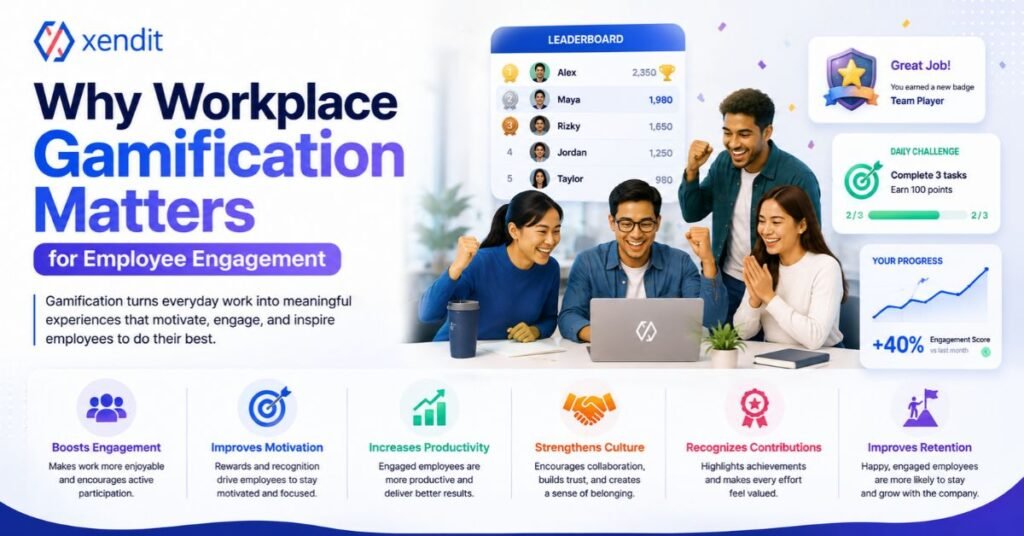
Work feels different than it did a decade ago. Teams sit in different cities. Chats replace hallway talks. Gallup’s global workplace research keeps finding that only a minority of workers feel truly engaged. That’s a big gap. Leaders now ask a fair question: how to improve employee engagement without forcing fun?
One answer is a thoughtful employee engagement platform. It adds clear goals and quick feedback to daily tasks. Done well, it feels like a helpful scoreboard. Done badly, it feels childish. The difference lies in design. Good design respects people’s time and treats them like adults. It also connects every task to real business results.
Why Traditional Employee Engagement Strategies Can Fall Short
Old methods move slowly. Many firms rely on yearly awards and annual surveys. By the time results arrive, the moment has passed. A thank-you in December can’t fix a rough March. Weak employee recognition programs also miss quiet contributors. Over time, employee satisfaction drops. People feel unseen. Frequent, small recognition works better because it matches how people actually experience work.
How Gamification Can Improve Motivation and Productivity
People love visible progress. A progress bar that fills up pulls you forward. That’s behavioral reinforcement at work. Good employee motivation techniques use it to reward helpful habits. The result is steady employee productivity improvement. Over months, that lifts organizational productivity too. Simple rule of thumb:
Show people their progress, and they’ll want to make more of it.
Why Collaboration Matters More Than Competition
Think of a football team. The scoreboard matters. But nobody wins by hogging the ball. The same holds at work. Pure rankings can split a team. Shared goals pull it together. Smart team collaboration activities let people win side by side. This supports a collaborative workplace culture where knowledge flows freely. Teams that help each other solve problems faster. They also enjoy the work more.
How Workplace Gamification Works
Every system follows a basic loop. First, you set a goal. Next, people take action. Then they get feedback. Finally, they earn a reward. That loop is the heart of gamification mechanics. A strong gamification framework keeps the loop short and clear. Short loops build habits. Long loops lose people. So speed matters.
The mechanics must serve real work. That’s the idea behind business process gamification. Instead of adding a separate game, you wrap game features around tasks people already do. Closing a ticket, finishing a course or sharing a tip can all count. The table below shows the loop in action.
| Loop Stage | Example at Work |
| Goal | Resolve 20 customer tickets this week |
| Action | Agent handles tickets with care |
| Feedback | Dashboard updates after each ticket |
| Reward | Badge, shout-out or learning credit |
Daily Wins and Instant Feedback
Small wins add up fast. Instant feedback systems tell people right away how they’re doing. Imagine a support agent who sees a green streak after five happy customers. That tiny signal feels good. It also shows what “good” looks like. Without feedback, people guess. With it, they adjust on the spot. Managers save time too because fewer check-ins are needed.
Collaborative Quests and Team Challenges
Big goals need many hands. Collaborative challenges give teams a shared mission. For example, sales and product teams might work together to collect customer feedback. Both groups win only if the full set arrives. This builds trust between departments. These team collaboration activities also break down silos. People who rarely talk start swapping ideas.
Smart Challenges and Personalized Goals
One size never fits all. A designer and an accountant need different goals. Personalized employee goals match tasks to role, skill and interest. A new hire might get easy starter quests. A veteran might get stretch goals. This keeps everyone in the sweet spot. Tasks feel neither boring nor impossible. Better still, AI-powered personalization can suggest the next best challenge automatically.
Progress Tracking and Reward Systems
People need to see how far they’ve come. Strong progress tracking makes growth visible. Dashboards, levels and points and badges do the job. Leaderboards and rankings can add friendly energy when used lightly. Achievement-based rewards then celebrate real milestones. Together they form solid employee reward systems. Some firms add digital reward programs such as e-vouchers or learning credits. Non-cash rewards often work as well as cash.
Key Benefits of Workplace Gamification
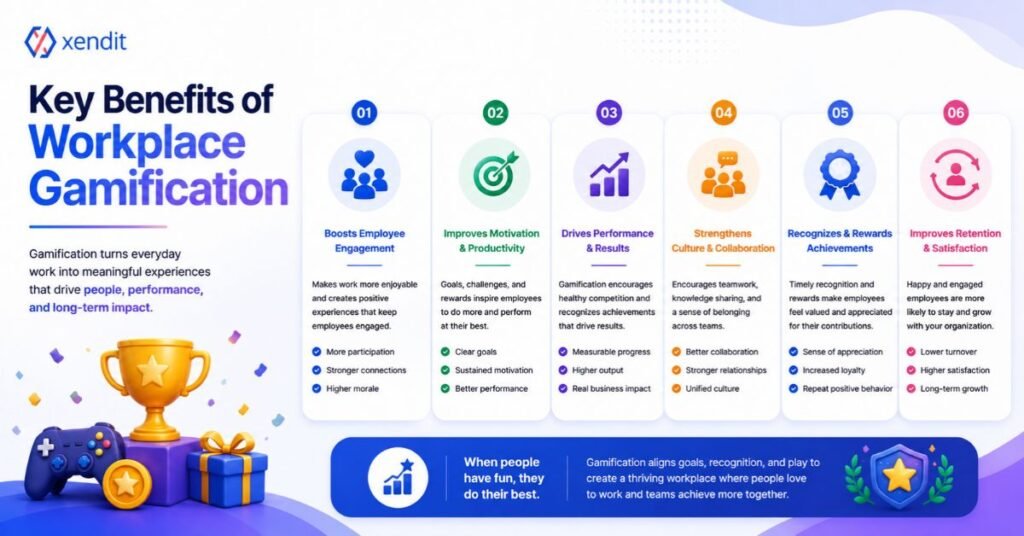
The benefits of gamification for employees reach well beyond fun. Teams feel clearer about goals. Managers get better data. Learning sticks longer. Of course, results depend on design. A weak setup brings little. A thoughtful one can shift daily habits. The table below sums up the main gains.
Read More: Goralblue Com Review 2026 Features, Content, Travel & SEO Guide
| Benefit | What It Looks Like in Practice |
| Higher motivation | People join more activities |
| Faster learning | Short lessons with quick quizzes |
| Quick feedback | Instant progress updates |
| Better teamwork | Shared goals across teams |
| Clear results | Numbers tied to business goals |
Why do these gains matter to leaders? Because they link to cost. Better engagement can cut turnover. Faster onboarding saves training hours. Clear data helps managers coach well. So gamification can pay back its setup cost when the goals are sound. Smaller firms can start with a simple tracker and a weekly shout-out.
Improved Employee Motivation and Participation
Motivation grows when effort feels noticed. Gamified tasks turn quiet work into visible progress. As a result, employee participation rates often climb. People join optional activities because the activities feel rewarding. Managers see more ideas and more questions. One tip helps a lot: start small. Launch a two-week challenge first. Then watch who joins and why.
Better Onboarding and Employee Training
New hires face a flood of information. Gamification for employee onboarding makes it easier to digest. Interactive employee training uses short quizzes, levels and missions. Learners get quick wins. That’s smart workplace learning and development. Industry write-ups reported that Deloitte added badges and leaderboards to its leadership training. Reports said more people came back to the program each week. Treat such results as encouraging, not guaranteed.
Faster Feedback and Visible Progress
Waiting kills momentum. Yearly reviews feel far away. Live dashboards fix that gap. Employees see how today’s work moves the needle. They can fix problems early. Managers can praise people while the moment is fresh. Visible progress also lowers stress because people stop wondering where they stand. Clear signals replace guesswork.
Stronger Teamwork and Collaboration
Shared missions build bonds. When a team earns a badge together, everyone feels proud. Cross-team quests create new friendships. Here’s an illustrative example. A fintech support team and an engineering team join a “bug-hunt week.” Support logs customer pain points. Engineers fix the top ones. Both teams celebrate the drop in complaints. Nobody competes against a teammate. They compete against the problem.
Measurable Performance Improvements
Numbers make progress real. Good workplace performance metrics show what changed after launch. Teams can track ticket times, course completions or sales calls. Strong workplace performance management links those numbers to goals. Clean performance measurement also keeps debates fair. You can say “completion rose from 60% to 80%” instead of “it feels better.” Data builds trust when everyone can see it.
How to Design an Effective Workplace Gamification Strategy
A good plan beats a flashy tool. Many projects fail because they start with software. Start with people and goals instead. This workplace gamification implementation strategy has five steps. Each step builds on the last. Follow them in order. Skip none. Small businesses can use the same steps with simple tools such as a shared spreadsheet.
The five steps are: set a goal, choose mechanics, set fair rules, measure results and improve. Think of it as a cycle. You’ll return to the start often. That’s normal. Great programs evolve. The best workplace gamification best practices all share one idea. Keep the design simple, fair and tied to real work.
Read More: Best Wireless Earbuds of 2026 Top Picks for Sound, ANC & Comfort
Step 1: Identify a Clear Business Goal
Pick one goal first. Maybe you want faster onboarding. Maybe you want fewer support delays. Write it in one sentence. Add a number and a date. For example, “Cut onboarding time by 20% in six months.” A clear goal guides every later choice. Without it, points and badges become noise. Ask yourself one question: what behavior do we want more of?
Step 2: Choose Meaningful Gamification Mechanics
Now pick your tools. Match each mechanic to the goal. Badges suit learning. Streaks suit daily habits. Team quests suit collaboration. Avoid piling on every feature. Too many rules confuse people. Pick two or three mechanics and test them. Meaningful design also avoids fake urgency and pushy timers. People can tell when a system tries to trick them.
Step 3: Set Fair Rules and Reward Systems
Fairness decides whether people trust the program. Publish the rules in plain words. Explain how points work. Explain who can earn what. Fair and transparent reward systems reward quality and teamwork. They don’t just count volume. Think carefully about employee rewards and incentives. Cash can backfire. Recognition, learning time and small perks often work better. Good workplace incentive programs respect different roles.
Step 4: Collect Baseline Data and Measure Results
Measure before you launch. Record today’s numbers first. Without a “before” picture, you can’t prove a change. Track employee engagement metrics such as participation and completion. Add business numbers such as speed or quality. Use simple performance tracking systems at first. A basic dashboard is fine. Review the data every month. Share the results openly with the team.
Step 5: Evaluate Feedback and Improve the Experience
Numbers tell part of the story. People tell the rest. Run short surveys. Hold open chats. Ask what feels fun and what feels forced. Then fix the pain points quickly. Retire mechanics that don’t work. Keep the ones people love. This habit keeps the gamified employee experience fresh. It also shows staff that leaders listen. That trust matters more than any badge.
Technology, AI, and Personalization in Workplace Gamification
Good tools make gamification easier to run at scale. Modern workplace engagement technology tracks goals, sends reminders and updates scores in real time. It also pulls data from apps people already use. That keeps extra clicks low. The best setups feel invisible. People simply do their work and see progress appear.
Smart features are growing fast. Many HR teams now explore artificial intelligence in HR for recommendations and early warnings. Payments play a role too. Prizes, vouchers and event fees need smooth money flows. That’s where a Xendit payment gateway or a similar service could fit. Still, tools only help when the plan is sound.
The Role of Technology in Employee Engagement
Technology removes busywork. It gathers data, updates dashboards and sends nudges. A good employee engagement platform can connect with chat apps and project tools. Strong employee experience management depends on that smooth flow. In fintech firms, staff already live in digital tools. So gamification in fintech companies often feels natural. Ask a simple question when you shop: does this tool fit our daily work?
How AI Can Personalize Challenges and Feedback
AI can learn what each person needs. It can suggest courses, goals or team quests. This is AI-powered personalization in action. It also helps managers spot trends early. For example, falling activity may signal stress. The manager can reach out kindly. Yet AI must stay transparent. Staff should know what data feeds it. Humans should always make the final call about people.
How Payment Integrations Can Support Digital Rewards
Rewards need rails. A company might pay out prizes through bank transfers or e-wallets. Payment API integration can automate that work. So can reward payout integration for contests and referral bonuses. Can Xendit support payments for gamified events? In theory, its payment tools could handle fees and payouts. Its pricing follows a pay-as-you-go model per successful transaction. Always check current terms and local rules first.
Challenges and Risks of Workplace Gamification
Gamification isn’t magic. It can backfire. Poor design creates stress and mistrust. Staff may feel watched or pushed. Some may game the system. Leaders need to know the risks before launch. Honest planning protects both people and results. It also supports ethical workplace gamification practices.
So, what are the risks of employee gamification? The big five are pressure, quantity bias, lost inner drive, privacy gaps and unfair rules. Each one has a fix. The sections below explain how. Handle them early and the program stays healthy. Ignore them and trust fades fast.
Leaderboard Pressure and Employee Burnout
Public rankings can sting. The same people sit at the top every week. Others feel stuck. That pressure can drain energy. Strong employee burnout prevention starts with design. Use team boards instead of personal ones. Reset scores often. Let people opt out. Also, link gamification and employee well-being by rewarding rest and learning. Never reward long hours. Healthy habits beat grinding.
Rewarding Quality Instead of Quantity
Counting volume is easy. But more isn’t always better. A support agent can close tickets fast and leave customers upset. So reward quality too. Add customer ratings or peer reviews to the score. Reward accuracy and helpfulness. This keeps people from chasing empty numbers. Clear quality rules also stop cheating. When quality counts, the whole team wins.
Protecting Intrinsic Motivation
Rewards can crowd out inner drive. Psychologist Edward Deci studied this effect for decades. When people work only for prizes, they may lose interest once prizes stop. So protect intrinsic employee motivation. Daniel Pink’s book Drive points to autonomy, mastery and purpose. Give people choice. Show how their work matters. Use rewards as thank-yous, not bribes. Sustainable employee motivation strategies rest on meaning.
Employee Privacy and Data Security
Gamification collects lots of data. That raises serious questions. Strong workplace data privacy starts with consent. Tell staff what you collect and why. Collect only what you need. Limit who can see personal scores. Follow local laws such as GDPR where they apply. Secure the systems too. A leak would break trust fast. Treat employee data like customer data.
Ensuring Fairness Across Different Roles
A single scoreboard rarely works. Sales has clear numbers. Legal teams don’t. So set role-based goals. Compare people only with similar roles. Give back-office teams ways to shine too. This approach supports fair and transparent reward systems. Review results for bias each quarter. If one group never wins, fix the rules. Fair play keeps the whole program credible.
How to Measure Workplace Gamification Success
You can’t improve what you don’t measure. The old line “what gets measured gets managed” is often credited to Peter Drucker. It fits here. Pick employee engagement KPIs before launch. Mix people numbers with business numbers. Check them often. Measuring employee engagement success also builds trust with leaders who fund the program.
Avoid vanity numbers. Points earned don’t prove value. Ask what changed in real work. Did learning improve? Did teams talk more? Did customers notice? Compare results to your baseline. Report both wins and misses. The table below lists useful measures.
| Area | Example Measure |
| Engagement | Weekly active users, event sign-ups |
| Performance | Task speed, quality scores |
| Satisfaction | Survey scores, pulse checks |
| Retention | Turnover rate, tenure |
| Wellbeing | Burnout signals, workload feedback |
Employee Engagement and Participation Rates
Start with who shows up. Employee participation rates reveal early interest. Track sign-ups, logins and challenge completions. Look for trends by team and role. A sharp drop after week three signals fatigue. Pair numbers with short surveys. Ask why people join or skip. Healthy programs keep steady participation without nagging. Voluntary joining is the best sign.
Productivity and Performance Metrics
Next, check business results. Pick a few metrics tied to your goal. Examples include resolution time, error rates and training completion. Compare teams that use the program with teams that don’t. Use time windows that make sense. Also watch for side effects. Did speed rise while quality fell? Balanced scorecards help here. Good performance measurement looks at the full picture.
Employee Satisfaction and Retention
People stay where they feel valued. Track employee satisfaction through short surveys. Add questions on recognition and growth. Then watch employee retention over six to twelve months. Falling turnover is a strong signal. Exit interviews help too. Ask leavers what the program meant to them. These numbers move slowly. Be patient. Don’t expect miracles in a month.
Burnout, Feedback, and Long-Term Outcomes
Short-term spikes can fool you. Look at the long game. Check stress levels, workload and time off. Ask for honest feedback often. Sustainable programs improve morale for years. Unsustainable ones fade after the first excitement. Review the design twice a year. Retire tired features. Add fresh quests. Long-term success comes from steady care, not big launches.
Common Misconceptions About Xendit Gamification Summit at Work
Myths spread fast online. Sites copy each other. Soon a guess sounds like a fact. That’s what happened with Xendit Gamification Summit at Work. Many pages repeat the same bold claims. Few show proof. A little care protects you from bad advice. It also helps you spot weak sources in any topic.
How does Xendit Gamification Summit at Work work, then? The honest answer is simple. No confirmed public program exists to describe. What does exist is the wider practice of gamification. Use that knowledge instead. The table below clears up the biggest myths.
| Myth | Reality |
| Many articles prove the summit exists | Repetition isn’t proof |
| Xendit sells employee rewards software | Not documented publicly |
| Gamification always lifts engagement | Results depend on design |
| You need leaderboards and cash prizes | Neither is required |
Does Repeated Online Coverage Prove a Program Exists?
No. Many sites copy text from one another. A claim repeated ten times is still one claim. Look for primary sources instead. Check official event pages, press releases and ticket links. Look for named speakers with real profiles. If none appear, stay cautious. This habit helps with any trending topic. Trust evidence, not volume.
Does Xendit’s Payment Platform Include Employee Rewards Software?
Public sources describe Xendit as a payments company. They don’t show a packaged employee rewards product. Its tools could still support payouts or event fees through APIs. But that’s different from a full HR tool. For recognition software you’d pick a dedicated vendor. Then you could connect payments behind it. Always read the official product pages first.
Does Gamification Always Improve Engagement?
No. Some programs flop. People may find them silly or stressful. Others work for a month and then fade. Results depend on goals, fairness and fit. Gamification amplifies a good culture. It can’t fix a broken one. If trust is low, start by fixing basics. Listen to staff. Then add game features carefully.
Are Leaderboards and Cash Rewards Necessary?
Not at all. Many programs thrive without either one. Team progress bars, badges and thank-you notes work well. Learning credits and extra time off also please people. Cash can shift focus from craft to payment. Leaderboards can cause stress. Use them lightly and optionally. The best choice depends on your culture and goals.
Lessons Businesses Can Learn From Workplace Gamification
Strip away the hype and a few lessons remain. They apply to a ten-person startup or a ten-thousand-person firm. Small businesses can try them with free tools. Larger firms can scale them through software. Think of these lessons as a friendly checklist. Review them before every launch.
What are the best employee engagement strategies for fintech companies? Fast-moving teams need quick feedback, clear goals and shared wins. Regular learning helps staff keep up with new rules and tools. Those ideas match the lessons below. Pair them with respect for people’s time. Then adjust as you learn.
Keep Participation Voluntary and Natural
Forced fun isn’t fun. Let people opt in. Build features into tools they already use. Avoid extra logins. Keep the tone light and respectful. When joining feels natural, people stay longer. Voluntary programs also reveal honest interest. If few people join, that’s useful feedback. Don’t punish those who skip.
Reward Meaningful Behaviors
Pick behaviors that matter. Celebrate teaching a colleague. Celebrate fixing a root cause. Celebrate learning a new skill. These acts build real value. Meaningful performance-based employee recognition also tells people what the company cares about. Avoid rewarding empty activity. Clicks and logins mean little by themselves. Quality, teamwork and growth deserve the spotlight.
Prioritize Collaboration and Fairness
Teams thrive on trust. Design goals that need cooperation. Share credit widely. Check rules for bias often. Make the scoring easy to understand. When people trust the system, they engage honestly. When they suspect favoritism, they quit trying. Fair design is the backbone of every healthy program.
Listen to Employee Feedback
Employees know what works. Ask them early and often. Use short surveys and open forums. Then act on what you hear. Share what changed because of their input. That loop builds loyalty. It also improves the design faster than guessing. A program that evolves with staff stays alive.
Focus on Employee Experience, Not Just KPIs
Numbers matter. People matter more. A program that hits targets but hurts morale will fail later. Balance results with wellbeing. Ask how work feels, not just how fast it moves. Good employee experience management treats staff as partners. When people feel valued, results follow. That’s the lasting lesson.
Xendit Pricing, Market Coverage, and Integration Considerations
Money details matter when you plan events or rewards. Xendit’s fees vary by payment method and country. Reviewers describe its pricing as complex because each method carries different costs. Volume deals may exist for bigger users. Check the official pricing page for your country. Fees change over time.
Coverage matters just as much. The platform focuses on Southeast Asia. Firms serving North America or Europe can’t rely on it alone. So global teams should plan backups. Compare providers before you commit. Test with a small pilot first.
Payment Processing and Event Registration
Events need smooth checkout. Guests expect quick payment with familiar methods. A gateway can accept wallets, cards and bank transfers. That makes gamified event registration easier. Good event payment processing also sends receipts and confirms entry automatically. Fewer manual steps mean fewer errors. Test the checkout on mobile because many users pay from their phones.
Reward Payouts and Payment Integration
Paying winners needs care. You must verify recipients and avoid errors. Automated reward payout integration can speed this up. Developers connect it through APIs. Finance teams then track every payment. Keep clear records for audits. Also check tax rules for prizes. They differ by country. Ask an accountant before you launch cash rewards.
Why Pricing and Regional Availability Matter
Hidden fees can wreck a budget. Local taxes may add more. Some payment methods cost more than others. Regional limits can also block global teams. Review the full fee table before signing. Ask sales about volume discounts. Confirm that your target countries are supported. A short checklist now saves headaches later.
Read More: Best Wireless Earbuds Under $200 in 2024 Guide to Top Picks for Sound, ANC & Value
The Future of Workplace Gamification
Where is this field heading? Expect smarter personalization first. AI will suggest goals that match each person’s skills. Learning and recognition will blend into one flow. Tools will plug into chat apps and project boards. Wellbeing features will grow too. Companies want energy, not exhaustion. Gamification trends for 2026 point toward calmer, more human design.
Flashy mechanics will matter less. Meaning will matter more. Programs that respect privacy and fairness will earn trust. Those that pressure people will lose it. So the winning formula stays simple. Use technology to support people. Keep goals clear. Keep rules fair. Then let curiosity and teamwork do the heavy lifting.
Frequently Asked Questions
Is Xendit Gamification Summit an Official Xendit Program?
Public sources don’t confirm it. Xendit’s public event pages don’t clearly list an event with this name. Some third-party sites claim otherwise but offer no proof. Check Xendit’s official channels for any announcement. Until then, treat the phrase as an online term, not a verified program.
Does Workplace Gamification Actually Improve Productivity?
It can. Clear goals, quick feedback and visible progress help many teams. However, results vary. Poor design can hurt morale. Measure your own results against a baseline. Studies show mixed outcomes, so test with a small pilot before a full rollout.
What Is Gamification and How Does It Work?
Gamification adds game features to non-game settings. Examples include points, badges and progress bars. It works through a loop of goal, action, feedback and reward. People enjoy seeing progress. That feeling keeps them engaged. At work, the features should connect to real tasks.
What Is the Most Popular Gamification Platform?
No single platform leads for every need. Popularity depends on region, budget and purpose. Some tools focus on learning. Others focus on sales or customer loyalty. Compare features, privacy terms and pricing. Read recent reviews. Run a trial with a small team before you buy.
Does Gen Z Like Gamification?
Many younger workers enjoy game-style features. They grew up with apps that use streaks and levels. Still, they dislike fake or pushy design. Authentic goals and fair rules matter more than flashy badges. Ask your own team. Preferences differ from person to person.
What Are the Key Gamification Trends for 2026?
Expect more AI personalization and tighter links with learning. Wellbeing-focused design is rising. Team-based goals are replacing harsh rankings. Companies also pay closer attention to data privacy. Simple, transparent systems should keep gaining ground. Check recent industry reports for fresh data.
Conclusion
Here’s the bottom line. The phrase Xendit Gamification Summit at Work is popular online. A confirmed official program under that name isn’t. Xendit itself is a real payments firm with clear strengths in Southeast Asia. Workplace gamification is real too. It can lift motivation, learning and teamwork when you design it with care.
So what should you do next? Start small. Pick one clear goal. Choose two simple mechanics. Set fair rules. Measure results. Listen to your team. Then improve step by step. Keep people at the center. If you do, you’ll build an engagement program that lasts.