

7 Tubefalire Explained Facts Shocking Truth & Possible Causes
You type a strange word into a search bar. Ten results load. Each one tells a different story. That is what happens with tubefalire. One page calls it a system error. Another calls it a platform. A third treats it as a trend. Almost none say where the word came from. This tangle of unknown internet keywords deserves a slow, careful look.
Here is the honest starting point. The meaning of Tubefalire has no official confirmation. Yet the problems linked to it are real. Dropped uploads, frozen apps, and timeouts hit people every day. Tubefalire explained the right way means sorting facts from guesses. You will see what is known, what is only claimed, and how to fix the Tubefalire digital errors people describe. You will also learn how to check any odd term yourself.
What Is Tubefalire?
What is Tubefalire? No trusted source answers that question yet. No dictionary lists the word. No standards body, software vendor, or cloud provider defines it. A confirmed Tubefalire definition simply does not exist. Anyone searching for the Tubefalire meaning will find guesses instead. Some websites use the word as a label for digital system failures. In their version, data stops flowing between a device, a network, and a server. That claim is a Tubefalire online definition. It is not a confirmed Tubefalire technical term. You won’t find it in official product documentation.
Now consider the origin of the word Tubefalire. It looks like a blend of “tube” and “failure.” It could also be a typo, a coined brand, or filler text. No record proves any of these ideas. A search for the exact spelling often returns near matches, such as pages about tubeless tires. Tubefalire Explained Treat the word as unverified internet terminology. A real Tubefalire technical explanation, if one ever appears, must come from a named source. Until then, caution is wise.
Key Facts About Tubefalire
A short list of Tubefalire facts beats a long list of guesses. Start with what you can confirm. The word has no official definition. No source confirms a maker, a release, a version, or a support page. Everything beyond that rests on claims. The table below separates the two.
| Claim | Status | Why It Matters |
| Tubefalire has an official definition | Not confirmed | No dictionary, standards body, or vendor lists it |
| Tubefalire is a software product or brand | No supporting source found | No product page or documentation is tied to the name |
| Tubefalire is malware | No supporting source found | No security report backs the idea |
| Tubefalire describes digital failures | Claimed by some sites only | Those sites name no original source |
| Packet loss, timeouts, and corrupted uploads are real | Confirmed | Networking and reliability references document them |
Notice the pattern. Confirmed items describe general digital failures. Unconfirmed items describe the word itself. That gap matters for content accuracy. A claim with no named source is an unsupported online claim. Treat it that way until proof appears. Strong source credibility comes from named authors, clear dates, and links you can open.
What Do Current Search Results Reveal About Tubefalire?
Tubefalire search results tell a story all by themselves. Exact-match pages are few. Many look alike. Tubefalire Explained Several share the same headings, the same lists, and even the same numbers. A proper search engine results analysis asks who wrote each page. It also asks when they wrote it and what they cite. Thin pages with no sources should carry little weight.
Why does this matter? Results shape belief. If ten weak pages agree, the claim feels true. Agreement is not proof. Copies agree because they copy. Careful readers check whether the pages trace back to one of the reliable online sources they trust. If they don’t, the pattern is just noise.
Why Online Sources Provide Conflicting Definitions
Conflicting Tubefalire explanations appear for a simple reason. Writers fill a gap with guesses. One calls the word a streaming glitch. Another calls it a network fault. A third calls it a software brand. Each version sounds confident. None shows evidence. Without an agreed source, every page invents its own answer. Rewriting makes things worse because each copy drifts further from the first guess. For fact-checking unfamiliar terms, disagreement is a warning sign. Real terms usually share a core meaning across independent sources.
Is Tubefalire a Real Product, Brand, or Technical Term?
Ask the blunt question: Tubefalire real or fake? The fair answer is “unproven.” Is Tubefalire a real word? It doesn’t appear in standard dictionaries. People do coin new words, so that alone proves nothing. A real word is not the same as a real product. For Tubefalire website legitimacy, look for a company name, a physical address, a privacy policy, and clear contact details. Check the domain age with a domain lookup. Stay careful with any site that sells something under this name without those basics.
Could Tubefalire Be a Typo or Placeholder Term?
Yes, it could. Fast typing can turn “tube failure” or “YouTube failure” into one odd word. Bulk publishing tools can also leave filler terms inside pages. Both cases create keyword ambiguity. Neither is proven here. Treat each as a hypothesis. A good researcher keeps several explanations open. Then they test each one against evidence.
Why Is Tubefalire Appearing in Online Searches?

Tubefalire online searches often start with curiosity. Someone sees the word on a page. They don’t know it. They look it up. That simple loop drives search query interpretation. Search engines read the query, guess the need, and return the closest pages. For this word, the Tubefalire search intent looks mostly informational. People want a meaning. Many also want a verdict on safety.
Some terms are emerging internet expressions. They grow from real communities. Others are undefined internet terms that spread through copied pages. The difference is evidence. Real slang leaves traces in forums, videos, and posts by real people. Hollow terms leave only near-identical articles. Spotting that difference is a core part of digital terminology research.
Search Engine Trends and Unfamiliar Keywords
Publishers watch rising searches closely. A new keyword with little competition looks like an easy win. So pages appear fast, often before anyone knows what the word means. You can watch these shifts yourself in Google Trends. A spike in unfamiliar digital terminology can signal real news. It can also signal a wave of copied articles. Spikes for unrecognized technical vocabulary deserve a second look before you trust any single page.
How AI-Generated Content Can Spread Confusing Definitions
AI-generated content confusion starts when a tool invents a definition. It may sound smooth. It may even look sourced. Then other pages repeat it. Soon the same claim appears everywhere. That is how AI-generated misinformation gains ground. Many AI-generated articles are fine when a human checks them. Trouble starts when nobody does. Google asks for original, helpful, reliable pages in its guidance on helpful content. Its spam policies also flag mass-produced pages that add little value. Those rules explain why thin pages around odd words often fade.
Is Tubefalire Related to Digital System Failures?
Some sites link the word to digital system failures. That link is a claim. It is not a fact. Still, the failures they describe are real and well studied. The Tubefalire causes these sites list all fall into the same layers. A device sends data. A network carries it. A server receives it. Storage keeps it. Security checks guard each step. When one layer slips, others often follow. Engineers call that chain reaction a cascading failure.
Picture water in a pipe. When pressure drops or a joint cracks, the flow stops. Digital paths work the same way. The sections below cover the common system errors at each layer. Learning them helps no matter what name you use. Strong digital infrastructure reliability begins with knowing where things break.
Network Connectivity and Communication Problems
Network connectivity problems cause most visible failures. Weak Wi-Fi drops signals. High latency delays replies. Packet loss forces data to resend. Slow DNS lookups stall page loads before they start. A shaky link can make a big upload stop at 87 percent. Each case is a network connection failure with different roots. Good network error diagnosis tests your own link first. It then checks each hop beyond it. Steady network stability matters more than raw speed.
Server Overload and Platform Errors
Server-side errors happen when the system, not you, is struggling. Traffic spikes can overwhelm machines. Poor load balancing sends too many requests to one place. Rate limits can block you on purpose. The result is server downtime or slow replies. Codes in the 500 range, like 503 “Service Unavailable,” point to the server. A 429 code means too many requests. The MDN status code reference explains each one. These application errors need patience or a fix from the platform owner.
Device, Software, and Compatibility Issues
Your own gear can be the weak link. Software compatibility issues appear after updates or with old apps. Browser compatibility gaps break pages on outdated versions. Software conflicts arise when plugins fight each other. Low memory slows large uploads. A hardware malfunction, such as a failing drive or an overheated chip, can cause random freezes. These faults often look like network trouble. That is why you test the device early. A second browser or device quickly shows whether the problem is local.
Data Integrity and File Corruption
Data integrity problems are quiet but costly. A broken upload leaves a half-written file. Bad encoding makes a file unreadable. File corruption can follow a power cut or a failing disk. Databases face the same risk, so database integrity checks matter. A checksum such as SHA-256 acts like a fingerprint. If the fingerprint changes, the file changed. The NIST hash functions page covers the standards. Good data corruption recovery starts with a clean backup and a verified copy.
Security, Permissions, and Access Problems
Security tools protect you. Sometimes they also block you. Cybersecurity and access control rules rely on tokens, permissions, and firewalls. An expired authentication token can stop a long task midway. A wrong permission can hide a file you own. A strict firewall can block a harmless request. Malware can also disturb normal processes. Balance is the goal. Strong protection shouldn’t trap honest users.
Common Warning Signs of Digital System Failures
Failures rarely arrive without a hint. Pages load slower than usual. Uploads pause near the end. Retry messages pop up again and again. Timeout errors multiply. Performance swings from fast to slow every few seconds. That swing is the strongest clue. Stable systems stay steady. Unstable ones wobble. Notice the wobble early. A quick action now can save hours later.
Picture an everyday example. You upload a big video before a deadline. The progress bar crawls, stalls, and slips backward. You retry. The same thing happens. Nothing is fully broken, yet nothing finishes. That half-working state is where many Tubefalire digital errors are said to live. Spotting the pattern helps you pick the right test. It also stops you from wasting time on random fixes.
How to Diagnose and Troubleshoot Digital Errors
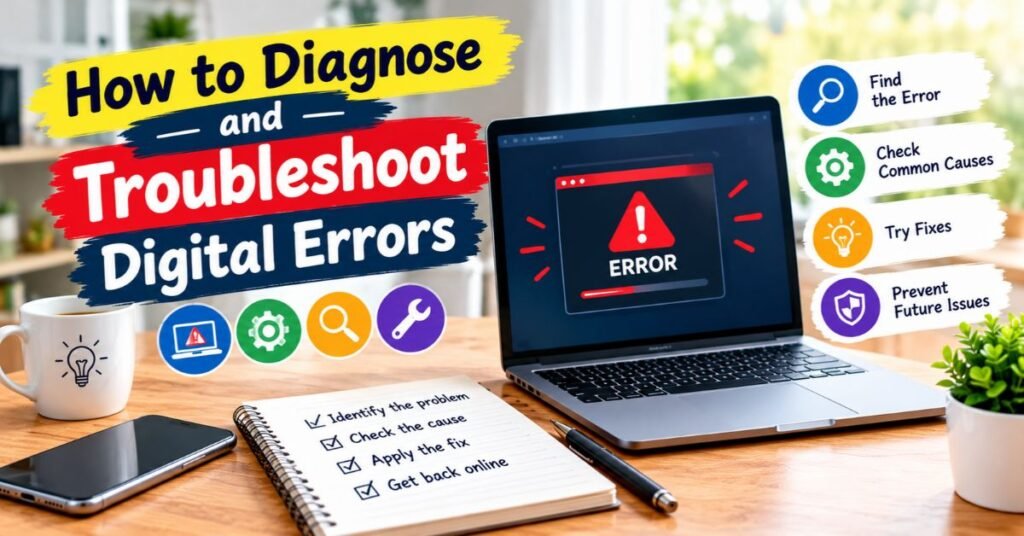
Technical error diagnosis works best in a fixed order. Start with the simplest cause. Move toward the deepest. Change one thing at a time so you know what worked. These digital troubleshooting methods apply to any system. They also form a practical base for Tubefalire troubleshooting, whatever the term turns out to mean.
Two habits help every time. First, write down what you see. Note the time, the message, and the steps you took. Second, run basic system diagnostics before any drastic move. A short root cause analysis beats guesswork. It also keeps small problems from growing. The steps below follow the layers from the earlier section.
See Also: OnlyWorkMoods com Review 2026 Is It Legit Safe and Worth Your Time
Check Your Network Connection
Run a speed test at Speedtest. Watch latency, not only download speed. High and jumpy latency hurts calls, streams, and uploads. Restart your router. Move closer to it or plug in a cable. Then try a different network, such as a phone hotspot. If the problem vanishes, the first network was the cause.
Test Your Device and Browser
Open a private window first. Try another browser next. Clear the cache and cookies. Turn off extensions one by one. Update the browser to the latest version. Close heavy apps to free memory. If you can, try the same task on another device. If it works there, the first device holds the fault.
Check Server and Platform Availability
Visit the platform’s official status page first. Then check an outage tracker such as Downdetector. If other people report the same issue, the fault sits on the server side. Waiting is then the best fix. Don’t reset your gear needlessly.
Inspect Files, Data, and Error Logs
Open the error logs if you have access. Browser developer tools show failed requests in the console and network tabs. Compare file sizes before and after a transfer. Verify hashes when a file matters. Re-upload from a clean copy. For damaged files, try your backup first. That is simple data corruption recovery at home.
Identify Software Conflicts and Security Restrictions
Think about what changed. A new update, plugin, VPN, or security tool may be the cause. Undo the latest change and test again. That is software debugging techniques at small scale. Also check whether your session expired. Log out, then log back in. If a firewall blocks a trusted app, adjust the rule with care.
Common Digital Failure Causes and Troubleshooting Solutions
Common system errors follow patterns. The same few causes explain most cases. The table below matches symptoms to likely causes and fast fixes. It also shows which layer to inspect first. Use it as a quick map before you dig deeper.
| Symptom | Likely Cause | Quick Fix | Layer |
| Upload stops midway | Unstable connection | Switch networks, then retry | Network |
| Video buffers endlessly | High latency or packet loss | Lower quality, restart router | Network |
| Page shows a 503 error | Server overload or downtime | Wait, then check the status page | Server |
| App freezes | Low memory or software conflict | Close apps, update, restart | Device |
| Downloaded file won’t open | File corruption | Download again, verify checksum | Data |
| Login fails suddenly | Expired token or blocked session | Sign out, sign in again | Security |
| Feature breaks after update | Compatibility gap | Roll back or update linked tools | Software |
When a quick fix fails, move up a level. Gather screenshots, timestamps, and error messages. Then contact support. Clear details speed up technical support solutions a great deal. Vague reports like “it just broke” slow everyone down.
Why Technical Errors Keep Coming Back
A repeat error is rarely random. It usually points to a deeper cause. Weak design, missing redundancy, aging hardware, and poor monitoring are common culprits. Quick fixes treat the symptom. A real root cause analysis asks “why” several times until it finds the source. Skip that step, and the same error returns next week.
History offers a sharp lesson. On October 4, 2021, Facebook, Instagram, and WhatsApp went offline for roughly six hours. Meta later explained that a maintenance command accidentally cut the company’s backbone network. A bug in a safety tool failed to stop it. Then the DNS servers became unreachable, and the outage deepened. Read Meta’s own account for the details. One small change spread through many layers. That is a cascading failure in the real world.
How to Prevent Common Digital System Failures
Tubefalire prevention is really system failure prevention. The name matters less than the habits. Prevention costs less than repair. It also protects your time, your files, and your trust. Preventive maintenance works like servicing a car. Small checks stop big breakdowns.
Four habits cover most risks. They are updates, monitoring, backups, and security. Each one takes only minutes a week. Together they lift application reliability and cut down on surprises.
Keep Software and Devices Updated
Software updates fix bugs and close security holes. They also keep apps compatible with changing services. Turn on automatic updates where you can. Restart devices regularly. Retire hardware that no longer gets patches. When work depends on a device, test big updates on a spare first.
Monitor System Performance and Network Stability
Performance monitoring shows trouble before it grows. At home, check router health and note slow hours. At work, use dashboards for speed, errors, and load. Track trends rather than single readings. Steady network stability often needs only small upgrades, like better router placement or a wired link.
Maintain Backups and Protect Data Integrity
Good data backup strategies follow the 3-2-1 rule. Keep three copies of important data. Store them on two types of media. Keep one copy off site. Test restores now and then. A backup you never tested is a hope, not a plan. Compare checksums before and after key transfers to protect data integrity.
Follow Basic Cybersecurity Practices
Cybersecurity best practices are simple. Use long, unique passwords. Turn on multi-factor authentication. Download software only from official sites. Think twice before clicking links in odd messages. CISA’s Secure Our World program offers clear, free tips. Good habits also protect you from scam pages that ride on trending, unknown words.
See Also: 15+ Easy Simple Health Check Methods to Monitor Your Health at Home
How Developers Can Reduce Digital System Failures
Developers shape stability. Every design choice either hides risk or exposes it. Strong application reliability comes from testing, clear errors, and a recovery plan. Teams that plan for failure recover faster than teams that hope for luck.
The best systems don’t crash. They slow down safely. That mindset sits at the heart of developer error handling and wider digital infrastructure reliability. The next three areas show how teams put it into practice.
System Monitoring and Performance Testing
Server performance monitoring tracks response time, error rate, memory, and traffic. Alerts warn teams before users complain. Load testing simulates busy days. Stress testing pushes past limits to find the breaking point. Latency testing exposes slow routes. Run these tests before launch and after every big change.
Error Handling and Recovery Planning
Clear error messages beat generic failures. Exponential backoff spaces out retries so a struggling server can recover. Input validation stops bad data at the door. Graceful degradation keeps core features alive under load. System recovery strategies include rollbacks, restore drills, and written runbooks. Solid system recovery planning names who acts, in what order, and how fast.
Cloud Infrastructure and Reliability
Cloud computing reliability depends on design, not luck. Multi-region setups, health checks, and automatic failover limit the damage of one outage. Third-party dependencies add risk, so map them early. Amazon CTO Werner Vogels is often quoted as saying, “Everything fails all the time.” Build with that truth in mind. The AWS Well-Architected Reliability Pillar and the Google SRE book offer proven guidance for cloud infrastructure.
See Also: Why Does Ozdikenosis Kill You The Truth About This Viral Disease Claim Guide 2026
How to Verify Unknown Terms Like Tubefalire
Online information verification is a learnable skill. It protects you from bad advice and unsafe downloads. The same steps work on unknown technical terms of any kind. They also build digital information literacy. Use the table below as a repeatable checklist for online term verification.
| Step | Action | What a Real Term Usually Shows |
| 1 | Search the exact term in quotes | Many independent pages with one consistent meaning |
| 2 | Look for official documentation | A vendor, standards, or project page |
| 3 | Check the authors | Named experts with dates and credentials |
| 4 | Trace each claim | Links to an original source |
| 5 | Inspect the domain | A clear owner, age, and contact details |
| 6 | Consult fact-checking sites | Independent confirmation |
Now apply the checklist to this word. Step one gives few exact matches. Step two finds no official page. Steps three and four meet vague claims with no named source. That is why the status stays “unverified.” The result isn’t a verdict of “fake.” It simply means the evidence is missing.
Check Reliable Sources and Official Documentation
Start with the makers. Technical documentation verification means reading vendor docs, standards, and project pages. Look for the original publisher, not a copy. Official product documentation names versions, features, and support paths. Reliable technical references include standards bodies and well-known engineering handbooks. Check source credibility by asking who benefits from the claim. A domain lookup can show who owns a site and when it was registered.
Compare Search Results and Technical References
Never trust one page. Compare at least three independent sources. Independent means they didn’t copy each other. Use fact-checking websites when a claim looks viral. Look at older versions of a page in the Internet Archive. Changed wording may reveal a quiet rewrite. Compare what pages say with what technical references say. Real terms match across both. Invented ones rarely do.
Recognize Misleading or Unsupported Claims
Learn the red flags. Vague phrases like “studies show” hide the study. Round numbers with no source feel suspicious. Copied sentences across sites suggest recycling. Missing authors and missing dates add doubt. Strong hype with thin facts is another warning. Search engine misinformation thrives on these habits. A slow, skeptical read protects you better than any tool.
Frequently Asked Questions
Is Tubefalire a Real Technical Term?
No confirmed source lists it as one. A few websites use it loosely for digital failures. None point to a standard, a vendor, or a reference book. Until an official source appears, it remains an unverified label.
Is Tubefalire a Virus or Malware?
No supporting source describes a Tubefalire virus or malware threat. Still, scam sites often chase trending words. Never download files or “fixers” that use this name. Scan any suspicious file with VirusTotal. Keep your security software updated.
Is Tubefalire a Streaming or Video Platform?
No supporting source shows a Tubefalire streaming platform. The “tube” part may remind people of video sites. A few pages also mention buffering problems. That doesn’t make it a service. A real platform has an app store listing, official social profiles, and a help page.
Did Tubefalire Originate on YouTube?
No evidence supports that idea. No video, channel, or post proves it. It remains a guess. Treat any page that states it as fact with care.
Why Do Websites Describe Tubefalire Differently?
Most pages guess. Many copy each other. Some use writing tools that invent a smooth answer. Few cite a source. Without a shared reference, every page drifts in its own direction.
How Can I Verify Whether Tubefalire Is Legitimate?
Use the six-step checklist from the verification section. Look for a company, a documentation page, and a support channel. Run a domain lookup. Compare independent sources. Avoid payments or downloads tied to the name until proof appears.
Will Tubefalire Have a Confirmed Definition in the Future?
Maybe. Words gain meaning through use. A company, project, or community could adopt it and document it clearly. Until that happens, the term stays unverified. Watch for credible announcements from named sources.
Final Thought
The word tubefalire is unverified. The failures people link to it are not. Network drops, server errors, software clashes, corrupted files, and access problems happen daily. Each one has a clear cause and a practical fix. Knowing that matters more than any label.
Put the habits to work. Test your connection. Update your software. Back up your files. Question every claim that lacks a source. Then apply the same checks to the next strange word you meet. Curiosity is a strength. Careful checking turns it into knowledge.