

Growth Navigate Funding Complete Startup Funding Guide for Founders in 2026
You have a sharp idea. Early customers like it. Yet your bank balance can’t keep pace with your plans. Almost every founder hits this wall at some point. Here’s the good news: you can climb it. With the right plan, Growth Navigate startup funding turns a vague money problem into a clear set of steps. You’ll see how to fund a startup in 2026, compare real costs, spot shady offers, and build a roadmap you can follow this quarter.
Quick Answer: Match your money to your revenue stage. Below $200K in annual recurring revenue, bootstrap or take a small angel check. Between $200K and $1M, price out revenue-based financing. Above $1M, a priced seed round may make sense if speed matters more than ownership. Seed dilution often runs 15 to 25 percent. A seed round can take about five months to close. So start early. Always convert every offer into its full yearly cost before you sign.
What Is Growth Navigate Funding?
Names online can fool you. Several websites use “Growth Navigate” for startup tools, growth advice, or fundraising help. Some pages even point to different companies. So treat the phrase as a method first and a brand second. Growth Navigate startup funding starts with your goals and then matches them to the right money.
That order matters. Most founders chase cash first and plan second. They end up with the wrong deal. A growth-first approach flips the habit. You define what the money must buy. Then you pick the startup financing solutions that fit. The four sections below unpack the idea.
Understanding Growth Navigate and Its Purpose
The purpose is simple: connect Growth Navigate business growth with the capital that powers it. Think of a ship’s captain. She doesn’t buy fuel before she knows the destination. In the same way, startup founders should set a target before they hunt for cash. Several unrelated sites share this name. Never assume two pages belong to the same company. Check the official site, the company registry, and the written terms before you trust any claim. The method works with any lender, investor, or tool you meet.
How Growth Navigate Funding Works
The process follows four moves. First, you measure your business performance metrics. Next, you find the gap between what you have and what you need. Then you match that gap to a funding type. Finally, you test the deal against your numbers. Picture a bakery that wants a second oven. The owner knows the oven costs $12,000 and adds 40 loaves a day. That clear link between spending and sales makes the funding choice easy. This is how how Growth Navigate Funding works in real life: goal, gap, match, test.
Does Growth Navigate Provide Direct Business Funding?
Only the official website and signed contracts can answer that. Some firms lend their own money. Others simply introduce you to lenders or investors. A few sell advice and nothing more. Ask one blunt question: who supplies the money, and under what contract? A real provider names the lender or investor and puts the funding agreements in writing. If the answer stays vague, walk away. Never pay a “success fee” before you see a written offer. Clear answers build trust, and fog hides problems.
Growth Navigate Funding vs. Traditional Fundraising
Traditional fundraising starts with a pitch. A growth-first path starts with the math. That small shift changes who holds the power. When you know your numbers, you negotiate from strength. The table below shows the contrast.
| Factor | Traditional Fundraising | Growth Navigate Approach |
| Starting point | Pitch and story | Numbers and goals |
| Typical question | “How much can I raise?” | “What must the money buy?” |
| Speed | Often months | Depends on the chosen path |
| Control | Often shared with investors | Chosen on purpose |
| Main risk | Overpaying in equity | Skipping the paperwork |
Neither path is wrong. Still, the growth-first route wastes less money.
Why Startup Funding Matters for Business Growth in 2026
Cash is the oxygen of a young company. Without it, even a great product gasps. With the right amount, a team can hire, test, and learn fast. The key phrase is “the right amount.” Too little starves growth. Too much invites waste. Smart business funding strategies aim for the middle.
The market also shifted. Money now flows to proof instead of promises. Investors want paying customers, steady retention, and a reason your growth will last. So founders who bring clean data win better terms. Let’s look at the landscape, the benefits, and the numbers that matter.
The Startup Funding Landscape in 2026
The market splits in two. According to Crunchbase, as summarized in one founder guide, a handful of giant AI rounds swallowed most venture dollars in early 2026. Everyone else shares what’s left.
Carta data shows US priced seed rounds fell from a 2022 peak to roughly 1,500 deals in 2025. Fewer companies get seed funding, but the median check grew. This shift shapes startup funding options 2026. Founders now win by showing traction early. A waitlist alone rarely moves an investor. Paying users do.
How Funding Supports Business Growth and Expansion
Funding works like a loop. You spend money to win customers. Those customers pay you back over time. Then you reuse that cash for the next round of customers. Suppose you spend $1,000 to win a customer who pays $100 a month.
You recover your cost in ten months. After that, every month is profit. That loop is where growth capital for businesses earns its keep. Business expansion funding also pays for new hires, stock, and markets. Yet money only helps when the loop already works. If payback stretches to 30 months, extra cash digs a deeper hole.
Key Financial Metrics Founders Should Know Before Raising Capital
Investors and lenders check a short list of numbers. Learn them before any meeting. Monthly recurring revenue (MRR) shows steady income. Customer acquisition cost (CAC) shows what each buyer costs you. Customer lifetime value (LTV) shows what each buyer is worth. A common rule says LTV should reach about three times CAC. Your burn rate tracks monthly spending, and your cash runway tracks how long the cash lasts. Finally, return on investment (ROI) tells you if spending pays off.
| Metric | What It Tells You | Healthy Sign |
| MRR | Predictable income | Rising each month |
| CAC | Cost to win one customer | Below LTV by a wide margin |
| LTV | Lifetime value of a customer | About 3x CAC or more |
| Burn rate | Monthly cash spent | Matches your plan |
| Cash runway | Months of cash left | Over six months |
| ROI | Return on spending | Positive and growing |
Types of Startup Funding for Business Growth
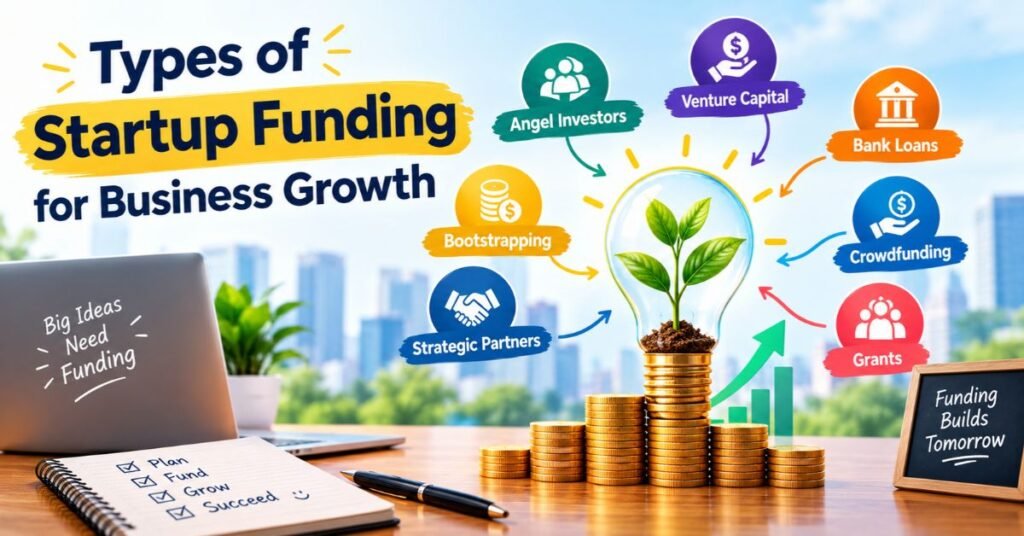
Every funding route has a price tag. Some cost interest. Others cost ownership. A few cost your own sleep. The trick is to pick the price you can live with. Think of it like shoes. A great pair that pinches will ruin your day.
Below, you’ll meet six routes. Each one suits a different stage and risk level. Together they form the toolkit of funding options for entrepreneurs. Read them all before you decide. The best-fitting option often hides in plain sight.
Bootstrapping and Self-Funding
Startup bootstrapping means you fund growth from savings, side income, and customer sales. You keep full control. Nobody calls a board meeting. The business also hears the truth fast. If customers don’t pay, you know within weeks. The cost is speed. SaaS Capital’s research on private software firms reports median bootstrapped growth near 15 percent for companies between $3M and $20M in recurring revenue.
That’s healthy but slow. Bootstrapping fits niche markets where a small team can reach profit without a big sales force. It also forces discipline. Every dollar must earn its seat.
Angel Investors and Pre-Seed Funding
Angel investors are people who back young firms with their own cash. Checks often range from $25,000 to $250,000. Angel investor funding usually moves faster than institutional money. Many angels also share advice and contacts. Pre-seed investment sits one step up and often comes from small funds. The trade-off is expectations. Angels want updates and follow-through. A SAFE or convertible note also adds hidden dilution. Model your cap table with the note converted before you sign. To attract angels, show early proof: paying users, a clear market, and a founder who learns fast.
Venture Capital and Equity Financing
Venture capital funding buys speed with ownership. Venture capital firms invest large sums and expect giant outcomes. That expectation matters. If your business can reach $5M in revenue and stay there, a fund can’t make its math work. Equity financing also brings board seats, reporting rules, and long timelines. One industry analysis puts the median seed round at 142 days to close. That’s nearly five months of meetings. VC fits winner-take-most markets and high capital needs. It fits poorly when your goal is a profitable, owner-run company.
Revenue-Based Financing
Revenue-based financing gives you cash now. You repay with a fixed share of future sales until you hit a set total. There’s no equity and no board seat. When sales dip, payments shrink. When sales climb, payments grow. Watch the repayment cap. Take $50,000 at a 1.3x cap. You repay $65,000 in total. The $15,000 difference is a flat fee. Repay faster and your yearly cost rises. Providers often ask for $200K or more in recurring revenue. This works well for firms with steady, predictable income.
Business Loans and Small Business Grants
Business loans for startups give you cash with a clear schedule. Borrow $50,000 at 12 percent for three years. Your payment lands near $1,661 a month. You repay about $59,800 in total. That’s a form of debt financing. It keeps your ownership intact. Check for collateral and personal guarantees. A guarantee can put your own assets at risk. Small business grants need no repayment. However, they’re competitive and full of rules. Browse official sources such as Grants.gov or the US Small Business Administration. Never pay a stranger who promises a “guaranteed” grant.
Hybrid Funding Strategies for Startups
Hybrid plans mix routes in stages. A founder bootstraps to real revenue first. Later she raises equity from a stronger spot. Some founders add a revenue-based line to fund ads while keeping their equity. This path suits alternative startup financing fans. Investors price risk. Every month of verified revenue lowers that risk and lifts your startup valuation. Calendly offers a famous example. It began with a small seed round and grew far beyond it before raising a large Series B. Treat such stories as proof of what’s possible. They aren’t forecasts.
How to Choose the Right Funding Option for Your Startup
Speed tempts everyone. A fast offer feels like relief. Yet total cost matters more than speed. A quick deal with heavy fees can sting for years. So slow down and compare.
Use a three-question test. What will this money cost? What will I give up? What could go wrong? Honest answers cut through sales talk. That’s the heart of how to choose the right startup financing. The five checks below will sharpen your decision.
Match Funding Options to Your Business Growth Stage
Your stage decides your tool. A new idea needs proof, so savings and small grants fit. Early traction needs customers, so angels and small loans help. Scaling needs systems, so larger rounds and bank lines make sense. The table below gives a first filter. It’s a starting point and not a rule.
| Stage | Main Priority | Typical Funding | Key Number |
| Idea | Prove demand | Savings, small grants | Interviews held |
| Early traction | Win first customers | Angels, small loans | CAC |
| Scaling | Build systems | Venture capital, bank loans | Monthly growth rate |
Revisit the table every quarter. A company that fits one row today may fit another in nine months.
Compare Interest Rates, Fees, and Repayment Terms
A low headline rate can hide extra charges. Ask for the full yearly cost, often shown as APR. Then add origination fees, late fees, and early payoff penalties. Compare interest rates and fees across at least three offers. Also study the repayment terms. A short loan strains monthly cash. A long loan costs more over time. Put each offer in a simple table and compare the totals side by side. For flat-fee products such as revenue-based deals, convert the cap into an annual rate. Then compare it with a bank line of credit. Numbers beat gut feelings.
Understand Equity Dilution and Investor Expectations
Equity dilution shrinks your slice when new owners join. Say an investor puts $200,000 into a company worth $800,000 before the deal. The company is now worth $1,000,000. The investor owns 20 percent. You own 80 percent. Each later round cuts your share again. Three rounds can push a founder below half ownership. Beyond ownership, study investor expectations. Funds want fast growth, regular updates, and a path to a big exit. Read the board rights and exit terms before you agree. Know the rules before you join the game.
Evaluate Funding Risks and Eligibility Requirements
Every deal carries risk. Loans bring repayment pressure. Equity brings shared control. Grants bring paperwork. Before you apply, check funding eligibility. Lenders often look at business age, revenue, and business credit. Investors look at traction and team. These startup funding requirements and eligibility rules change by country and industry. So check local rules first. Match the term to the need. Use short funding for short needs such as working capital. Use longer funding for big assets. A lawyer’s review of any contract costs far less than a bad clause.
When Is Bootstrapping Better Than Venture Capital?
Bootstrapping wins when your market is small or steady. It also wins when you want a profitable, owner-run business. Picture a niche software tool with 800 loyal customers. Venture funds won’t chase it. Yet the owner can earn a great living. In the bootstrapping vs venture capital debate, speed is the real divide. VC fits markets where the first big winner takes most of the prize. Bootstrapping fits markets where steady profit beats a race. Ask yourself one question. Do you want a rocket or a sturdy truck?
How to Calculate Your Startup Funding Requirements
Never guess your number. A guess either starves your plan or buries you in dilution. A clear figure also impresses lenders. It shows you understand your own business. That confidence opens doors.
The work starts with your current numbers and ends with a goal. You’ll move through four steps. Each step builds on the last. By the end, you’ll know how much funding does a startup need and why.
Start With Revenue, Expenses, and Cash Flow
Open your books and list three numbers. Write down monthly revenue, monthly costs, and cash in the bank. Those three tell the real story. Startup cash flow management begins here. Many founders watch profit and ignore timing. Yet a firm can show profit and still run dry. Customers may pay in 60 days while rent comes due in 30. Cash flow forecasting fixes that blind spot. Build a simple 12-month sheet. Mark every expected inflow and outflow. Update it each month. Early warnings give you time to act.
Estimate Startup Costs and Operating Expenses
Split costs into two groups. One-time costs include equipment, a website build, and legal setup. Operating costs repeat each month and include salaries, software, and ads. Then add a safety buffer of about 15 percent. This sum shows your startup capital requirements. Here’s an example for a small online store.
| Cost Item | Amount (USD) |
| Inventory | $35,000 |
| Two hires for six months | $36,000 |
| Marketing | $15,000 |
| Software and website | $5,000 |
| Legal and accounting | $4,000 |
| Subtotal | $95,000 |
| Buffer (15%) | $14,250 |
| Total needed | $109,250 |
Calculate Your Cash Runway and Financial Gap
Your cash runway equals cash divided by monthly burn rate. Suppose you hold $90,000 and spend $15,000 a month. You have six months. That’s already tight. Fundraising can take months, so start well before the last dollar. To find the gap, subtract your cash from your target need. If you need $109,250 and hold $40,000, the gap is $69,250. That figure is your funding target. It’s also the answer to how to calculate business cash runway in plain math. Update it monthly.
Set Realistic Growth Targets and Funding Goals
Targets should stretch you without snapping you. Build three scenarios: growth stays flat, growth hits your plan, and growth reaches half your plan. Run each through your repayment or ownership math for 36 months. Most bad deals look fine in the plan case. They fall apart in the half-plan case. Your financial projections should survive the gloomy view. If they don’t, the deal is too heavy. This habit supports sound business financial planning. It also makes your pitch more honest and more believable.
How to Prepare Your Business for Growth Funding
Preparation raises your odds. Lenders and investors see piles of requests. Tidy files stand out like a lit window on a dark street. Think of it as packing before a trip. You can’t pack at the airport.
The goal is speed and trust. When you answer questions fast, people believe you. That’s the core of how to prepare a business for funding. The five items below form your toolkit. Gather them before your first meeting.
Create a Clear Business Plan and Financial Forecast
A strong business plan is short and honest. It says what you sell and who buys it. It names your rivals and shows why you win. It also lays out how you earn money. Keep it to a few pages. Pair it with a three-year forecast. That’s the base of startup financial planning and forecasting. Show your assumptions openly. Investors forgive modest numbers. They don’t forgive hidden ones. A reader should grasp your idea in five minutes. If not, trim the plan until they can.
Organize Financial Statements and Business Records
Lenders love tidy numbers. Prepare your profit and loss report, balance sheet, and cash-flow report. Together they form your financial statements. Add tax returns and bank records. Keep contracts, invoices, and cap table files in one shared folder. Messy books raise doubts. Clean books build trust. Hire a bookkeeper if you feel lost. The cost is small next to a lost deal. Good records also speed up due diligence, which can save you weeks.
Build a Strong Pitch Deck and Investment Proposal
Your investor pitch deck tells a story in about ten slides. Open with the problem. Show your solution, your market, and your traction. Then present your team, your numbers, and your ask. Be specific. Say, “We seek $100,000 for inventory, two hires, and marketing over twelve months.” That one line shows a plan. Add a short investment proposal that lists use of funds and expected returns. These documents help you land startup investment opportunities. Keep slides clean. Let your data do the talking.
Demonstrate Market Demand and Customer Traction
Market validation is proof that people want what you sell. Talk to 20 possible buyers. Run a short survey. Sell a small version first. If people pay, you have evidence. Then show traction. Share your growth in users, sales, and retention. Compare a waitlist with paying customers. The waiting list loses every time. Investors trust behavior over opinion. A founder with $15,000 in monthly revenue and strong retention has a real conversation. A founder with a hunch does not.
Explain How Funding Will Generate Business Growth
Show the chain from money to results. Funding buys inventory. Inventory fills orders. Orders lift revenue. Revenue repays the lender or rewards the investor. Add a rough ROI estimate so the reader sees value. Also explain business scalability. Can you serve ten times more customers without ten times more cost? Software and digital services often can. Physical shops usually need more work. Be candid about limits. Honest answers build credibility, and credibility wins money.
Growth Navigate Funding A Step by Step Roadmap

Big plans feel heavy. A simple loop makes them light. You’ll walk through seven steps in order. Each step answers one question and feeds the next. Together they turn Growth Navigate startup funding into daily action.
The roadmap fits any business size. It also keeps your choices grounded in facts. You never spend big on a guess. Follow the steps and repeat them every quarter. Think of it as a compass, not a cage.
Step 1: Measure Your Current Business Performance
Start with a snapshot. Record revenue, profit, customer count, CAC, LTV, and cash. These business performance metrics show where you stand today. Without a baseline, you can’t prove progress. Pull the numbers from your books and not from memory. Memory flatters. Spreadsheets don’t. Share the snapshot with your team. Everyone should see the same picture. Even a rough baseline beats none. You’ll refine it each month as your tracking improves.
Step 2: Identify Your Biggest Growth Bottleneck
A bottleneck is the narrow neck of a bottle. Everything slows down there. Picture an online shop with 10,000 visitors a month and only 50 sales. Traffic isn’t the problem. The product page or checkout is. Buying more ads would waste money. Fixing the page might double sales at no extra ad cost. Name your one biggest blocker in a single sentence. Then aim your money at it. This habit strengthens your business growth strategies from day one.
Step 3: Set Clear and Measurable Growth Objectives
Vague goals make vague results. Use numbers and dates. “Add 30 paying clients by December” works. “Do better this year” doesn’t. Link each goal to one metric you track monthly. Small wins also lift team morale. These goals feed your startup funding strategies for business growth. They also tell investors exactly what their money will change. A measurable goal is a reachable goal. Write it down and put it where everyone can see it.
Step 4: Match the Funding Source to Your Business Needs
Now pair your goal with a money source. A short cash gap suits a short loan. A big, risky push may suit equity. Steady sales may suit revenue-based financing for startups. Compare the cost of each source with the profit your goal creates. If the goal earns less than the money costs, skip it. This step answers how to raise capital for a new business in a practical way. Match the term to the task. Never fund a three-month problem with a five-year debt.
Step 5: Calculate the Total Cost of Funding
Look beyond the headline number. Add interest, fees, caps, and equity given up. Convert everything to a yearly cost. For equity, estimate what your slice may be worth later. A 20 percent stake in a company that grows tenfold is expensive. Use a table to compare each source. Ask providers for the all-in cost in writing. Hidden fees love to hide in footnotes. Total cost is the only fair yardstick. It lets you compare apples with apples.
Step 6: Compare Offers and Review Funding Agreements
Never accept the first offer. Gather at least three. Then read each contract line by line. Check commissions, exit costs, covenants, and personal guarantees. This is how to evaluate business funding offers like a pro. If a clause confuses you, ask a startup lawyer. A few hours of legal help cost far less than a bad term. Run offers in parallel with a clear deadline. Sequential talks can stretch a 142-day process into a year.
See Also: FentoMagazine Com USA Complete Guide to Features, Content Safety and Reviews 2026
Step 7: Track Results and Adjust Your Growth Strategy
Check your numbers once a month. Compare them with your targets. If a plan works, do more of it. If it fails, change course fast. Don’t cling to a bad idea because you already paid for it. This habit is how to measure startup growth in a steady way. It also supports sustainable business growth strategies. Slow and steady often beats a wild sprint. Share updates with investors too. Regular news builds trust and can unlock follow-on funding.
How Digital Tools and SEO Support Business Growth
Digital tools stretch every dollar. They reach customers, cut routine work, and give you data. Yet a tool works only when tied to a goal. Pick the goal first. Then choose the tool. A great app on a dusty shelf does nothing.
Search visibility also deserves a place in your plan. Many funding dollars flow into content and marketing. So you should know what actually works. The sections below cover the basics. They show how SEO helps businesses grow without costly tricks.
Build a Strong Online Presence
Your website is your shop window. Make it clear and fast. Add real photos, honest reviews, and simple contact details. Keep social profiles active. Trust signals matter because visitors want proof you’re real. Lenders and investors also look you up online before they call. A polished presence supports digital business funding strategies and signals that your firm is alive. Fix broken links, update old pages, and answer messages quickly. Small details add up to a big first impression.
Improve Search Engine Visibility and Organic Traffic
Search engines send free visitors. Write helpful pages that answer real questions. Use the words your buyers type. Add clear titles and fast pages. Growing organic search traffic takes months. Still, it lasts longer than most paid ads. Founders often hear that they need special markup to appear in AI answers. Google’s own documentation on AI features and your website says no extra requirements exist. Don’t pay for “AI Overview optimization” as a separate service. Pay for original reporting, real data, and clean technical SEO.
Use Analytics to Measure Marketing Performance
Data shows what works. Use digital marketing analytics to track visitors, sales rate, and customer value. Check the numbers every week. Look for patterns and not single days. Say a campaign brings traffic but no sales. Pause it. Move the money elsewhere. Free tools such as Google Analytics cover the basics. Tag your campaigns so you know which ad drove which sale. Clear data also strengthens your investor updates. Numbers speak louder than adjectives.
Automate Repetitive Business Tasks
Machines excel at boring work. Automate email replies, invoices, booking reminders, and report pulls. A small team that saves five hours a week gains a full work day each month. Those hours go to selling and service. Automation also cuts errors. Start with the task you hate most. Then test the tool for 30 days. Measure the time saved. If the saving beats the cost, keep it. This is one of the cheapest ways to lift efficiency before you raise any money.
Connect Customer Acquisition With Revenue Growth
Tie every marketing dollar to a sale. Say you spend $500 on ads and win 25 buyers. Each buyer costs $20. If each buyer spends $80, the math works. If each spends $15, it doesn’t. Track CAC against LTV for every channel. Then shift money toward channels with the best ratio. Strong customer acquisition cost (CAC) control makes you attractive to lenders. It also proves your growth loop works. When the loop works, outside money multiplies results. When it doesn’t, outside money multiplies losses.
Funding Strategies for Digital Publishers and Online Businesses
Publishers face a special version of the funding puzzle. Their income rides on traffic. Traffic rides on platforms they don’t control. A single algorithm change can shake the whole house. That’s why most content sites don’t fit venture models.
Still, plenty of funding options for content websites exist. Smart owners stack several sources and reduce risk. The five sections below show how. Each one helps you finance growth without losing your footing.
How Content Websites Can Finance Sustainable Growth
Start with reinvested revenue. Ad income, affiliate income, and sponsorships can fund next quarter’s content. Pre-sold sponsorships work even better. A sponsor who pays three months upfront acts like a loan with no interest. Small angel money or friends-and-family cash fits when you plan to launch a paid product such as a newsletter, a tool, or a course. Equipment and software financing also help. They’re cheap and boring. Often the boring option is the smartest. This mix offers small business funding without giving up control.
Revenue-Based Financing for Digital Publishers
Revenue-based deals suit sites with steady income. Lenders look at your last 12 months of revenue and your churn. Strong, repeat income lowers your cost. Wild swings raise it. If monthly revenue jumps by 40 percent in either direction, repayments get uneven and planning gets painful. Use these funds for short-payback tasks such as paid acquisition or a proven content series. Never use them to fix a leaky business model. Always convert the repayment cap into a yearly rate first.
See Also: WiseStudySpot Com Review 2026 Features, Safety, Legitimacy, and What to Know
Growing Through Advertising and Affiliate Marketing Revenue
Ads and affiliate links fuel many sites. They’re also fragile. Rates change and programs close. Spread your risk across several networks and products. Add direct revenue such as memberships, digital products, or consulting. A site that earns 90 percent of its income from one source can’t borrow easily. Lenders and buyers both discount that risk. Track revenue per thousand visits so you see which pages truly pay. Then build more pages like your winners.
How SEO Performance and Website Traffic Affect Business Valuation
Buyers of websites study traffic closely. They check the share of visits from organic search traffic, the age of the domain, and the spread of top pages. Steady, diversified traffic raises your startup valuation. A site that lives on one keyword scares buyers. Typical sale prices follow a multiple of annual profit, and the multiple rises with stability. Marketplaces such as Flippa show how buyers think. Clean analytics, documented processes, and low owner dependence all lift the price.
Balancing Content Investment, Operating Costs, and Profitability
Content costs money before it earns. A single in-depth article may cost $300 to $800 and take months to rank. So set a content budget tied to your cash runway. Track cost per article and revenue per article. Prune pages that never earn. Update pages that nearly do. Keep operating costs lean with shared tools and flexible freelancers. Aim for a profit margin that funds the next round of content. That loop, and not a big check, builds a durable publishing business.
Common Startup Funding Mistakes to Avoid
Many founders raise money and then waste it. They hire too fast. They rent fancy offices. They launch five products at once. Revenue lags while cash burns away. Good money plus a weak plan makes a short story.
You can dodge most traps with a little foresight. Learn the six below before you start. They’ll teach you how to avoid startup funding mistakes that sink promising firms. A single smart habit can save you months of pain.
Raising More Money Than Your Business Needs
More cash feels safe. In practice, it often breeds waste. Extra money also costs extra ownership. A bloated round at an early stage can leave you with too little equity to stay motivated. Raise enough to hit your next milestone with a buffer. Then raise again from a stronger position. A clear use-of-funds table keeps you honest. Every dollar should link to a goal. If it doesn’t, cut it from the ask.
Choosing Funding Without Understanding the Total Cost
A friendly rate can hide a nasty total. Origination fees, caps, and covenants add up. Ask for the all-in cost in writing. Then convert it to a yearly rate. Compare it with a bank line. Many founders skip this step because math feels dull. Yet this one hour of math can save thousands. Never sign anything you can’t explain to a friend in two sentences. Clarity protects you.
Ignoring Cash Flow and Financial Runway
Profit on paper doesn’t pay rent. Cash does. A founder who ignores cash runway may face a crisis with no warning. Check your balance weekly. Update your forecast monthly. Start fundraising when you still have nine to twelve months of cash. Desperation weakens your hand. Investors smell it. A calm founder with options gets better terms than a rushed one. Time is leverage.
Giving Up Too Much Equity Too Early
Early equity is the most expensive money you’ll ever take. Each point you sell now could be worth far more later. Typical seed rounds dilute founders by 15 to 25 percent. Several rounds can push you under 50 percent. Delay a priced round if the business is healthy. Use smaller tools first, such as revenue-based financing or a small loan. Model each round on a cap table before you agree. Know what you’ll own after three rounds.
Relying on Unrealistic Revenue Projections
Hockey-stick charts look pretty. They also destroy trust. Investors have seen thousands of them. Base your financial projections on real conversion rates, real churn, and real hiring plans. Show a base case and a downside case. If your plan only works with perfect luck, rethink it. Honest numbers invite honest talks. Over-promising wins a meeting and loses a deal. Under-promising and over-delivering wins the next round.
Paying Unverified Funding Advisers or Services
Scammers love hopeful founders. Case study (illustrative): A café owner paid $2,000 to an adviser who promised “guaranteed funding.” Nothing happened and no refund came. A quick registry check would have shown that the firm didn’t exist. One hour of research could have saved the fee. Real advisers share credentials, written fees, and past client references. They never promise approval. Verify first. Pay later, and only after you read the contract.
Is Growth Navigate Funding Legitimate and Reliable?
A fair answer needs evidence. Many websites share similar names. Nobody can vouch for all of them at once. So treat legitimacy as a checklist and apply it to any provider you meet.
The rule is simple: verify first and share data later. Take your time. A real firm will welcome questions. A shady one will rush you. Here’s how to check how to verify a business funding website in five steps.
How to Verify the Website and Company Information
Start with the basics. Check the domain age and the contact page. Look for a real street address and a working phone number. Then search public company registers for the firm’s registration. Many countries run free online registers. Confirm that the name matches across the site, contracts, and payment pages. A mismatch is a warning. Search the company name with words like “complaints” and “reviews.” Read several pages and not just the first result. Trust patterns and not single posts.
How to Check Funding Claims and Service Details
Ask who really lends or invests. Demand the answer in writing. Request license numbers where your country requires them. Ask for two past client contacts and then call them. Also check adviser credentials. Real advisers share their qualifications openly. Treat any promise of guaranteed results with deep caution. Compare the claims on the site with the claims in the contract. Differences matter. If a provider can’t explain its own product in plain words, move on.
Review Fees, Contracts, and Refund Policies
Read every funding contract line by line. Look for commissions, upfront fees, and exit costs. Ask what happens if you don’t get approved. Find the refund rules before you pay a cent. If a clause confuses you, ask a lawyer. The US Federal Trade Commission offers solid scam-spotting tips at consumer.ftc.gov. Use similar guidance from your own country’s consumer agency. Keep copies of every document. Good paperwork protects you if a dispute arises later.
Warning Signs of Misleading Funding Offers
Some signs should stop you at once. The table below lists the loudest alarms.
| Red Flag | Why It Matters |
| Guaranteed approval | No honest lender can promise it |
| Large upfront fees | Real lenders usually take costs from the loan |
| Pressure to sign today | Scammers hate time to think |
| Vague or missing contract | You can’t enforce what you can’t read |
| Requests for passwords or bank logins | Strong sign of fraud |
| Unclear company details | Hard to trace if things go wrong |
One red flag deserves a pause. Two deserve a walk-away.
How to Protect Your Business Before Sharing Financial Information
Share data in steps. Start with a summary. Then give details only after the provider signs a non-disclosure agreement. Never hand over online banking passwords. Legitimate lenders use secure read-only links or uploaded statements. Use a separate email address for funding talks. Store documents in a secure folder with limited access. Keep a log of who received what and when. These small habits protect your business credit and your customers’ privacy. Caution costs nothing and saves plenty.
See Also: Milohacherry Coin Explained Features Risks Legitimacy and Buying Guide 2026
Who Can Benefit From Growth Navigate Funding Strategies?
These ideas fit many kinds of firms. Priorities differ though. A startup needs proof. A shop needs stock. An older company needs steady expansion. Pick the group that matches you and adapt the steps.
Every business gains from clear goals and honest numbers. That’s the universal part. The details change with your model. Let’s walk through five common groups and what each should focus on first.
Early-Stage Startups and First-Time Founders
Early-stage startups need to prove demand and stretch every dollar. Focus on testing, learning, and keeping costs low. Savings, small grants, and pre-seed investment fit best. First-time founders also gain from mentors and startup programs. Track a few numbers closely: MRR, CAC, and cash. A solid plan and clean books earn trust fast. Don’t chase a big round too soon. Instead, build proof that makes the later round easy.
E-Commerce Businesses and Online Stores
Online stores need cash before they earn it. They buy stock and then wait for sales. Good planning prevents empty shelves and burned-out teams. Watch ad spend and return rates. Many stores bridge gaps with short loans or revenue-based deals. Keep a close eye on working capital. Seasonal peaks can drain cash right when you need it most. Negotiate supplier terms and test small batches first. Healthy margins make every funding option cheaper.
Digital Publishers and Content Website Owners
Publishers should diversify first. Add memberships, digital products, and several ad or affiliate sources. Then use reinvested profit to fund new content. Small angel checks work when you plan a clear product. Keep an eye on traffic sources. Heavy reliance on one platform raises your risk and lowers your value. Record your numbers in clean reports. They’ll help if you borrow or sell later. Steady income opens the best doors.
Service-Based Businesses
Agencies, consultants, and contractors sell time and skill. Growth often hits a ceiling when the team fills up. Funding for hiring, training, or equipment can lift that ceiling. Invoice financing and short loans suit cash gaps caused by slow-paying clients. Track billable hours and payment delays. Healthy cash flow forecasting keeps payroll safe. Raise prices before you raise debt. A modest rate increase often funds growth with no outside money.
Established Small and Medium-Sized Businesses
Older firms may want to open new sites, buy a rival, or enter new markets. Because they have history, they often qualify for business loans for startups and growing firms on better terms. Use business expansion funding with care. A bold move needs careful financial projections. Lenders will ask for them. Compare banks, credit unions, and online lenders. Protect your core cash flow while you expand. Growth should add strength and not strain.
Frequently Asked Questions
What Is Growth Navigate Funding?
It’s a growth-first method for finding capital. You set goals, measure your numbers, and match them to the right business financing guide steps and funding types. It’s a method and not a promise of money. Several websites use similar names, so confirm which company you’re dealing with. Check the official site, the registry, and the written terms before you share data or pay any fee.
Does Growth Navigate Provide Direct Business Funding?
Only the official website and signed contracts can answer that. Some firms lend directly. Others only introduce you to lenders or investors. Ask who supplies the money and who bears legal responsibility. If nobody gives a clear answer, look elsewhere. A real provider names the lender, states the fees, and puts every promise in writing before you pay anything.
Is Growth Navigate Funding a Grant, Loan, or Investment?
It depends on the provider and the product. Grants usually need no repayment. Loans do. Investments trade ownership for cash. Ask for the exact product name and the written terms. Never assume. A clear agreement will say which type you’re getting, along with the repayment terms, fees, and any equity or collateral involved. If the paperwork doesn’t say, don’t sign.
What Are the Main Types of Startup Funding in 2026?
The main types include bootstrapping, angel checks, pre-seed and seed rounds, venture capital, revenue-based financing, business loans, and grants. Hybrid mixes are rising too. Each type trades speed, cost, and control differently. These are the best funding options for small businesses and startups alike. The right pick depends on your stage, margins, and goals. Compare total cost before you choose.
How Can Startups Calculate Their Funding Needs?
List your one-time costs and monthly operating costs. Add a 15 percent buffer. Then subtract the cash you already hold. The result is your funding gap. Divide the total by your monthly burn to see your runway. Test the plan in three scenarios: flat, planned, and half-planned growth. This method shows how to calculate startup funding needs with real numbers and no guesswork.
Is Bootstrapping Better Than Venture Capital?
Neither wins in every case. Bootstrapping gives you control and forces discipline. It grows slower. Venture capital gives you speed and a network. It costs ownership and freedom. Choose bootstrapping for niche markets and owner-run profit. Choose venture capital for fast-moving markets where scale decides the winner. Match the path to your goal and your tolerance for risk.
When Does Revenue-Based Financing Make Sense?
It makes sense when your income is steady and your margins are healthy. Providers often want about $200K in annual recurring revenue. It works best for paid acquisition with a short payback. It fits poorly when sales swing wildly. Always convert the repayment cap into a yearly rate. Then compare it with a bank loan. If the math works, it’s a fast, equity-free option.
Conclusion
Smart funding starts with a clear goal. Know your startup funding requirements. Compare every option on total cost and ownership. Prepare clean records, a sharp business plan, and a tight pitch. Then verify every provider before you share data or sign anything. That mix of planning and caution protects your business and your peace of mind.
Your next step is small. Open a blank page. Write your goal, your number, and your deadline. Use the cost table above to find your gap. Once you see the real figure, each choice gets easier. Stay curious, stay careful, and keep your eyes open. Strong Growth Navigate business growth comes from good decisions made one step at a time.