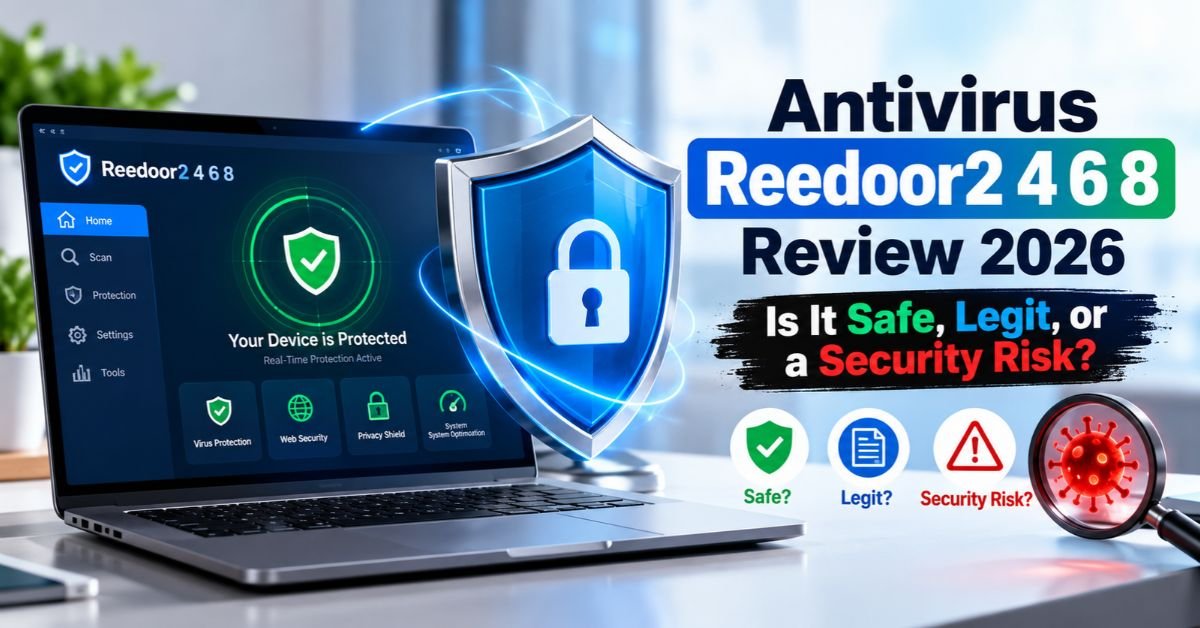
Antivirus Reedoor 2 4 6 8 Review 2026 Is It Safe, Legit, or a Security Risk
You search for a cybersecurity software tool late at night. A shiny new name pops up with glowing praise. Then you spotAntivirus Reedoor 2 4 6 8 and wonder if it’s the real deal.
Here’s the short answer. Searches found no verifiable publisher and no independent lab results. Treat it as unsafe until someone proves otherwise. This Antivirus Reedoor2.4.6.8 review shows you what the web claims, what the evidence says, and what to do next. You’ll also learn how to check installed Windows applications, how to remove the program, and which safer tools to pick. The research for this guide covered the vendor space, the major test labs, and general web results in October 2026.
What Is Antivirus Reedoor2 4 6 8?
What is Antivirus Reedoor2.4.6.8? Ask around and you’ll hear two very different stories. Promotional blogs call it an AI-powered security suite. Warning articles call it a suspicious antivirus program and a possible potentially unwanted application. The name is easy to find online. The proof behind it is not.
That gap matters for Reedoor2.4.6.8 legitimacy. A real product leaves a trail: a website, a team, a support page, and a public history. This name leaves almost none of that. Keep that thought in mind as you read on.
Understanding Its Purpose and Reported Functionality
Promotional pages say Reedoor antivirus software protects your device with an AI engine. They also mention a firewall, a VPN, and an encrypted file vault. Think of these as reported claims, not confirmed facts. No official product page or manual backs them up. A real malware detection software vendor publishes feature lists, system requirements, and update notes. Here you get vague slogans instead. So the stated purpose sounds nice, but nobody can confirm that the program does any of it.
What Is Known About Its Developer and Origin?
Some pages credit a company called “Reedoor Security Technologies.” Searches found no website, no street address, and no named team for that company. That’s a big problem. How to verify software developers starts with simple questions. Antivirus Reedoor 2 4 6 8 Who built it? Where is the company based? Can you contact support? When none of those answers exist, software publisher verification fails at step one. A brand-new name with no history is a warning sign in the world of security vendor reputation.
Is Antivirus Reedoor2.4.6.8 a Verified Security Program?
No. It fails every basic test. Genuine security software verification needs four things. The first is a named publisher. The second is a digitally signed installer. The third is a listing at an independent lab. The fourth is a public track record. The table below shows how the name scores.
| Verification check | What a real product shows | What Reedoor2.4.6.8 shows |
| Named publisher | Company name and address | None found |
| Signed installer | Valid digital signature | No trusted source to check |
| Lab listing | AV-TEST or AV-Comparatives results | No listing found |
| Public history | Years of reviews and updates | Only new, similar blog posts |
What Do Websites Claim About Antivirus Reedoor2 4 6 8?
Promotional pages make big promises. Some describe a “Neural-Net Threat Recognition Engine.” Others promise a detection rate near 99.9%. The language sounds exciting. Real antivirus software security claims come with test reports. These pages show none.
Now read several of those pages side by side. You’ll see the same phrases again and again. Unrelated sites share almost identical sentences. Honest reviewers don’t write that way. Copy-paste marketing is a classic sign of a pushed download campaign. It also explains why online antivirus reviews for this name deserve a hard look.
Advertised Features and Security Benefits
The pages list a long menu of perks. They mention an AI engine trained on billions of samples. They talk about real-time threat protection and a “quantum-encrypted” vault. A few add a built-in VPN and a firewall. These sound like the features of top reliable antivirus programs. Yet no page offers a screenshot of a real scan or a link to technical documents. Big words cost nothing to write. Proof takes effort.
Claims vs. Available Evidence
Claims are cheap. Evidence costs effort. The table puts each promise next to what a search found. Notice the platform mix-up too. One blog says Windows only. Another says Windows, macOS, and Android. Real vendors know which systems they support.
| Claim | Where it appears | Evidence found |
| AI engine trained on 10 billion samples | Multiple blogs | None |
| 99.9% detection rate | Review sites | No listing at AV-TEST or AV-Comparatives |
| “Quantum-encrypted” file vault | Promotional posts | No technical documents |
| Built-in VPN and firewall | Promotional posts | No verified product page |
| Windows only | One blog | Contradicted by another blog |
| Windows, macOS, and Android | Another blog | Contradicts the claim above |
How to Verify Its Features and Official Documentation
Use a simple routine to test any big claim. First, look for the vendor’s own website and read its support pages. Antivirus Reedoor 2 4 6 8 Next, search for the product at AV-TEST and AV-Comparatives. Both labs publish real independent antivirus testing results. Then upload any installer to VirusTotal before you open it. That free step shows what dozens of scanners think of a file. If a product has no website, no lab data, and no manual, the claims are just words.
Is Antivirus Reedoor2 4 6 8 Safe and Legitimate?
Is Antivirus Reedoor2.4.6.8 safe? Not based on the evidence. Here’s the nuance. A file with “Reedoor” in its name isn’t automatically a destructive virus. But nothing proves it’s harmless either. “Not proven safe” and “proven harmful” are different things. Still, the first one is reason enough to stay away.
Picture a stranger offering to hold your house keys. His business card looks nice. Would you hand them over? Of course not. You’d ask for references first. The same logic applies to Reedoor2.4.6.8 safety. If you wonder, is Antivirus Reedoor2.4.6.8 safe to install in 2026?, the answer is no. Pick a tool you can verify instead.
Potential Security and Privacy Risks
Fake or shady tools create real antivirus security risks. A rogue program can steal passwords and banking details. It can also open the door to ransomware and spyware. These cybersecurity threats often start with a simple install. Antivirus privacy risks grow because security tools ask for deep software permissions. A real tool needs those rights to scan files. A fake tool can misuse them to read your data. That’s why antivirus privacy and data protection should be part of every decision. Scareware may also charge your card for a fix that never works.
Warning Signs of Suspicious Antivirus Software
Learning how to identify suspicious programs starts with spotting patterns. Antivirus Reedoor 2 4 6 8 One red flag can be a fluke. A pile of them forms a pattern. Here are the signs of fake antivirus software seen with this name. The publisher is anonymous. The marketing copies itself across sites. Independent labs never mention the product. Platform lists change from page to page. Buzzwords like “quantum-safe” and “zero-latency” explain nothing. Even the version number gets odd treatment. One page says each digit in “2.4.6.8” stands for a feature area. Real version numbers track releases and not slogans. These are also signs that an antivirus program may be unsafe.
How to Assess Its Credibility and Trustworthiness
How to check whether Reedoor2.4.6.8 is legitimate takes about five minutes. First, find the company and its team. Second, look for lab listings. Third, search the name plus “scam” or “removal” and read what forums say. Fourth, check where the download comes from. Fifth, look at the pricing for pressure tactics. So, is Reedoor2.4.6.8 legitimate? Every check fails or turns up nothing. Strong software authenticity shows up fast when it exists. Weak authenticity hides behind clever words.
Understanding Fake Antivirus Software and Scareware
Fake antivirus software pretends to protect you. In truth, it harms you. The classic playbook is simple. A pop-up claims your computer has dozens of viruses. The scan results are invented. Then the program demands payment to “fix” the problem. Experts call this rogue security software or scareware.
Scareware works because fear makes people click fast. Scammers know that. The scam is also not new. The FTC has fought it for years. The case study below shows how big it can get.
Case study: The FTC’s fake scan case. In 2008, the FTC charged a group of defendants who used fake scans to scare people into buying useless software. The products included WinFixer, WinAntivirus, DriveCleaner, ErrorSafe, and XP Antivirus. The FTC said more than one million people bought them. A federal court later ordered the final defendant to pay over $163 million, and an appeals court upheld that judgment in 2014. Read the details in the FTC press releases before you quote any figure.
How Fake Antivirus Programs Reach Users
Most people never go looking for trouble. Trouble finds them. A free download often hides extra programs in its installer. A “free antivirus upgrade” review page may push a bad link. Malicious ads can appear above real search results. Third-party download sites also repackage files. These weak spots are how fake antivirus programs reach users. They also explain how to identify fake antivirus programs on a computer. Look for software you never chose to install. Safe antivirus installation and removal starts with downloading only from the vendor’s own site or an official app store.
Common Scareware Tactics and Fake Security Alerts
Scareware leans on speed and fear. It shows loud alerts, red warning screens, and countdown timers. It claims that your files will vanish unless you pay now. Here’s a typical fake alert, written as an example.
Real tools don’t talk like that. Learning how to identify fake security alerts is a core skill. Antivirus Reedoor 2 4 6 8 Check the source first. A real alert comes from your installed security app or from Windows Security. A web page can’t scan your PC. Good security alert verification means closing the page and opening your real security app. Never call a phone number in a pop-up.
Fake Antivirus Software vs. Legitimate Security Tools
Real tools and fake ones behave very differently. A legitimate product names its company and lists clear prices. A fake one hides its owner and pushes urgency. Use this table as a quick guide to antivirus software security claims.
| Feature | Legitimate tool | Fake or rogue tool |
| Publisher | Named company with public history | Anonymous or brand-new |
| Lab results | Listed at AV-TEST or AV-Comparatives | Missing |
| Pricing | Clear plans and refund policy | Pressure and fake countdowns |
| Updates | Official servers and regular patches | Unclear source |
| Pop-ups | Rare and calm | Constant and alarming |
How to Check Whether Antivirus Reedoor2 4 6 8 Is Installed on Your Device
Worried it’s on your computer? Take a breath. The check takes about five minutes. You don’t need special skills. You only need to look in four places: your apps list, your running processes, your browser, and a trusted scanner.
Go through the steps in order. A sneaky program may hide in one spot but show up in another. Antivirus Reedoor 2 4 6 8 Write down any name you don’t recognize. Then research it before you delete anything. This careful habit keeps useful programs safe. It also gives you a record if you need to report a problem later.
Step 1: Review Installed Apps and Programs
Start with the apps list. This is the easiest way to learn how to check installed Windows applications. Open Settings, choose Apps, and then open Installed apps. Scroll through the list. Look for anything named Reedoor or any tool you don’t remember adding. Sort by install date because new entries often show up at the top. On a Mac, open the Applications folder in Finder. On Android, open Settings and then Apps. This simple step is also the first move in unwanted application removal.
Step 2: Check Running Processes and Startup Apps
Some programs hide even when the apps list looks clean. Press Ctrl + Shift + Esc to open Task Manager. Check the Processes tab for odd names or heavy resource use. Then open the Startup apps tab. These system startup processes run every time you turn on your PC. Slow performance often points to suspicious software behavior in the background. Right-click an unknown item and search for it online before you disable it. Never end a process until you know what it does.
Step 3: Inspect Your Browser Extensions
Browsers are a favorite hiding place. Rogue tools love extensions because they can watch your clicks. Good browser extension security is easy to practice. In Chrome or Edge, open the Extensions page from the menu. In Firefox, open Add-ons and themes. Remove anything you don’t recognize. Then reset your homepage and search engine. Unknown tools can change both without asking. Check each extension’s permissions too. An extension that wants to read every site you visit deserves a second look.
Step 4: Scan Your Device With a Trusted Security Tool
Now run a full scan. This is the heart of how to scan a computer for malware. Open Windows Security and choose Virus & threat protection. Pick Full scan. For stubborn threats, select Microsoft Defender Offline scan. It restarts your PC and checks outside normal Windows. Antivirus Reedoor 2 4 6 8 A Windows malware scanner like this uses real-time malware protection and fresh threat data to catch problems fast. This is also how to scan Windows for potentially unwanted applications. Update the security definitions first so the scan sees the newest threats.
How to Remove Antivirus Reedoor2 4 6 8 Safely
Found it? Stay calm. How to remove Reedoor2.4.6.8 is simple when you follow the right order. First, disconnect from the internet only if pop-ups demand payment. Next, uninstall the program from Settings. Then run a full scan. Finally, clean out your browser extensions and startup items.
After cleanup, protect your accounts. Use a clean device to change your key passwords. Start with email and banking. Then watch your accounts for charges or logins you don’t know. Good malware removal tools and habits don’t stop at deleting files. A stolen password can cause harm long after the program disappears.
Uninstall the Program Using Windows Settings
This is how to remove Antivirus Reedoor2.4.6.8 from Windows in the simplest way. Open Settings and choose Apps. Open Installed apps and find the program. Click the three dots beside its name and select Uninstall. Follow the prompts and restart your PC. This is also the basic answer to how to uninstall unwanted software. Take a screenshot of the program’s name first. That record helps if you need to report it later.
What to Do If the Software Will Not Uninstall
Some programs fight back. If the uninstall button fails, restart Windows in Safe Mode. Safe Mode loads only basic drivers. That often stops stubborn files from running. Try the uninstall again from there. If the program still stays, restart normally and run the Microsoft Defender Offline scan. Keep these as two separate steps. Safe Mode helps with removing files. The offline scan checks your system from outside Windows. If nothing works, ask a trusted technician for help.
Scan for Remaining Files and Potential Threats
Uninstalling isn’t the finish line. Leftover files and settings can linger. Update Microsoft Defender Antivirus first. Reconnect to the internet briefly if you went offline. Then run a Full scan from Windows Security. Review the results and let the tool quarantine anything it flags. Check your browser and startup list once more. A second scan a day later is smart. It confirms that malware prevention is working and that no hidden piece returned.
What to Do If You Already Installed the Program
Maybe you installed it days ago. Don’t worry. Here’s what to do if you installed suspicious antivirus software. Run the removal steps above right away. Watch your accounts for strange activity. If you paid, call your bank and ask about a chargeback. In the US, file a report at ReportFraud.ftc.gov. Elsewhere, contact your national fraud or consumer agency. Early action limits damage. It also helps others avoid the same trap.
What to Avoid When Removing Suspicious Software
Panic leads to mistakes. Never click “fix now” buttons inside pop-ups. Never pay for a “cleanup.” Don’t download random removal tools from search ads because they may be more fake software. Don’t call phone numbers shown in alerts either. Scammers love that trick. Stick with built-in Windows Security settings and trusted tools from known vendors. Calm, slow steps beat fast clicks every time.
How to Choose a Reliable Antivirus Program
Good security tools are easy to verify. That’s the goal. Don’t pick a name because it sounds clever. Pick one you can check. Think of it like buying a car. You’d inspect the engine first.
The right choice also strengthens endpoint security on every device you own. It supports operating system protection and sound computer security best practices. Use the steps below as a five-minute routine. If one check fails, walk away. If several fail, run.
Essential Features of Trusted Antivirus Software
Trusted antivirus software for Windows shares a few habits. The company names itself and its team. Support channels are real. The history is public. Independent labs list the product. Threat detection capabilities cover viruses, spyware, ransomware, and phishing. Updates arrive often from official servers. Security software licensing is clear, with plain prices and a refund policy. A product that sells through official stores and shows these traits earns trust over time. Rogue tools can’t fake that track record.
Read More: How to Install 35ds3chipdus 3 Complete Setup, Code Usage, and Troubleshooting Guide 2026
How to Verify Antivirus Reviews and Security Claims
Don’t take a review at face value. This is how to evaluate antivirus reviews with confidence. Check who wrote it. A real name and a track record add weight. Look for screenshots and test data. Then compare the claims with AV-TEST and AV-Comparatives. This is how to verify antivirus software before downloading. It’s also how to evaluate antivirus software reviews and claims without guessing. Be careful with content farms and affiliate sites. They want clicks and commissions, not honest answers. Any antivirus software review 2026 should point to proof you can check yourself.
Free vs. Paid Antivirus Software: Which Is Better?
Free antivirus vs. paid antivirus isn’t a simple contest. Many home users do well with free built-in tools. Paid suites add extras like a VPN, a password manager, and stronger controls. They suit people who download often or work in risky settings. The table below shows the trade-offs. The best pick depends on your habits.
| Factor | Free tools | Paid suites |
| Cost | No extra fee | Subscription |
| Core protection | Often strong | Often strong |
| Extras | Basic | VPN, password manager, more |
| Best for | Careful users | Heavy downloaders and busy families |
How to Compare Antivirus Performance and System Impact
Antivirus software performance matters as much as detection. A tool that slows your PC gets turned off. Labs usually score three areas: protection, performance, and usability. Protection shows how well a tool stops threats. Performance shows how much it slows your system. Usability shows how often it flags safe files by mistake. Read the latest round at each lab since scores change. Also test a free trial on your own device. Watch how fast your apps open and how long scans take.
Safer Alternatives to Antivirus Reedoor2 4 6 8
You may not need to buy anything. Microsoft says Defender is built into Windows 11 and runs by default. That gives you solid Windows antivirus protection from day one. It also covers ransomware protection and phishing protection basics.
Still, some people want more. A few extras can help if you share devices or work offline. These antivirus software alternatives all have public histories and lab listings. Always check the newest test results, since scores shift each round.
Read More: What Is TheSindi Com Complete Guide To Features Content And Trustworthiness 2026
Microsoft Defender Antivirus for Windows Users
Microsoft Defender Antivirus comes with Windows and needs no separate install. It offers real-time malware protection and cloud-based checks. It also handles virus and spyware detection in the background. Recent lab reports have been strong. One report suggested that detection can dip when the PC has no internet connection, so keep your device online and updated. Review the current numbers at AV-TEST and AV-Comparatives before you decide. Microsoft explains the basics on its Windows security page.
Reputable Third-Party Antivirus Solutions
Several paid brands appear often in lab tests. These include Bitdefender, Kaspersky, and Norton. Each offers a suite with extras. Availability and legal rules differ by country. For example, some governments have restricted certain vendors. Check local rules before you buy. The table lists what to compare. Fill in the latest lab scores yourself, and note the test round and date.
| Product | Cost model | Extras often bundled | What to check |
| Bitdefender | Paid subscription | VPN, password manager | Latest lab round and regional availability |
| Kaspersky | Paid subscription | VPN, privacy tools | Latest lab round and local restrictions |
| Norton | Paid subscription | VPN, backup, monitoring | Latest lab round and renewal price |
How to Choose the Right Security Tool for Your Needs
Match the tool to your life. A light user who browses and streams can lean on Defender. A heavy downloader may want a paid suite with a VPN and extra layers. Someone who works offline often should test detection with no connection. Families may value parental controls and multi-device plans. This is how you find the best trusted antivirus alternatives for Windows users. Good cyber threat prevention also needs habits. Update Windows, use strong passwords, and avoid unknown links.
Read More: URL Encoder Spell Mistake 11 Common Errors, Causes, and Easy Fixes
Frequently Asked Questions
Is Antivirus Reedoor2 4 6 8 a Virus?
Is Reedoor2.4.6.8 a virus? Not necessarily. Some analyses call it a potentially unwanted application or scareware rather than a classic virus. That still makes it a poor choice. Detection results vary because no trusted lab lists it. Any program that nags you with fake alerts can harm your device. Remove it and scan your system.
Is Reedoor2 4 6 8 a Real Windows Program?
No reliable source says so. Microsoft doesn’t list it as a Windows component. No known security vendor lists it either. The name may exist as a file or a web page. That doesn’t make it a real product. Always ask who made it before you trust it.
Can Antivirus Reedoor2 4 6 8 Be Trusted?
The evidence says no. It has no verifiable publisher and no independent testing. Its marketing pages copy each other. Trust has to be earned through proof. Until proof appears, skip the download and choose a tool with a clear track record.
How Do I Remove Reedoor2 4 6 8 From Windows?
Uninstall it from Settings and then Apps. Run a full Microsoft Defender scan next. Add an offline scan if problems remain. Clean out browser extensions and startup items too. Finally, change your passwords from a clean device. If the program won’t budge, try Safe Mode.
Should I Trust Positive Reviews of Reedoor2 4 6 8?
Be careful. Many reviews share the same wording and show no proof. Some exist only to sell downloads. Look for named authors, real screenshots, and lab data instead. If a review lacks all three, skip it.
Do I Need Paid Antivirus Software?
Often you don’t. Built-in tools like Defender can be a solid base. Paid options make sense if you want extra features or better offline coverage. Think about your habits. Careful users can stay safe with free tools. Heavy downloaders may want more layers of digital privacy protection.
Final Thought
Here’s the bottom line. Antivirus Reedoor2 4 6 8 has no verifiable publisher. It has no independent lab results. Its marketing copies itself across the web. Those facts all point one way. Skip the download. Strong cybersecurity software choices start with tools you can actually verify.
What should you do next? Run a scan if you feel uneasy. Keep Windows updated and download only from official sources. Then share this guide with a friend who might click the next shiny link. A little caution today protects your files, your money, and your peace of mind tomorrow.