
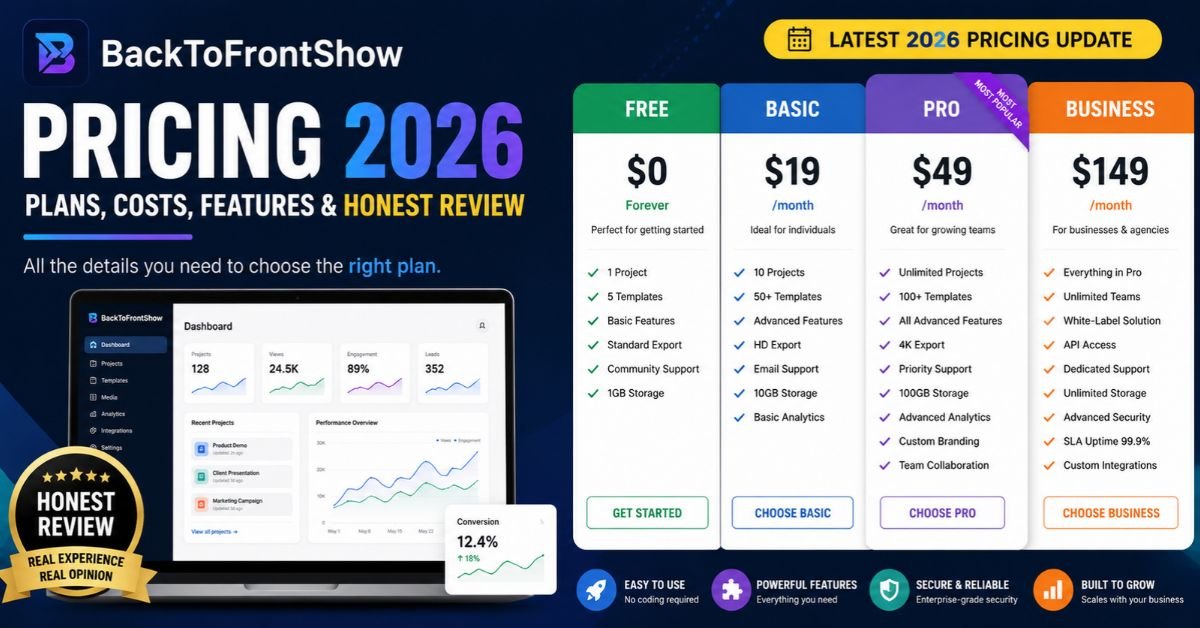
BackToFrontShow Pricing 2026 Plans Costs Features & Honest Review
Picture this. You search for BackToFrontShow pricing 2026 and find three different answers in five minutes. One page says $29. Another says $149. The official site lists Basic at $1,200 per month and Pro at $3,600. That gap can wreck a budget before the first invoice arrives.
Here’s the plan. Every figure below carries a clear label: published, calculated or still unconfirmed. You’ll see BackToFrontShow subscription plans, features, trial rules and possible extras in plain English. Good pricing transparency matters when a podcast analytics subscription costs thousands per year. Time to sort fact from noise.
BackToFrontShow Pricing at a Glance
Start with the headline numbers. The official site lists three BackToFrontShow pricing plans. Basic costs $1,200 per month. Pro costs $3,600 per month. Enterprise has no public price. Buyers must request a custom pricing quote instead.
| Plan | Published Monthly Price | 12-Month Calculation | Main Use |
| Basic | $1,200 | $14,400 | Core professional podcast analytics |
| Pro | $3,600 | $43,200 | Advanced behavior, engagement and integrations |
| Enterprise | Custom pricing | Custom | Large organizations with deeper analytics needs |
Think of the table as a quick map. It shows the BackToFrontShow monthly cost next to a simple yearly calculation. The yearly figures come from basic multiplication. The company hasn’t published them as annual packages. Use them for planning only.
BackToFrontShow Plans and Pricing Overview
BackToFrontShow subscription plans follow a classic three-step ladder. The Basic subscription tier opens the door with core audience data. The Professional subscription tier, sold as the Pro plan, adds behavior tracking and an API. The Enterprise pricing model moves to custom quotes for large teams. This structure suits podcast analytics software pricing aimed at businesses rather than hobbyists. Anyone asking “How much does BackToFrontShow cost?” gets a firm answer for two tiers and a sales call for the third.
Monthly vs. Annual Subscription Costs
The site shows a monthly subscription plan price only. Basic runs $14,400 across twelve months. Pro runs $43,200. Those BackToFrontShow annual pricing figures come from simple multiplication. A true annual subscription plan might carry a discount. Nothing public confirms that yet. Many buyers also wonder about monthly billing vs annual billing for podcast software. Ask for both quotes in writing. Then compare the full BackToFrontShow subscription cost over a year.
Important Pricing Details to Verify Before Subscribing
Prices tell only half the story. Confirm the subscription billing cycle first. Ask about contract length and renewal terms. Check how many users and shows the plan covers. Find out whether BackToFrontShow hidden fees exist for setup or extras. Solid pricing verification takes about ten minutes. It can save thousands of dollars. Finish it before you sign anything.
What Is BackToFrontShow?
BackToFrontShow is a podcast analytics platform. It studies what listeners do after they press play. The tool covers audience demographics, devices, locations and engagement. It serves podcast analytics for creators and media teams alike. Think of it as a dashboard for your audience’s habits.
Many people confuse it with a hosting service. Hosting stores and delivers episodes. Analytics explains the audience behind the downloads. The same domain also holds an older podcast page. That overlap fuels confusion in search results. The sections below clear it up.
BackToFrontShow as a Podcast Analytics Platform
The official homepage describes a four-step flow. First comes integration with your podcast. Next the platform collects listener data. Then you review a dashboard full of audience insights. Finally you build a custom report. This flow supports podcast performance tracking and podcast data reporting in one place. The homepage also offers Request Access and Book a Demo buttons. That makes BackToFrontShow a measurement tool rather than a simple publishing tool.
Who Is BackToFrontShow Designed For?
Think of buyers who turn data into revenue. Professional podcasters fit that picture. So do large networks and media companies. Agencies that run several shows gain from podcast audience analytics too. Marketing teams use the numbers for sponsorship and advertising choices. That explains the focus on BackToFrontShow pricing for podcast networks and agencies. A beginner who only needs download counts won’t need this depth.
Podcast Analytics vs. Podcast Hosting
Hosting and analytics solve different problems. A host stores episodes and sends them to listening apps. An analytics tool studies how people respond. That’s why podcast software cost varies so widely. Hosting often stays cheap. Advanced podcast analytics tools can cost far more. BackToFrontShow sits firmly in the second group.
| Podcast Hosting | Podcast Analytics |
| Stores and distributes episodes | Studies listener behavior |
| Helps publish content | Helps analyze performance |
| Usually includes basic statistics | Can provide deeper demographics |
| Focuses on delivery | Focuses on insights |
| Often lower cost | Advanced platforms may cost much more |
BackToFrontShow vs. the Original Back to Front Show Podcast
The same domain once hosted a different show. The legacy Episode #001 page describes The Back to Front Show as a web podcast. Keir Whitaker and Kieran Masterton hosted it. Topics included web development, co-working, site generation and design events. The current homepage focuses on audience analytics instead. The public pages don’t explain how the two connect. Readers should avoid guessing about any link between them.
How Much Does BackToFrontShow Cost in 2026?
Two plans have public prices and one needs a quote. Several independent guides repeat the same figures. Examples include TheZeroNet and Tycoon Story. Still, the official page remains the first place to check.
A fair BackToFrontShow pricing review treats price as only one input. The next sections break down each tier. They also explain why numbers differ so much online.
BackToFrontShow Basic Plan Price
The BackToFrontShow Basic plan costs $1,200 per month. Over twelve months that adds up to $14,400. The price buys core audience insight rather than episode storage. Expect demographics, locations and engagement tracking. That’s a steep BackToFrontShow subscription cost for a hobby show. For a monetized show with sponsors the math looks very different.
BackToFrontShow Pro Plan Price
The BackToFrontShow Pro plan costs $3,600 per month. That’s $2,400 more than Basic. Across a year the gap reaches $28,800. Anyone weighing BackToFrontShow Basic vs Pro should ask one question. Will the extra data earn more than the extra cost? Pro adds behavior tracking, device analytics, AI sentiment tools and API access.
BackToFrontShow Enterprise Plan Price
The BackToFrontShow Enterprise plan shows the words “Contact Us for Pricing.” No public number exists. Large organizations negotiate based on their own setup. Data volume and integration needs probably drive the quote. Anyone comparing BackToFrontShow Pro vs Enterprise should prepare details first. A strong brief speeds up the custom pricing quote. It also helps you spot padded add-ons.
Why BackToFrontShow Pricing Information Varies Across Websites
Old pages linger online. Writers copy each other. Some sites confuse the name with similar products. Others publish generic software estimates such as $29, $79 or $149. One third-party comparison table even lists $11,400 as the Basic yearly cost. Simple math gives $14,400. Errors like that make podcast subscription pricing research tricky. Always match third-party numbers against the official page.
BackToFrontShow Basic Plan Features, Benefits & Limitations
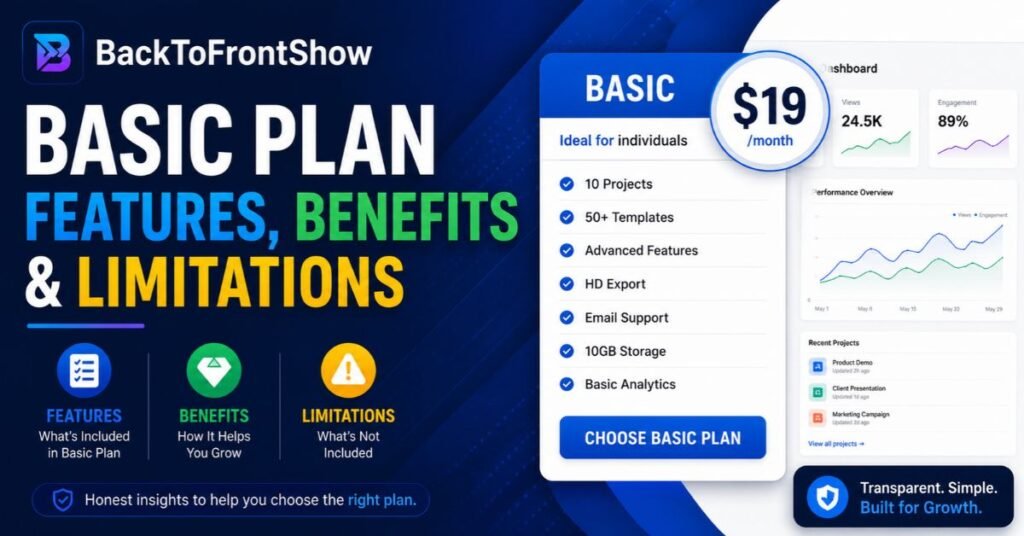
The Basic tier acts as the front door. It targets professional shows that want clearer audience data. You get the essentials without the advanced toolkit.
Details differ slightly between the pricing page and the homepage. Both count as official marketing material. Confirm the exact inclusions before you pay.
Key Features Included in the Basic Plan
The dedicated pricing page lists listener demographics and playback locations. It also lists podcast audience engagement monitoring with likes, shares and comments. Round-the-clock support and data security features complete the list. The homepage adds episode performance tracking, listening trends and customizable reporting. It also mentions feedback analysis plus accessibility and compliance. Together these tools cover basic listener engagement metrics. They show who listens and how they react.
What Is Missing From the Basic Plan?
The dedicated pricing page doesn’t list several advanced tools under Basic. That doesn’t prove Basic can never include related features. It only shows how the page presents each tier.
| Capability | Basic (Pricing Page) | Pro / Enterprise |
| Listener demographics | Yes | Yes |
| Engagement monitoring | Yes | Yes |
| Listening behavior tracking | Not listed | Yes |
| Device analytics | Not listed | Yes |
| AI sentiment analysis | Not listed | Yes |
| API integration | Not listed | Yes |
| Geographic analytics | Not listed | Enterprise |
| Dedicated account manager | No | Enterprise |
Who Should Choose the Basic Plan?
Basic suits an established show with real sponsor or ad activity. Better data can improve sponsor reports and content choices. It can also sharpen audience targeting. Consider BackToFrontShow pricing for small podcasters carefully though. A hobby show earning little may struggle to justify $1,200 each month. Cheaper tools might serve that creator better.
BackToFrontShow Pro Plan: Pricing, Features & Benefits
Pro is where the platform gets serious. It adds behavior tracking, real-time updates and integrations. The price jumps to match.
The homepage says Pro includes everything in Basic plus more. Extras include audience growth, churn rates, segmentation and engagement metrics. Larger teams get the most from those layers.
Key Features Included in the Pro Plan
The pricing page lists a long set of tools. It names listening behavior tracking, episode popularity and average listening time. It also lists multi-platform device analytics and AI-driven sentiment analysis. Feedback aggregation, real-time updates, 24/7 support and data security round out the list. These tools feed listening behavior analysis and sharper podcast performance metrics. They explain much of the BackToFrontShow features and benefits story for larger teams.
Advanced Analytics and Reporting Capabilities
Raw growth can hide trouble. Picture a show that gains 20,000 new listeners in one month. Now picture 15,000 regular listeners leaving that same month. The net gain shows only 5,000. That looks healthy but hides a leak. Audience churn analysis exposes the leak. Audience segmentation then splits listeners into new fans, loyal fans and casual visitors. Teams can track the listener retention rate and aim content at groups that stay.
API Integrations and Data Access
The pricing page lists API integration under Pro. It can connect the platform with outside systems. That makes it one of the podcast analytics tools with API access worth a look. Still, the public page skips key details. Ask about request limits, available endpoints and export rules. Ask whether technical help comes with the plan. Clear answers protect your third-party integrations from nasty surprises.
Who Should Choose the Pro Plan?
Pro fits podcast networks, media groups and larger marketing teams. It also suits companies that run several data systems. Teams that need churn and segmentation data benefit most. More features don’t automatically mean more value. The extra insight must drive decisions worth more than $2,400 per month. Run that test before upgrading.
BackToFrontShow Enterprise Plan Features and Custom Pricing
Enterprise targets large organizations with deep needs. It stacks more tools, more support and more customization on top of Pro. The price stays private.
The homepage and the pricing page describe Enterprise a bit differently. Both mention custom reporting and advanced integrations. Direct confirmation settles any gaps.
Enterprise Analytics and Custom Reporting
This tier delivers true enterprise podcast analytics. The pricing page lists geographical analytics, device analytics and custom analytics reports. It also lists premium report templates and real-time updates. The homepage adds predictive analytics, marketing and CRM integration and user behavior tracking. Big organizations often need tailored views for different departments. Custom reports make that possible.
Dedicated Support and Onboarding
For large teams the service layer can matter as much as the software. Enterprise lists a dedicated account manager and advanced user training. It also lists monthly analytics webinars and custom onboarding. Priority feature requests give big customers a louder voice. Strong customer support services and onboarding assistance shorten the learning curve. They also help new staff use the data faster.
Custom Integrations and Account Management
Enterprise includes enterprise-grade API integration. It also lists white-labeling for custom branding. Account managers coordinate the rollout and handle questions. This mix supports analytics software scalability as a company adds shows and users. Growth rarely stays tidy. A platform that scales with your team saves painful migrations later.
How to Request an Enterprise Pricing Quote
Prepare your facts before you contact sales. Clear details lead to a cleaner quote.
| What to Prepare | Why It Matters |
| Number of podcasts | Shapes the account setup |
| Number of users | Affects seat needs |
| Audience size | Influences data volume |
| Required reports | Defines customization work |
| API requirements | Sets integration scope |
| Historical data needs | Affects migration effort |
| Training needs | Determines support level |
| CRM or marketing tools | Guides integration planning |
| White-label needs | Adds branding requirements |
BackToFrontShow Basic vs Pro vs Enterprise
Side-by-side views cut through marketing language. A proper BackToFrontShow pricing comparison shows exactly where each tier starts and stops. The jump between tiers also tells a story.
The goal isn’t to buy the biggest plan. The goal is to buy the smallest plan that solves your problem. The next sections show how.
Feature-by-Feature Plan Comparison
A clean subscription plan comparison helps you see gaps at once. This BackToFrontShow plan features comparison merges the pricing page and the homepage. Because the two pages differ, confirm entitlements before you pay.
| Feature | Basic | Pro | Enterprise |
| Listener demographics | Yes | Yes | Yes |
| Engagement monitoring | Yes | Yes | Yes |
| Listening behavior | Not listed on pricing page | Yes | Yes |
| Device analytics | Not listed | Yes | Yes |
| Sentiment analysis | Not listed | Yes | Yes |
| Real-time updates | Not listed | Yes | Yes |
| API integration | Not listed | Yes | Yes |
| Geographic analytics | Not listed | Not listed | Yes |
| Custom reports | Homepage mentions customizable reporting | Homepage mentions customizable reporting | Pricing page lists custom reports |
| Dedicated account manager | No | No | Yes |
| White-labeling | No | No | Yes |
Basic vs. Pro: Which Plan Offers Better Value?
Basic costs $1,200 per month. Pro costs $3,600. The difference equals $2,400 monthly and $28,800 yearly. Value depends on whether Pro’s extras change your decisions. Behavior tracking, churn data and API access can lift sponsor revenue and retention. If your team won’t use them, the extra spend simply drains cash. Match features to real needs rather than wishful thinking.
Pro vs. Enterprise: Key Differences
Pro has a published price. Enterprise doesn’t. Pro focuses on advanced analytics and integrations. Enterprise adds geographic analysis, white-labeling and a dedicated account manager. It also brings custom onboarding, training and priority requests. Choose Enterprise when customization and hands-on support matter more than a fixed price. Otherwise Pro often covers the analytical core.
How to Choose the Right Subscription Plan
Which BackToFrontShow plan is best? The answer depends on revenue, team size and data needs. Use this quick guide.
| Your Situation | Likely Fit |
| One monetized show needing audience basics | Basic |
| Network or team needing churn, segmentation and API access | Pro |
| Large organization needing custom reports, training and white-labeling | Enterprise |
| Hobby show with small revenue | Probably a cheaper tool |
What Features Do You Get With BackToFrontShow?
The platform bundles many tools into one dashboard. Each feature answers a different business question. Together they turn raw listening data into usable direction.
Not every feature appears in every plan. Check which tier holds the tools you need. The BackToFrontShow subscription benefits grow quickly as you climb tiers.
| Feature | What It Helps Explain |
| Listener demographic analytics | Who your listeners are |
| Audience engagement tracking | How listeners interact |
| Listening behavior | What people play and for how long |
| Device analytics | Which devices they use |
| Geographic analytics | Where listeners live |
| Sentiment analysis | How feedback feels |
| Real-time updates | Recent audience changes |
| API access | Links with other tools |
| Custom reports | Tailored business reporting |
Listener Demographics and Audience Insights
Knowing your audience shapes every business choice. The platform tracks audience demographics and playback locations. These podcast listener demographic reports help you tell advertisers who actually listens. Strong audience proof can raise sponsor trust. It can also guide topic and guest choices. Better insight means fewer guesses and fewer wasted episodes.
Audience Engagement and Listening Behavior Analytics
Downloads show only that someone clicked. Engagement shows what happened next. The pricing page lists likes, shares, comments, episode popularity and average listening time. Use these tools to track podcast audience engagement across your catalog. Pro adds deeper behavior tracking for finer listening behavior analysis. Patterns reveal which episodes hook people and which lose them.
Device, Platform, and Listening Trends
Listeners use phones, smart speakers, desktops and more. The platform lists multi-platform device analytics. That shows which devices dominate your audience. Publishers can then tune audio quality, show notes and promotion for those platforms. Trend views also reveal shifts over time. Spotting a change early beats reacting late.
Audience Segmentation and Churn Analysis
Averages hide the truth. Segmentation splits listeners into groups such as new, loyal and occasional. Churn analysis shows who leaves and when. Together they help you measure podcast listener retention with precision. They also help you analyze podcast audience growth beyond raw totals. A show that wins fans but loses them quickly has a retention problem. These tools find it.
Sentiment Analysis and Audience Feedback
Comments carry feelings as well as facts. AI-driven sentiment analysis sorts feedback into positive, negative and neutral groups. Pro and Enterprise include it on the pricing page. Teams can spot reaction trends without reading thousands of comments by hand. A sudden drop in positive feedback may signal a content problem. Early warnings protect the brand.
Real-Time Analytics and Performance Reports
Speed matters during a launch or a sponsor campaign. The real-time analytics dashboard in Pro and Enterprise delivers fresh numbers. Teams can react the same day rather than the next month. Regular podcast reporting tools also package results for bosses and sponsors. Clear reports save hours of spreadsheet work. They also make meetings shorter.
API Access, Integrations, and Data Export
APIs let different tools share data. Pro and Enterprise list API integration for outside systems. The homepage also mentions CRM links for Enterprise. Public pages don’t explain data export options in detail. Ask about export formats, limits and podcast data export and migration help. Leaving a platform should never trap your numbers.
Custom Dashboards and Reporting Tools
Every team needs different views. The homepage describes custom reports built on the platform’s own dashboards. Enterprise adds premium templates for a polished look. Sales teams may want sponsor-ready summaries. Editors may want episode-level breakdowns. Flexible podcast reporting tools let each group see what matters. Ask for a demo to test how deep the customization goes.
How Much Does BackToFrontShow Cost Per Year?
Yearly cost is simple math with a catch. The site shows monthly prices only. Multiply by twelve and you get a planning figure.
Real contracts may differ. Discounts, fees and add-ons can move the final bill. Treat the table below as a starting line rather than a quote.
Calculating the Annual Subscription Cost
The BackToFrontShow annual subscription cost at published monthly rates is easy to compute. Basic equals $1,200 times 12 for $14,400. Pro equals $3,600 times 12 for $43,200. Enterprise stays custom. These numbers aren’t official annual prices.
| Plan | Monthly Rate | Calculation | 12-Month Cost |
| Basic | $1,200 | $1,200 × 12 | $14,400 |
| Pro | $3,600 | $3,600 × 12 | $43,200 |
| Enterprise | Custom | Custom | Custom |
Monthly vs. Annual Billing Options
Monthly billing keeps you flexible. You can stop or switch if needs change. Annual billing can lower the effective monthly rate at some companies. Whether BackToFrontShow offers that isn’t clear on public pages. Compare monthly billing vs annual billing through written quotes. Weigh savings against cash flow and lock-in risk.
Annual Discounts and Long-Term Contracts
The public pricing page doesn’t clearly promise a yearly discount. So promising savings would be risky. Ask sales directly about annual rates and multi-year deals. Request contract length, renewal terms and cancellation rules in writing. A tempting discount loses its shine if the contract is hard to leave.
Is an Annual Subscription Always Cheaper?
Are BackToFrontShow annual plans cheaper? Only if the company offers a lower yearly rate. Even then cheaper doesn’t always mean better. An annual deal ties up cash. It may limit downgrades and refunds. Run a quick cost-benefit analysis before committing. If the savings are small and the risk is high, monthly may win.
Does BackToFrontShow Offer a Free Plan or Free Trial?
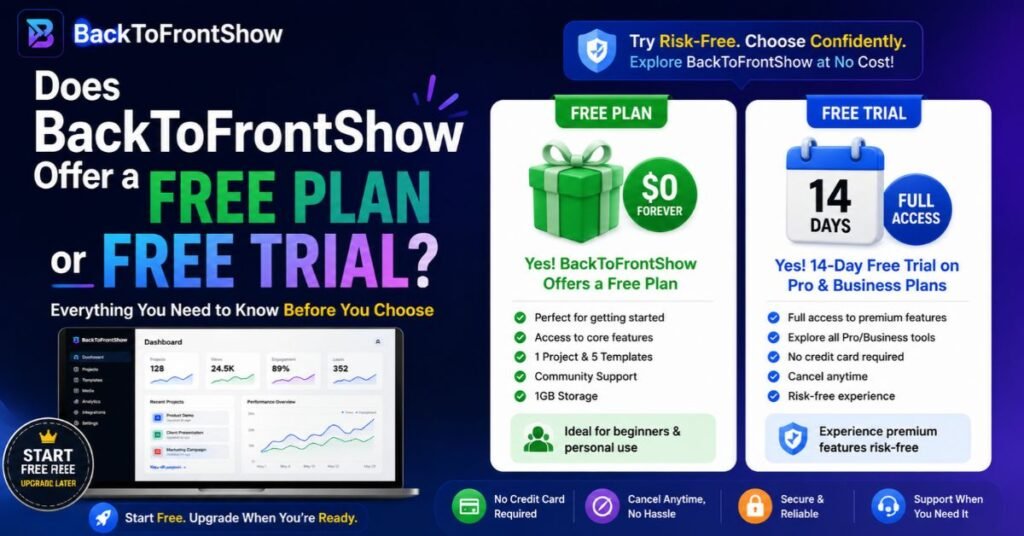
Free access is the first question many creators ask. The answer needs careful wording. The plan structure shows no permanent free tier. The site does show a “Start free Trial” link.
That link leads to an application page rather than instant access. Terms stay vague. Confirm details before you plan around a trial.
Read More: 55+ MiloMagazine Co Uk USA Website Review, Content, Credibility, and SEO Opportunities
BackToFrontShow Free Plan Availability
Is BackToFrontShow free to use? The published pricing lists Basic, Pro and Enterprise only. No permanent BackToFrontShow free plan appears in that structure. Anyone seeking free analytics may prefer basic dashboards from hosts or listening apps. Those tools are lighter but cost nothing. They make a smart starting point for new shows.
Free Trial Eligibility and Trial Limitations
Does BackToFrontShow offer a free trial? The site displays a trial link. That link opens a Request Access page. The page asks you to apply, pick a plan and wait for approval. Public pages don’t state trial length, limits, card requirements or auto-conversion rules. Free trial eligibility therefore remains unclear. Ask for each detail in writing.
How to Request Access or a Product Demonstration
The homepage shows both Request Access and Book a Demo buttons. A demo lets you test the dashboard with your own questions. Bring a list: reports you need, integrations you use and users who need access. Ask about sample data and trial scope. A good demo exposes weak spots before you spend a dollar.
Are There Any Hidden BackToFrontShow Costs?
Does BackToFrontShow charge hidden fees? Public pages don’t prove any exist. They also don’t list every possible charge. That gap is the real issue.
A written fee breakdown fixes it. Ask early and ask clearly. Surprise invoices hurt more than high sticker prices.
Potential Additional Fees and Optional Services
These are questions rather than claims. Ask about setup fees and storage limits. Ask about bandwidth rules and overage charges. Ask about extra users, additional podcasts and API usage. Ask about custom development and historical data imports. Any “yes” answer should appear in your contract with a price attached.
User Seats, Multiple Podcasts, and Account Limits
Team size and show count can change your bill. Confirm the user account limits for each plan. Ask whether pricing covers one podcast or the whole account. Networks need clarity on multiple podcast management costs. A plan that looks cheap for one show may balloon across ten. Get seat and show limits in writing.
Onboarding, Integrations, and Custom Reporting Costs
Enterprise lists custom onboarding. Other tiers don’t spell out setup help. Integrations and custom reports may also need extra effort. Ask whether technical assistance comes free or costs money. Staff time counts too. An integration that takes two engineers a month isn’t free.
Read More: TechNewsOutlets Com USA Review Facts Benefits and Risks In 2026
Contract Terms, Renewals, and Refund Policies
Public pages don’t fully explain contracts. Ask about renewal timing and auto-renewal rules. Request the subscription cancellation policy in writing. Ask about the refund policy and pro-rated refunds. Podcast analytics subscription cancellation should be simple and clear. Know the exit path before you walk in.
How to Calculate the Total Cost of Ownership
The total cost of ownership goes beyond the monthly fee. Add the subscription, onboarding, training, integration work, data migration and admin time. Include any extra seats or shows. Use this formula: Subscription + Setup + Training + Integrations + Admin Time + Extras. The result shows the real price of podcast analytics software pricing for your team. Compare that number against expected gains
Who Should Use BackToFrontShow?
Strong-fit buyers share one trait. They can turn data into money or major decisions. Sponsor deals, ad sales and audience strategy all benefit.
Revenue scale makes the case stronger. When income dwarfs the subscription, the risk feels small. When income is thin, risk grows fast.
Independent Podcasters and Small Creators
Small creators should proceed with caution. A monetized solo show with solid sponsor income might justify Basic. Better data can help renew sponsors at higher rates. A hobby show likely can’t carry $1,200 monthly. Those creators can start with free dashboards. Upgrade later when revenue supports it.
Growing Podcasts and Professional Production Teams
Growing shows reach a point where guesswork hurts. Producers need proof of what works. The platform offers podcast audience growth tools that reveal where listeners come from and why they stay. Teams can build a stronger podcast monetization strategy with that evidence. These shows often fit Basic or Pro. The right tier depends on team size and revenue.
Podcast Networks, Agencies, and Enterprise Businesses
Networks and agencies handle many shows and many sponsors. Data becomes a shared language. Consider a simple case study. A network runs five shows and earns $60,000 monthly. Sponsors want proof of audience quality. Pro’s churn and segmentation tools help the network sell premium ad slots. Even a $3,600 subscription becomes a small share of revenue. This example is illustrative.
Who May Not Need BackToFrontShow?
Not every creator needs deep analytics. Sometimes simple stats do the job. Overspending on tools can slow a young show.
Compare two imaginary podcasts to see the gap. The table below shows how scale changes the verdict. These examples are illustrative.
| Metric | Podcast A | Podcast B |
| Monthly revenue | $800 | $50,000 |
| Monthly listeners | 4,000 | 500,000 |
| Team size | One person | 12 people |
| Analytics needs | Basic | Advanced |
| Basic plan cost | $1,200 | $1,200 |
Podcast A would pay more for analytics than it earns. Podcast B would pay a tiny slice of revenue. Better sponsor reports could return far more than the fee. Operation size decides the verdict.
Beginners Who Need Only Basic Podcast Statistics
New creators mostly need download counts and a few trends. That’s enough to learn the ropes. Podcast analytics software for beginners should be simple and cheap. Advanced tools can overwhelm a new producer. Master the basics first. Upgrade when questions outgrow the free dashboards.
Creators Who Already Have Sufficient Analytics Tools
Some shows already track what they need. Their host and listening apps may supply enough data. Paying for a second platform adds cost without new insight. Check for gaps before buying. If current tools answer your top questions, keep them. Spend the money on content or promotion instead.
Podcasters Working With a Limited Budget
Budget limits are real. Many creators want affordable podcast analytics software that fits tight cash flow. At $1,200 monthly BackToFrontShow sits outside that range. Cheaper tools offer lighter insight at a fraction of the cost. A smaller show may grow faster by investing in better audio or guests. Revisit premium analytics when revenue catches up.
Read More: CracksTube com Review 7 Key Facts on Safety & Features 2026
Is BackToFrontShow Worth the Price?
Is BackToFrontShow worth the price? No single answer fits everyone. A small creator may find $1,200 hard to defend. A commercial network may see it as a modest cost for powerful insight.
The test is simple. Does the data create more value than it costs? The sections below give you a way to measure that.
BackToFrontShow Pros and Cons
A balanced view helps. Strengths sit alongside real limits.
| Pros | Cons |
| Detailed audience insight | High entry cost |
| Engagement monitoring | Big jump from Basic to Pro |
| Listener behavior analysis | Enterprise price isn’t public |
| Advanced Pro analytics | Trial terms aren’t clear |
| API support | Pages show different feature lists |
| Real-time data | Billing and contract details need confirmation |
| Enterprise customization | May not suit small hobby podcasts |
Potential Benefits of Using BackToFrontShow
Good analytics can sharpen sponsor pitches. They show advertisers exactly who listens. They help editors double down on winning topics. They help marketers spend less on audiences that never engage. They also reveal where listeners drop off. Each insight can protect or grow revenue. The benefit appears only when the team acts on the data.
Limitations and Possible Drawbacks
Cost leads the list. Basic alone costs $14,400 yearly. The Pro upgrade adds $28,800 more. Enterprise pricing stays hidden until you talk to sales. Trial and contract details need direct confirmation. Two official pages describe features differently. Small podcasts may never earn enough to cover the subscription. These drawbacks don’t doom the platform. They just demand careful buying.
Return on Investment and Audience Growth
An old business saying claims that what gets measured gets managed. Analytics follows that idea. Your return on investment (ROI) depends on actions taken after you read the dashboard. Better retention, stronger sponsorships and smarter marketing all raise income. Track podcast analytics return on investment with clear before-and-after numbers. Ask whether the platform helps you calculate podcast analytics ROI with exports or reports. Measurement without action earns nothing.
Break-Even Calculation for Podcast Creators
Use a simple rule. Monthly value created must equal or exceed the monthly subscription cost. Value can come from new sponsors, higher ad rates, better retention or leaner marketing.
| Scenario | Monthly Cost | Value Needed Monthly | Value Needed Yearly |
| Basic | $1,200 | $1,200 | $14,400 |
| Pro | $3,600 | $3,600 | $43,200 |
| Upgrade from Basic to Pro | $2,400 | $2,400 | $28,800 |
A dashboard doesn’t create value alone. The value comes from decisions made with the data.
BackToFrontShow Alternatives: How Does It Compare to Competitors?
Price alone makes a poor comparison. A smart review looks at depth, support and flexibility. It also checks how easily you can leave.
Smaller shows may find cheaper tools enough. Larger groups often prize integration and stability over the lowest price. Weigh each factor against your goals.
BackToFrontShow vs. Other Podcast Analytics Platforms
A solid podcast analytics platform comparison reviews several factors. Look at audience insight, reporting, integration and support. Also check data export and security. The table below lists key points. Use it when you weigh podcast analytics competitors.
| Factor | Why It Matters |
| Price | Controls total spending |
| Audience analytics | Shows depth of insight |
| Segmentation | Separates listener groups |
| Reporting | Supports business decisions |
| API support | Connects other systems |
| Historical data | Supports long-term analysis |
| Data export | Avoids vendor lock-in |
| User limits | Matters for large teams |
| Support | Matters in professional settings |
| Security | Protects business and audience data |
BackToFrontShow vs. Cheaper Alternatives
BackToFrontShow alternatives at lower prices often provide basic statistics. Free dashboards from hosts and listening apps are examples. They cover downloads and simple trends. They may skip deep segmentation, sentiment tools or custom reporting. To compare podcast analytics platform costs fairly, match features first and price second. Cheaper wins only if the tool still answers your key questions.
Which Podcast Analytics Platform Offers the Best Value?
Value depends on need. The best podcast analytics tools for creators match their stage. A starter show wants simplicity and low cost. Podcast analytics tools for growing audiences need retention and segmentation features. Large networks care about scale, support and data privacy and security. Test two or three options through demos. Then pick the tool your team will use daily.
What to Check Before Paying for BackToFrontShow
A smart buyer asks questions before signing. Written answers beat verbal promises. Keep every reply in one folder.
The list below covers the biggest unknowns. Public pages leave many of them open. Direct confirmation turns guesses into facts.
Is Pricing Based on Each Podcast or the Entire Account?
For a network, this question changes everything. Per-podcast pricing multiplies cost with every new show. Account pricing may cover many shows at once. The public pages don’t state which model applies. Ask sales to define the billing unit clearly. Then calculate the cost for your current shows and your plans for next year.
How Many Users and Podcasts Are Included?
Seat limits and show limits shape real cost. A large marketing team may need many logins. A network may need to add shows over time. Ask what’s included in each plan. Ask what extra seats or shows cost. Clear numbers help you budget without surprises.
Is Historical Analytics Data Included?
Past data shows long-term trends. It helps you judge seasonality and growth. Public pages don’t fully explain historical analytics data access. Ask how far back the platform can import. Ask whether history costs extra. Teams with years of past episodes should settle this before paying.
Are API Access and Third-Party Integrations Included?
The pricing page lists API integration for Pro and Enterprise. It doesn’t give limits or support details. Ask about request caps, endpoints and technical help. Check which third-party integrations work out of the box. A promised connection that needs custom coding costs time and money.
Are Onboarding and Custom Reports Included?
Enterprise clearly lists custom onboarding and custom reports. Other tiers don’t spell out setup help. Ask whether training sessions come with Basic or Pro. Ask how deep report customization can go. Good onboarding shortens the time to first insight.
What Level of Customer Support Is Provided?
The pricing page advertises 24/7 support. That sounds great but lacks detail. Ask about response times and contact channels. Ask whether every plan gets the same level. Fast answers matter when a report is due.
Can You Upgrade, Downgrade, or Cancel Your Plan?
Plans change as shows grow or shrink. The public site doesn’t fully explain plan changes. Ask when a downgrade takes effect and whether features vanish at once. Ask about pro-rated refunds. Clear exit rules keep you in control.
Who Owns Your Data, and Can You Export It?
Data ownership deserves a direct answer. Ask who owns reports built on the platform. Ask which export formats exist and whether history can be downloaded. Ask what happens to your data after cancellation. Strong answers protect you from lock-in. Podcast analytics privacy and data ownership should never stay vague.
How Does BackToFrontShow Protect User Data and Privacy?
The pricing page promotes data security features in broad terms. Professional buyers need specifics. Ask where data is stored and whether it is encrypted. Ask about access controls and retention periods. Ask whether independent security certifications exist. Don’t assume certifications without proof. Solid answers on data privacy and security build trust.
How to Verify BackToFrontShow Pricing Before Subscribing
How to verify BackToFrontShow pricing? Start with the official site. Then cross-check with independent guides. Finish by asking sales to confirm your exact plan in writing.
Software prices change often. A number that was true last spring may be stale today. Check the date on every source you use.
Official Pricing Information vs. Third-Party Estimates
Official pages should lead your research. They reflect the company’s current plans. Third-party guides add context and comparison. Some match the official numbers. Others drift far away with figures like $29 or $149. Use independent sources for ideas. Use official sources for budgets.
Why Pricing Dates and Subscription Terms Matter
Prices and terms shift over time. A discount may expire. A plan name may change. A feature may move to another tier. Note the date you checked each source. Save screenshots or copies of the pricing page. Dated proof helps if a dispute ever arises.
Questions to Ask Before Making a Payment
Bring a checklist to every sales call. Ask about contract length, billing cycle and renewal terms. Ask about trial rules, user limits and data caps. Ask about API limits, historical data and export options. Ask about onboarding, extra fees and the cancellation path. Get every answer in an email. Then decide with clear eyes.
Frequently Asked Questions
How Much Does BackToFrontShow Cost Per Month?
Basic is listed at $1,200 per month. Pro is listed at $3,600 per month. Enterprise requires direct contact for a quote. These monthly rates define the BackToFrontShow pricing per month for the two public tiers.
What Is the Cheapest BackToFrontShow Plan?
The cheapest publicly priced paid plan is Basic at $1,200 per month. No permanent free tier appears in the published structure. Smaller budgets may need other tools.
How Much Do the Basic, Pro, and Enterprise Plans Cost?
Basic costs $1,200 monthly. Pro costs $3,600 monthly. Enterprise uses custom pricing that buyers must request. Pro costs $2,400 more than Basic each month.
How Much Does BackToFrontShow Cost Per Year?
At published monthly rates Basic totals $14,400 across twelve months. Pro totals $43,200. These are calculations rather than official annual packages. Enterprise stays custom.
Does BackToFrontShow Offer Annual Discounts?
A guaranteed annual discount isn’t clearly shown on the public pricing page. Ask sales about yearly rates and multi-year terms. Don’t assume savings until the company confirms them.
Is There a Free BackToFrontShow Plan or Trial?
No permanent free plan appears in the pricing structure. The site displays a Start free Trial link. That link currently opens a Request Access application. Trial length and detailed terms aren’t clearly published.
Are There Any Hidden Fees?
A complete list of extra charges isn’t published. That doesn’t prove hidden fees exist. Ask for a written breakdown covering setup, users, API use, onboarding and data. Get everything in the contract.
Can You Upgrade or Downgrade Your Subscription?
The public site doesn’t clearly explain every plan change. Ask when upgrades and downgrades take effect. Ask whether features disappear at once. Confirm refund treatment before you commit.
Does BackToFrontShow Offer Refunds?
A detailed public refund policy isn’t clearly shown on the pricing page. Ask about refunds and pro-rated refunds before signing. Request the terms in writing.
Is BackToFrontShow a Podcast Hosting Platform?
No. The current homepage presents it as a podcast analytics platform. It focuses on audience behavior, engagement, demographics and reporting. Hosting tools store and distribute episodes instead.
Why Do Different Websites Show Different BackToFrontShow Prices?
Some pages use old data. Others copy errors or confuse similar names. A few publish generic software estimates. Always compare third-party numbers with the official page.
Does BackToFrontShow Include API Access and Historical Data?
The pricing page lists API integration for Pro and Enterprise. Public details on historical data are limited. Teams that need long-term reporting should confirm access before paying.
Can You Export Your Podcast Analytics Data?
Public pages don’t fully explain export rules. That doesn’t mean exports are blocked. Ask about formats, limits and post-cancellation access. Clear answers protect you from lock-in.
Final Thought
BackToFrontShow isn’t a low-cost podcast tool. Basic at $1,200 and Pro at $3,600 place it in the professional analytics class. Its real test is simple. Can the insight support smarter, richer decisions? Large networks and commercial shows may say yes. Small hobby podcasts will likely struggle to justify the spend.
Verify everything before you pay. Confirm pricing, trial terms, user limits, data access, cancellation rules and possible extra fees. Run a break-even check against real revenue. Test a demo with your own questions. Great analytics only pay off when you act on what they show. Numbers on a screen don’t build an audience. Smart decisions do.