
Chief Technical Examiner: Roles, Responsibilities, Qualifications, and Importance in Modern Organizations
Introduction
A chief technical examiner plays an important role in maintaining technical standards, ensuring quality, and evaluating the accuracy of technical work across different organizations. In today’s technology-driven world, businesses and government institutions depend on skilled professionals who can examine technical systems, identify weaknesses, and ensure that projects meet established requirements. This is where the chief technical examiner becomes particularly valuable.
The position combines technical knowledge, analytical thinking, professional judgment, and leadership abilities. A person working in this role may be responsible for reviewing engineering projects, inspecting technical operations, examining documents, evaluating equipment, and ensuring compliance with relevant standards. The exact responsibilities depend on the organization, industry, and official structure of the department.
Although the title may sound specialized, the importance of this position extends across several sectors, including engineering, construction, infrastructure, manufacturing, information technology, and public administration. Understanding what a chief technical examiner does can help students, professionals, and organizations appreciate the importance of technical supervision and independent evaluation.
What Is a Chief Technical Examiner?
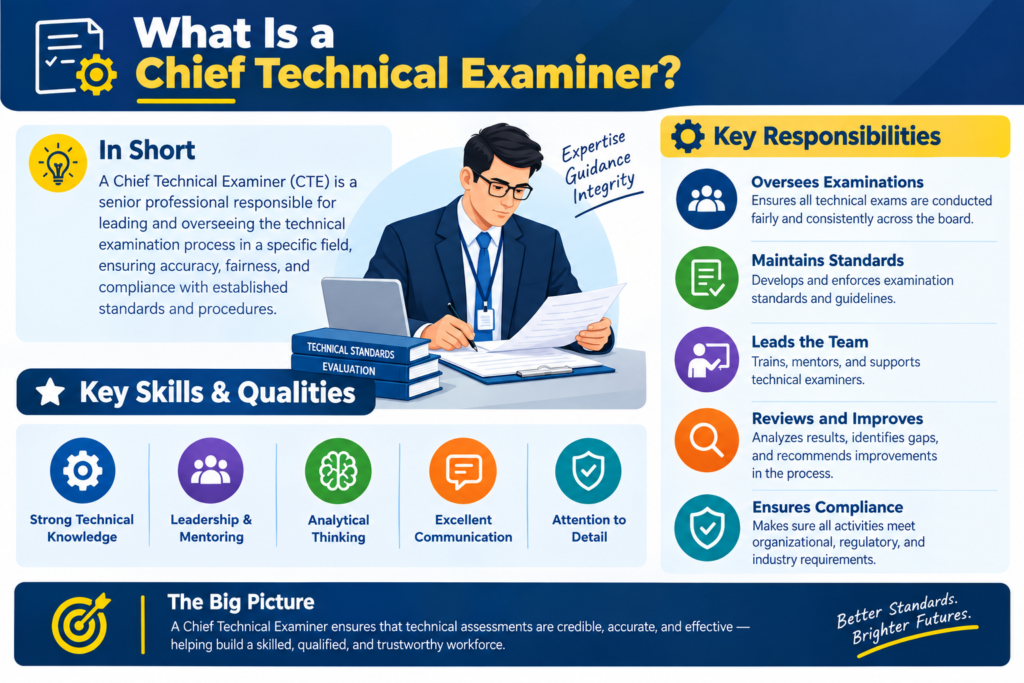
A chief technical examiner is a senior professional responsible for examining, reviewing, and evaluating technical activities within an organization or department. The position generally involves checking whether technical work follows approved procedures, professional standards, and organizational requirements.
Unlike professionals who focus primarily on completing technical assignments, an examiner concentrates on evaluating the quality and correctness of completed or ongoing work. This may include checking project reports, reviewing engineering designs, inspecting machinery, assessing construction activities, and identifying possible technical irregularities.
The word “chief” indicates a senior position that may include supervisory and administrative responsibilities. Depending on the organizational structure, the person may lead a team of technical examiners, coordinate inspections, prepare findings, and communicate recommendations to senior management.
The role is especially important in organizations where technical mistakes can create financial losses, operational problems, safety risks, or legal complications.
Main Responsibilities of a Chief Technical Examiner
The responsibilities of a chief technical examiner can vary significantly depending on the industry. However, several important duties are commonly associated with this professional position.
1. Technical Inspection and Evaluation
One of the primary responsibilities is examining technical work to determine whether it meets established requirements. This may involve inspecting physical infrastructure, evaluating equipment, reviewing engineering drawings, or examining project documentation.
The examiner must understand the technical specifications involved in a project. By comparing actual work with approved plans, the professional can identify mistakes, incomplete activities, or areas requiring improvement.
Technical inspections are essential because even small errors can become expensive problems if they remain unnoticed.
2. Quality Assurance
Quality assurance is another major responsibility. Organizations need reliable methods to confirm that their products, services, and projects meet expected standards.
A chief technical examiner evaluates the quality of technical processes and identifies weaknesses that could affect the final outcome. This may include checking materials, reviewing testing procedures, examining manufacturing processes, and assessing the performance of technical systems.
Maintaining consistent quality helps organizations protect their reputation and deliver dependable results.
3. Reviewing Technical Documents
Technical projects generate large amounts of documentation. These documents may include project proposals, engineering calculations, inspection reports, financial estimates, technical drawings, and compliance records.
A chief technical examiner reviews relevant documents to determine whether the information is complete, accurate, and consistent with approved requirements.
This responsibility requires strong attention to detail because incorrect calculations, missing information, and unclear specifications can affect important organizational decisions.
4. Identifying Technical Problems
Another important duty involves identifying problems that may affect the performance, safety, or financial efficiency of a project.
For example, an examiner working with an infrastructure project may discover that construction materials do not meet the required specifications. In a manufacturing environment, the same professional may identify equipment problems that could reduce production quality.
Identifying these issues early allows organizations to take corrective action before the problems become more serious.
5. Preparing Inspection Reports
Professional reporting is an essential part of technical examination. After completing an inspection or evaluation, the examiner generally prepares a report describing the findings.
A useful technical report explains what was examined, which standards were applied, what problems were identified, and what improvements may be necessary.
Reports should be accurate, understandable, and supported by appropriate evidence. They also provide organizations with a record of technical evaluations and help decision-makers understand potential risks.
Qualifications Required to Become a Chief Technical Examiner
The educational and professional requirements for this position depend on the organization and its industry. However, a strong technical background is generally important.
A bachelor’s degree in engineering, information technology, computer science, construction management, or another relevant technical discipline may provide a suitable foundation.
For positions involving specialized engineering responsibilities, qualifications in civil, mechanical, electrical, or industrial engineering may be particularly useful.
In addition to academic education, professional experience is often essential. Senior examination positions usually require individuals who understand technical operations and can evaluate complicated situations independently.
Some organizations may also require professional certifications, technical licenses, or additional training related to safety, quality management, auditing, or project evaluation.
The most important factor is the ability to combine theoretical knowledge with practical technical judgment.
Essential Skills of a Successful Chief Technical Examiner
Academic qualifications alone are not enough to perform this role effectively. A successful chief technical examiner needs several professional skills.
Analytical Thinking
Analytical thinking helps examiners understand complex technical information and identify the causes of problems. They must be able to compare specifications, evaluate evidence, and reach reasonable conclusions.
Attention to Detail
Small technical errors can create major consequences. Therefore, examiners must carefully review documents, measurements, calculations, and inspection results.
Communication Skills
A chief technical examiner frequently communicates with engineers, project managers, contractors, administrators, and other professionals.
The ability to explain technical findings in clear language is essential. Good communication also helps prevent misunderstandings and supports effective problem-solving.
Leadership and Management
In senior positions, examiners may supervise teams and coordinate multiple technical activities. Leadership skills help them distribute responsibilities, manage deadlines, and maintain professional standards.
Problem-Solving Abilities
Technical examinations often reveal unexpected problems. Professionals must understand the situation, consider available solutions, and recommend practical improvements.
Professional Integrity
Integrity is especially important because technical examination can influence financial decisions, project approvals, organizational performance, and public safety.
A reliable examiner must remain objective, avoid conflicts of interest, and base conclusions on evidence rather than personal preferences.
Importance of a Chief Technical Examiner in Government Departments
Government departments frequently manage large technical projects involving public infrastructure, transportation, buildings, utilities, and other essential services.
These projects require proper planning, financial control, technical supervision, and compliance with applicable regulations.
A chief technical examiner can contribute to accountability by reviewing technical work and identifying weaknesses in project execution. Depending on the department’s mandate, this may involve examining construction quality, reviewing estimates, checking technical specifications, and assessing whether completed work matches approved requirements.
Such evaluations can help government organizations identify irregularities, reduce unnecessary expenses, and improve the use of public resources.
However, the authority and responsibilities of an official holding this title depend on the applicable government rules and departmental structure. The position should not automatically be confused with a general engineering manager or an independent financial auditor.
Role in the Construction and Engineering Industry
Construction and engineering are among the fields where technical examination can have a particularly significant impact.
Large construction projects involve numerous activities, including site preparation, foundation work, structural development, electrical installations, plumbing, and finishing.
Every stage must meet appropriate engineering specifications and safety requirements.
A chief technical examiner may review construction plans, inspect completed work, examine material quality, and evaluate whether project activities follow approved standards.
For instance, when examining a building project, the professional may review structural calculations, inspect construction materials, and compare the actual work with approved engineering drawings.
These activities help identify possible defects before they create serious problems.
Technical examination also supports long-term infrastructure reliability. Roads, bridges, buildings, and public facilities require appropriate construction methods and quality materials to remain safe and functional.
Difference Between a Technical Examiner and a Chief Technical Examiner
Although both positions involve technical evaluation, their responsibilities may differ according to the organization’s hierarchy.
A technical examiner generally focuses on specific inspections, technical reviews, documentation, and assigned evaluation tasks.
A chief technical examiner may have broader responsibilities, including supervising examination activities, reviewing reports prepared by other professionals, coordinating inspections, and advising senior officials.
The chief-level position may also involve developing examination procedures and ensuring consistency across different projects or departments.
| Technical Examiner | Chief Technical Examiner |
|---|---|
| Handles assigned examination tasks | May supervise examination activities |
| Reviews specific technical work | May review broader projects and reports |
| Reports findings to senior officials | May communicate findings to senior management |
| Focuses on individual assignments | May coordinate multiple assignments |
| Works under an established structure | May hold a senior supervisory position |
These differences are general rather than universal. Actual responsibilities depend on the organization’s official job description.
Challenges Faced by a Chief Technical Examiner
Despite its importance, this profession comes with several challenges.
One common challenge is dealing with complicated technical projects. Modern engineering systems and industrial processes can involve specialized equipment, advanced software, and complex regulations. Examiners must continuously improve their knowledge to remain effective.
Another challenge is maintaining independence. Technical findings may sometimes conflict with the expectations of contractors, managers, or other stakeholders. A professional must remain objective even when facing pressure.
Time management can also become difficult when several inspections and reports need attention simultaneously. Senior examiners may need to coordinate different teams while ensuring that every assignment receives sufficient attention.
Additionally, technological changes create new responsibilities. Digital systems, automation, artificial intelligence, and modern construction techniques require professionals to develop new technical skills.
Overcoming these challenges requires continuous learning, professional discipline, and strong organizational support.
Technology and the Future of Technical Examination
Technology is changing how organizations inspect and evaluate technical work. Digital tools now make it possible to collect information, analyze performance, and identify potential problems more efficiently.
For example, digital inspection systems can help professionals record findings and organize technical documentation. Advanced measurement equipment can improve accuracy during physical inspections.
Artificial intelligence may also support the examination process by identifying unusual patterns in large datasets, highlighting inconsistencies, and assisting with document analysis.
In construction, drones and digital modeling technologies can provide additional information about project progress and structural conditions.
However, technology cannot completely replace professional judgment. A chief technical examiner must still interpret findings, consider the relevant circumstances, and make responsible decisions.
The future of this profession will likely involve a combination of traditional technical expertise and modern digital capabilities.
Career Opportunities and Professional Growth
The position of chief technical examiner may offer opportunities for experienced professionals who want to move into senior technical or supervisory responsibilities.
People with backgrounds in engineering, quality control, inspection, construction, manufacturing, and technical auditing may find relevant career pathways.
A typical professional journey may begin with an entry-level engineering or technical position. With experience, an individual may move into inspection, quality assurance, project evaluation, or technical auditing.
Further professional development can lead to senior examination, departmental management, or technical advisory responsibilities.
Career progression is not identical in every organization. Some positions require competitive examinations, formal promotions, professional certifications, or specific years of experience.
Individuals interested in this career should carefully review the recruitment requirements of their preferred department or industry.
Why Organizations Need Qualified Technical Examiners
Organizations operate more effectively when technical decisions are supported by reliable information and professional evaluation.
A qualified examiner provides an additional layer of oversight that helps identify problems and improve operational standards.
This is particularly important when organizations manage expensive equipment, complicated infrastructure, or projects involving public safety.
Independent technical evaluation can also improve transparency. When inspection findings are documented properly, managers have a clearer understanding of project performance and potential weaknesses.
Furthermore, regular examinations encourage employees and contractors to follow established procedures. This creates a stronger culture of accountability and continuous improvement.
The value of technical examination is therefore not limited to finding mistakes. It also helps organizations prevent future problems and develop better working practices.
Conclusion
A chief technical examiner is an important professional position associated with technical inspection, quality evaluation, compliance, and organizational accountability. The role requires a combination of education, practical experience, analytical thinking, communication skills, and professional integrity.
From government departments to engineering companies and manufacturing organizations, technical examiners help ensure that work meets established standards and that potential problems are identified before they become serious.
As technology continues to transform modern industries, the responsibilities associated with technical examination are also evolving. Digital inspection tools, artificial intelligence, automation, and advanced engineering systems are creating new opportunities for professionals in this field.
Ultimately, the chief technical examiner contributes to better decision-making, improved quality, and more reliable technical operations. For individuals interested in engineering, inspection, and professional leadership, understanding this position offers valuable insight into an important area of modern organizational management.