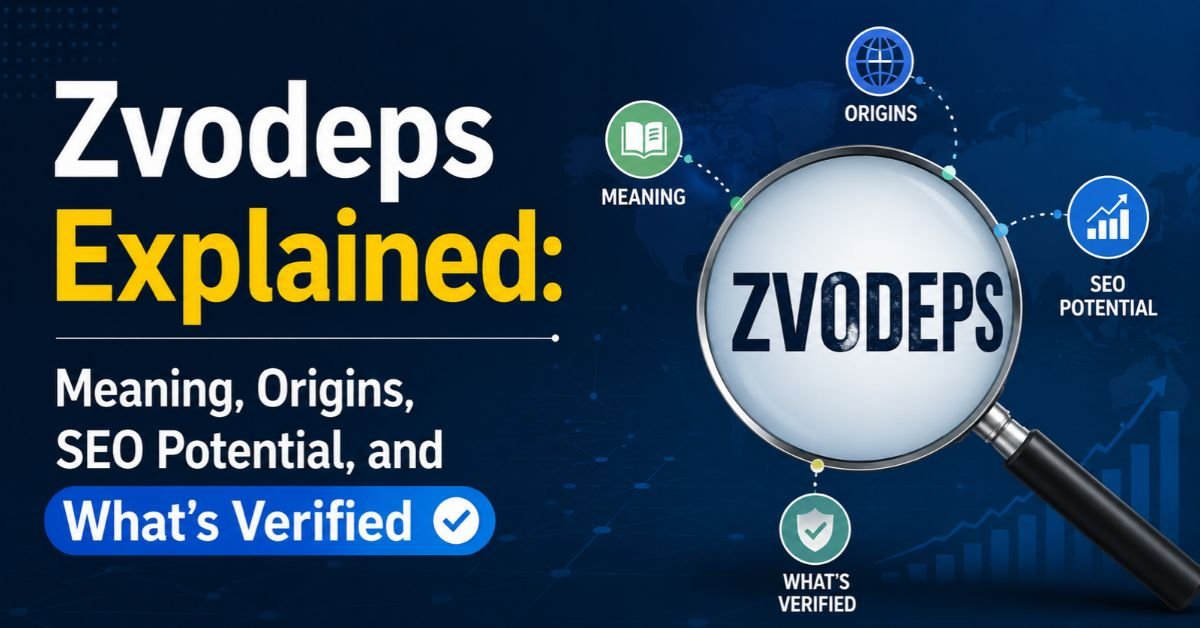
Zvodeps Explained 7 Essential Facts About Its Meaning and SEO Potential
You spot a strange word online. It looks like a software tool or a code library. You type it into Google and hope for a clear answer. Instead you get a pile of pages that don’t agree. That is the story of Zvodeps. This guide gives you Zvodeps explained in plain terms. You’ll see what is known and what is only talk.
The topic matters beyond one odd word. It shows how emerging internet keywords appear and spread. It also shows how easily guesses turn into “facts” online. Read on to learn the Zvodeps meaning, its possible roots, its safety questions, and its value for search marketing. You’ll also pick up habits that help with any unfamiliar term.
What Is Zvodeps? A Quick Overview
So, what is Zvodeps? The honest answer is short. It is a search term with no widely accepted, officially documented explanation. No dictionary lists it. No standards body defines it. No major company has claimed it in public records that we could find. The Zvodeps definition is therefore “unverified” and not “unknown by accident.”
That gap is exactly why the word draws attention. People hate a blank space. Writers fill it with stories about software, startups, or secret tools. A careful reader waits for proof first. This section lays out the facts in a simple form. Then it separates solid ground from guesswork.
Quick Facts About Zvodeps
Facts are easier to trust when you can scan them. The table below sums up the current status of the Zvodeps keyword. Zvodeps Explained Each row shows what evidence exists today. Treat “not verified” as a real answer. It means no reliable proof turned up during research. It does not mean the thing is false forever.
| Topic | Current Status |
| Dictionary entry | None found |
| Official definition | None found |
| Confirmed software or app | Not verified |
| Confirmed company or founder | Not verified |
| Registered technical standard | None found |
| Active search keyword | Yes, people do search for it |
What Is Currently Known About Zvodeps?
Very little is confirmed. The only firm fact is that people type the word into search engines. That gives it a digital footprint. Beyond that point, claims turn shaky. Some blogs call it a platform. Others call it a framework or a trend. None of them point to a primary source. Good verified information about Zvodeps would include an official page, a company filing, or technical documentation. Until those appear, the safest summary is simple. The meaning of Zvodeps is open. Anyone who states otherwise should show proof.
Is Zvodeps a Real Word, Website, or Product?
Ask is Zvodeps a real word. In a dictionary sense, no. It looks like an invented word. Invented words are normal in technology. Google grew out of a play on the number “googol.” Kodak was coined by its founder to sound crisp and memorable. Zvodeps may follow that pattern. Still, a coined shape proves nothing about a real business. The keyword is real because people search it. A matching site, app, or service has not been verified. Treat each claim as unproven until a trusted record backs it up.
Where Did Zvodeps Come From?
The origin of the term Zvodeps is unclear. No credible source names a creator or a launch date. No press release or archive explains it either. That leaves only informed guesses. Those guesses help you think. They do not settle anything.
Look at the Zvodeps origins the way a detective would. You collect clues and rank them by strength. A strong clue comes from a primary record. A weak clue comes from a repeated rumor. The sections below cover the most likely paths. Each one is labeled as a theory so nobody mistakes it for a fact.
Possible Origins and Meaning of the Name
The possible meaning of Zvodeps depends on how the word was formed. Perhaps it began as a brand experiment for a domain name. It may be a placeholder that someone forgot to replace. It could also be a typo or a garbled mix of other words. Some readers hear “dev” and “ops” inside it. That echo may be pure chance. Linguists call this kind of study word formation. Without a creator’s statement it stays speculation. The name might even carry no message at all. Plenty of brands are sounds first and stories later.
Why Zvodeps Looks Like a Technical Term
The word wears a technical costume. It is short and has an unusual first letter. It ends in a plural-style “s.” Many developer tools and SaaS products share those traits. That look makes it feel like a Zvodeps technical term. Our minds link odd, compact names with software. The table below compares common naming styles. Zvodeps fits the “unique letter combination” style. A style match is not proof of a product. It only explains why the word feels official.
| Naming Style | Example |
| Invented word | Kodak |
| Blended words | Microsoft |
| Abbreviation | IBM |
| Altered spelling | Flickr |
| Unique letter mix | Zvodeps (pattern only) |
Could Zvodeps Be an AI-Generated or Invented Word?
It could. Language models and content tools produce huge volumes of text. They also invent plausible names. Such AI-generated terminology can slip into published pages. Search engines may then pick it up. This is one possible path for AI-generated words and phrases. It is not a proven one. No evidence ties Zvodeps to any specific tool. Keep the idea as a reasonable theory. A rule of thumb helps here. If a term appears everywhere yet has no source, machine-made content is a fair suspect.
What Is Zvodeps Used For?
People often ask what is Zvodeps used for. The plain answer is that no verified use exists. No confirmed product has instructions. No service lists features. No tool has reviews from real customers. Claims about uses should be read with care.
That does not make the question silly. It makes it a good test of your research habits. You can learn to sort real tools from empty labels. The next sections show how. They also explain why context changes everything when a word is new.
Is Zvodeps a Website, Company, Service, or Framework?
Each label needs its own proof. A Zvodeps website needs a working domain with clear ownership. A company needs a registry entry. A Zvodeps product or service needs a description, pricing, or support pages. A framework needs code and documentation. The table below lists the proof for each claim. At present, none of these items has been verified for the exact spelling. That includes Zvodeps company information and any Zvodeps official website.
| Claim | Proof You Should See |
| Website | Working domain with ownership details |
| Company | Entry in a business registry |
| Service | Clear description, terms, and support |
| Framework | Public code and documentation |
How to Identify the Correct Zvodeps Reference
Spelling matters a lot. A search for the exact term found no official page during research. Near matches did show up. One was a Slovenian settlement called Zvodno. Zvodno is a village on the edge of the city of Celje in Slovenia. Another was a Czech firm. ZVOD s.r.o. is a limited company based in Prague. Neither is the same as Zvodeps. This is a handy case study. Lookalike names can mislead you. Compare each letter before you trust any page. Check the domain too. A single swapped character can point to a different owner.
Why Context Matters When Interpreting Unknown Keywords
One string can carry many meanings. A word on a coding forum may mean a package. The same word on a travel blog may mean a place. Context tells you which reading fits. This is the core of search intent analysis. You ask who wrote the page and why. You also ask what the reader wants. When facing unknown online terms, look at the page type first. Then check the date and the author. A term without context is only letters. Treat any definition that ignores context with caution.
How to Verify Information About Zvodeps
Online information verification is a skill. It protects you from false claims and bad advice. It also protects your reputation if you publish. The method works for any odd word. You don’t need special tools. You need patience and a few free lookups.
Think of the process as a ladder. Each rung moves you closer to solid proof. Skip a rung and the whole climb gets risky. The steps below follow a sensible order. Use them every time you meet a strange name.
Check the Exact Name, Spelling, and Domain
Start with the letters. Copy the term exactly and search it in quotation marks. Then test small variations. This catches typos and lookalikes. Next, look at any domain tied to the name. This is domain name verification. Look for odd endings or extra hyphens. Check for swapped letters too. Fraudsters love near-identical addresses. If a page claims to be the official domain, confirm that claim elsewhere. A site cannot vouch for itself. Look for a link from a trusted source back to it.
Find Primary Sources and Credible References
Learn the difference between primary and secondary sources. A primary source comes straight from the origin. Examples include a company filing, a product manual, or a signed statement. A secondary source describes or repeats the first one. Blogs usually fall in the second group. Strong reliable sources about Zvodeps would be primary first. Government registries, academic papers, and official documentation all count. A good starting point is the ICANN Lookup tool for domain records. Business registries help for company checks. Many Zvodeps online references are only secondary echoes.
Separate Verified Facts From Third-Party Claims
Sort every statement into two piles. The first pile holds facts you can prove. The second holds claims you can’t. A claim repeated on ten blogs is still one claim. Count sources by independence, not by number. This protects digital content credibility. Ask each time where the writer learned the fact. If the trail ends nowhere, mark it unverified. Good writers say so openly. Readers trust that honesty. It beats a confident guess every time.
Cross-Check Ownership, Purpose, and Publication Dates
Dates and owners tell stories. A page that claims fresh news but shows an old date is a red flag. So is a site with no named owner. Website ownership verification can start with domain records. Many records hide personal details for privacy. That is normal. Still, the registration date and registrar offer clues. Compare them with the claims on the page. A “new startup” on a domain older than ten years deserves a question. Also check the company background across several places.
What to Do When Reliable Information Is Unavailable
Sometimes proof simply doesn’t exist. That’s fine. Say so plainly. Write “no verified information found” and move on. Don’t fill the gap with a pleasing story. Note the date of your check. Facts can appear later. Set a reminder to look again in a few weeks. Use search trend monitoring to see whether interest grows. Honest gaps build independent verification habits. They also keep your readers safe from half-truths.
Is Zvodeps Safe to Visit or Use?
No trusted safety rating exists for this exact term. That means you can’t call it safe or unsafe. The right stance is careful neutrality. You should judge any page by its own signals. The keyword itself is only text.
Safety here is about habits. You protect yourself the same way on every unknown site. A few quick checks take under a minute. They catch most common tricks. The sections below walk through them one by one.
Check Website Details and the Destination URL
Look at the full address before you click. Hover over links to see the real target. Watch for suspicious redirects that jump you to another domain. Read the address bar after the page loads. Does it match what you expected? Check the “About” and “Contact” pages. A real site usually names its owner and gives a way to reach them. You can also test a link with the Google Safe Browsing site status tool. It flags many known threats. A clean result is helpful. It is not a guarantee.
Why HTTPS Does Not Guarantee Trustworthiness
The padlock icon confuses many people. HTTPS website security means the connection is encrypted. Nobody can easily read the data in transit. That’s all it means. It doesn’t prove the owner is honest. Free certificates are easy to get. Scam sites use them daily. Think of HTTPS as a sealed envelope. The seal keeps the letter private. It says nothing about who wrote it. Always pair the padlock with other website credibility checks. Look at ownership, reputation, and content quality.
Warning Signs to Check Before Downloading Files
Downloads carry the highest risk. Slow down before you click. A trustworthy source rarely forces an install. Be wary of files with double extensions or odd names. Pop-ups that rush you are another sign. So are pages that demand you disable your protection. Read the service description first. If it is vague, skip the download. Run files through a security scanner. Keep your system updated. When in doubt, don’t. A missed tool costs little. A bad file can cost a lot.
Protect Personal Information When Using Unknown Websites
Share as little as you can. Never type passwords or payment details into a site you can’t verify. Use a separate email for sign-ups. Turn on two-factor login for your key accounts. These steps support privacy protection at every level. Review what permissions a site asks for. Deny anything that seems unrelated. If a page wants your location for a simple article, that’s odd. Clear cookies after visiting questionable pages. Small habits add up to strong protection.
Understanding the Search Intent Behind Zvodeps

Every search has a reason. The search intent behind Zvodeps is mostly curiosity. People want to know what the word means. They want to know if it’s real. Some saw it on another site. Others are researchers or marketers. Understanding that reason shapes how you write about it.
Search engines now read meaning, not only matching words. They study how people behave after they click. Pages that answer the real question rise. Pages that repeat a term fall. That’s why a clear, honest explainer can win. This section shows how intent works for a mystery word.
Why People Search for Unfamiliar Keywords
Curiosity is the main driver. A new word triggers a need to close the gap. People also search to protect themselves. They want to avoid scams or fake tools. Others hunt for fresh topics to write about. These are unfamiliar search queries. They often grow from a single mention. A podcast, a post, or a chat message can spark thousands of lookups. Spikes may fade quickly. Some stay and become long-tail keywords with steady demand.
Informational, Navigational, and Commercial Search Intent
Most searches fall into three groups. Search intent classification helps you pick the right content. Informational searches want answers. Navigational searches want a specific site. Commercial searches want to compare or buy. The table below shows examples tied to this topic. Today the informational group dominates. Without a confirmed site there’s little to navigate to. Without a product there’s nothing to buy.
| Intent Type | Example Query | What the Reader Wants |
| Informational | What does Zvodeps mean in simple words | A clear explanation |
| Navigational | How to find the official Zvodeps website | A specific page |
| Commercial | Zvodeps pricing or reviews | A buying decision |
How Search Results Help Reveal Keyword Meaning
The first page of Zvodeps search results acts like a mirror. It shows what the engine thinks people want. Study the search engine results page (SERP) closely. Note the page types. Are they blogs, stores, or documentation? Look for repeated themes. Check dates and domains. This is basic SERP analysis. Remember that ranking is not proof. A page can sit high and still be wrong. Use the results as clues about intent. Do not use them as final answers. Read Zvodeps search engine results with a skeptical eye.
Zvodeps and Modern SEO: Potential Opportunities
The Zvodeps SEO potential is a fair topic. Fresh terms can bring early traffic. Few pages compete for them. A clear page can stand out fast. Yet the upside depends on honest content. A page that invents facts may win a click and lose trust.
Smart marketers treat such words as experiments. They test, measure, and adjust. They also protect their credibility. The sections below weigh the rewards and the risks. They also cover brand questions and a simple scoring method.
Why Low-Competition Keywords Attract Attention
Low-competition keywords promise quick wins. Few rivals mean a page can reach the top sooner. That helps new sites build topical authority. It can also lift organic search traffic and search engine visibility. Tools estimate keyword difficulty and search volume to guide the choice. Low difficulty with tiny volume may not pay off. A word nobody searches brings nobody. Balance both numbers. A rising word with moderate demand often beats a dead one with zero rivals.
Benefits and Risks of Targeting Emerging Keywords
Every choice has a price. The table below compares the two sides. Emerging keyword opportunities reward the early and the careful. They punish the careless. A word may vanish next month. Content built on hype can age badly. Fact-checked pages age better. Consider your goals first. If you want fast tests, go small. If you want lasting authority, pair the keyword with a wider topic.
| Benefits | Risks |
| Easier early rankings | Demand may disappear |
| Less competition | Thin content can hurt trust |
| Chance to build authority | Wrong facts spread quickly |
| Fresh content ideas | Little data for decisions |
How Semantic SEO Helps Explain Unfamiliar Terms
Engines no longer count words alone. Semantic SEO optimization looks at meaning and related ideas. It uses natural language processing to understand context. A page about Zvodeps should mention search intent, verification, and AI-made words. That builds a full picture. This is semantic search optimization in action. It also helps fill content gaps that rivals miss. Google’s own advice stresses useful, people-first writing. See its guide on creating helpful content. Stuffing a term repeatedly does the opposite.
Can Zvodeps Become a Recognizable Brand?
Possibly. Many famous names began as empty sounds. A strong brand name is short and easy to say. It looks distinct on a screen. It also needs a free domain and clear legal room. Real growth needs more than a name. It needs a product, steady use, and public trust. That builds a digital brand identity over time. Today the word has no such base. A future owner could shape its Zvodeps digital identity from scratch. Until then, it stays a blank label.
How to Evaluate the SEO Value of an Unknown Keyword
Use a short checklist. First, check demand with a trends tool. Second, review the SERP for quality and intent. Third, judge difficulty. Fourth, ask if the word fits your site. Fifth, look for keyword clustering options with related terms. Add content optimization only after those steps. Score each item from one to five. A low total means skip it. This simple method supports solid keyword research strategies. It keeps you from chasing noise.
How to Research an Emerging Keyword Like Zvodeps
Good research is a routine and not a lucky guess. You follow the same steps each time. That keeps your results fair and repeatable. It also keeps errors out of your writing.
The process starts with the search page itself. It continues with related terms and trend data. It ends with careful writing. The sections below explain each stage. Use them as a template for any keyword discovery task.
Analyze Search Engine Results Pages
Open the results and read slowly. Note who ranks and why. Check page types and publication dates. Look for repeated claims and track where they begin. Often they trace back to one weak source. Also study features like “People also ask” boxes. They reveal real questions. Repeat the search on a different device or region. Results can shift. This stage also shows Google indexing of unfamiliar keywords. A word can be indexed widely with no trusted meaning behind it.
Compare Related Keywords and Search Variations
Never study a term alone. Check neighbors and spellings. Try plurals, typos, and added words. Related queries often show what people truly want. You may find that a close variant has real demand while your target has none. This is where long-tail keywords shine. A phrase like “is Zvodeps safe to visit online” carries clear intent. Group similar phrases together. That helps you plan one strong page instead of five weak ones.
Monitor Search Trends and Keyword Demand
Demand moves. A word can spike and drop within days. Use a free tool such as Google Trends to watch interest over time. It shows relative popularity and not exact counts. Check different regions as well. Do this weekly for a month. A steady climb suggests real growth. A flat line or a quick fall suggests a fad. Good search trend monitoring guides your timing. It also shows when to stop investing.
Verify Claims Before Publishing Content
Publishing is a promise to readers. Check each claim twice. Trace it to a primary source. Note the date you checked. Remove anything you can’t back up. This habit protects your site from penalties and your readers from harm. It’s also good business. Trust is slow to earn and quick to lose. Run a plagiarism check as well. Original wording matters as much as accurate facts.
Create Helpful Content Without Inventing Facts
You can write a strong page about a mystery term. Just be honest about what’s unknown. Explain how to check it. Offer tools and steps. Answer the real questions people ask. This builds topical authority without fiction. Add clear headings, simple tables, and fair summaries. Link to trusted sources. Readers stay longer when a page respects them. Engines notice that too. Helpful honesty is a lasting strategy.
Common Misconceptions About Zvodeps

Myths spread fast around odd terms. They fill silence with confident noise. Knowing the common ones keeps you from repeating them. It also helps you spot weak pages quickly.
The table below gives a fast overview. Then four short sections explain each myth in more detail. The pattern is the same each time. A feeling gets mistaken for a fact.
Read More: Driving Modes Do Cadillac LYRIQ Affect Range and Battery Usage Complete Guide 2026
| Myth | Reality |
| Every indexed word has a meaning | Engines index invented words too |
| High rank equals truth | Rank reflects signals and not accuracy |
| Strange names hide secret tech | Many are branding tests |
| AI words are real products | Many have no official existence |
Does Every Indexed Keyword Have an Official Meaning?
No. Search engines store billions of pages. Many contain made-up or misspelled words. Once a page is indexed, its words become searchable. That tells you nothing about meaning. An unrecognized terminology entry can sit in the index for years. Official meaning needs an authority behind it. A dictionary, a standards group, or a company can provide that. Without one, the word is only a string of letters that people have typed.
Do High Search Rankings Prove Credibility?
They don’t. Ranking blends relevance, links, speed, and many other signals. Accuracy is only one factor. A well-optimized page with weak facts can still climb. This is why online reputation checks matter. Look at who runs the site and how they handle corrections. Compare claims across independent pages. Treat a top spot as a hint of popularity. Never treat it as a stamp of truth.
Does an Unfamiliar Name Indicate Hidden Technology?
Rarely. A strange name feels like a secret. Often it is just a creative label. Startups pick odd names to stand out. Content farms do the same to catch clicks. The oddness alone shows nothing. Look for proof such as code, patents, or customer stories. Without those, there’s no hidden tech to find. Curiosity is healthy. Just keep it tied to evidence.
Are AI-Generated Words Always Real Products or Services?
No. Generative tools can output names that sound polished. Those names may never reach a real market. Some appear in articles written by machine-generated content pipelines. Readers may then assume a product exists. Always run Zvodeps product verification the same way you would for any claim. Look for a working service and a legal entity. If both are missing, treat the name as text only.
Read More: Keine Karriere Subdomain Gefunden Ultimate Guide to Fix This Common Error 2026
How AI Is Changing Online Vocabulary and Search Behavior
Digital language evolution has sped up. Tools now draft thousands of pages in minutes. New words and phrases spread across the web at a pace people can’t easily track. Some stay for a day. Others settle in and gain real use.
Search habits are shifting too. People ask full questions and expect direct answers. Engines respond with smarter ranking and summaries. This section looks at how AI touches word creation, word reading, and the need for human judgment.
The Role of AI in Generating New Terms
Language models blend patterns from huge text sets. They can produce fresh names on request. Marketers use them for brand ideas. Spammers use them for bulk pages. Either way, the output adds to the pool of emerging search queries. Not every new term has a source in the real world. Some are echoes of other echoes. That is why a term can look popular and still be hollow.
How Search Engines Interpret Unfamiliar Words
Modern search engine algorithms try to guess meaning from context. They look at nearby words and past clicks. They compare the term with known entities. For an unknown word, they lean on the pages that mention it. If those pages are weak, the guess is weak. This is why quality matters so much. Clear, trustworthy pages teach engines what a term likely means. Poor pages teach them wrong lessons.
Why Human Verification Still Matters
Machines read patterns. People check reality. A person can call a company, read a registry, or test a product. Software can’t always do that. Human review also catches tone, bias, and harm. For online information accuracy, the final step should stay with you. Use AI to draft or sort ideas. Then verify each fact yourself. That mix gives speed without losing trust.
Could Zvodeps Become Important in the Future?
Nobody can say for sure. Growth depends on real adoption. A word becomes important when people use it for something. That could be a product, a project, or a community. Without a driver, interest fades.
Still, the question is fair and worth tracking. The sections below show which signals to watch. They also list the evidence that would settle the matter. Check back every few months.
Signals That Could Indicate Growing Interest
Watch for steady changes. The table below lists useful signals. A single spike is weak. A slow, steady rise is strong. Mentions on respected sites matter more than mentions on copycat blogs. A named owner stepping forward would be a major sign. So would a working site with documentation.
Read More: Best Pasticho Venezuelan Lasagna Near Me Where to Find Authentic Pasticho in 2026
| Signal | Why It Matters |
| Rising search volume over months | Shows real, lasting demand |
| Mentions on trusted publications | Adds outside credibility |
| An official site with ownership details | Gives a primary source |
| Community discussion with real users | Suggests actual use |
What Evidence Would Confirm Its Relevance?
Confirmation needs primary proof. A registered business with clear records would help. So would public documentation or a released product with reviews. A trademark filing would show serious intent. Press coverage from independent reporters adds weight. Until such proof appears, relevance stays unproven. Any article that claims otherwise should show its sources. Readers deserve that much.
Frequently Asked Questions
What Does Zvodeps Mean?
In simple words, it has no confirmed meaning. The meaning of Zvodeps is still open. It appears to be an invented or coined term. Possible readings exist but none has proof. If you meet a page that claims a firm definition, ask for its source. Until a creator or owner speaks up, “unverified” is the honest label.
Is Zvodeps a Real Word?
It’s real as a search term and not as a dictionary word. The question “is Zvodeps a real word or an invented term” has a mixed answer. It looks coined. No linguistic source explains it. Real use would require adoption by a community, a brand, or a product. For now it works as a label that people type and search.
Why Does Zvodeps Appear in Google Search Results?
Search engines index any text they can find. When several pages use a word, it becomes searchable. That explains why Zvodeps shows up. Indexing does not confirm truth or meaning. Pages may mention it for curiosity, for SEO tests, or by accident. Read each result with care.
Is Zvodeps a Website or a Company?
No reliable record shows it as either. During research no official page or registry entry matched the exact spelling. Close names did appear, but they belong to unrelated places and firms. Ask whether is Zvodeps a legitimate website only after you find a site worth testing. Then apply the checks from the verification section.
Is Zvodeps Safe to Visit?
There’s no trusted safety verdict. The word itself is harmless text. A specific site could still be risky. Check the full address and the owner. Use a safety lookup tool. Avoid downloads and avoid sharing private data. These habits apply to any unknown page.
Is Zvodeps Useful for SEO?
It can be useful as a case study. It shows how low-competition keywords and emerging keyword opportunities work. It also shows the danger of thin or invented content. A page that teaches readers how to verify strange terms can earn trust. That makes it more valuable than a page that only repeats the word.
Can Zvodeps Be Trademarked?
It might be possible. The answer depends on the country and on any existing marks. Usage in commerce also matters. Start with trademark availability research in official databases such as the WIPO Global Brand Database and the USPTO trademark search. A lawyer can then judge the risks. This article does not replace legal advice.
Final Thought
Here is the short version. Zvodeps is a real search term with no verified definition, owner, or product. Its look suggests a tech name. Its history suggests a coined word. Theories about Zvodeps origins remain theories. The Zvodeps online presence is thin and mostly made of repeated claims. Safety depends on the specific page you visit. The Zvodeps SEO potential is real but small unless someone builds genuine value around the name.
The bigger lesson reaches beyond one word. When you meet unknown online terms, slow down. Check spelling, domain, sources, and dates. Separate proof from talk. Publish only what you can back up. That approach protects you and wins reader trust. It also gives your content the best long-term shot at strong search engine visibility. Come back to the topic in a few months. The facts may look very different by then.