Future Timeline Predictions for 2026 Key Trends, Forecasts
What will happen in 2026 That question kept investors, planners, and curious readers busy for years. Now the year is over. You can finally check which Predictions for 2026 came true and which ones fell flat. Future Timeline This guide walks you through the most talked-about 2026 future predictions. It also tests them against real events. Think of it as a report card for future forecasting.
Most of the forecasts here come from the Future timeline 2026 built by Quantumrun Foresight. The firm listed 9 predictions across technology, science, health, culture, and business. Each one carried a likelihood score. That makes it just one of many possible futures. An old saying warns that the future loves to surprise us. The sections below show how true that is.
What Were the Biggest Predictions for 2026?
The most important predictions for 2026 shared a few big themes. Artificial intelligence topped the list. Space travel came second. Clean energy, cybersecurity, and ageing societies followed close behind. Future Timeline Together they formed the 2026 trends and forecasts that analysts discussed most. Many of these major events expected in 2026 sounded bold. Some were thrilling. A few were a stretch.
Foresight firms build their lists from data, patents, policy plans, and expert views. Then they attach a likelihood score. A 70 percent score doesn’t mean a sure thing. It means the outcome looks more likely than not. Keep that in mind when you read the table below. These predictions and expectations are educated guesses and not promises.
| Headline prediction | Area | Likelihood |
| Global AI investments reach $200 billion | Technology | 70% |
| NASA’s Artemis lands on the Moon | Space | 70% |
| Cybercrime costs hit $10. trillion | Security | 80% |
| Baltic States leave the Russian power grid | Energy | 70% |
| EU begins CSRD reporting for large firms | Business | 70% |
| Male contraceptive pills become widely available | Health | Not stated |
Fast Forecasts for 2026
Quantumrun’s “fast forecasts” gave readers a quick preview of the year. The list had something for everyone. Northern lights were expected to grow brighter as the Sun neared its peak. Future Timeline The BepiColombo probe was due at Mercury. VinFast was tipped to launch extreme fast charging. Meta was expected to release its third-generation smart glasses. These global predictions 2026 also covered travel rules and finance.
Look closely and you’ll spot patterns. Most items fall into five groups: space, mobility, gadgets, energy, and regulation. Likelihood scores mostly sit between 0 and 80 percent. Only a handful reach 80. That tells you the authors saw plenty of doubt. The table below sorts a few key items by theme.
See Also: What Is Snapjotz com Complete Guide to Features, Benefits & Uses 2026
| Forecast | Theme | Likelihood |
| Foldable phone shipments reach million | Gadgets | 80% |
| ETIAS travel authorization launches in Europe | Regulation | 80% |
| Meta releases third-generation AR glasses | Gadgets | 70% |
| ISA finalizes deep sea mining rules | Environment | 60% |
| BepiColombo enters Mercury’s orbit | Space | 6% |
| Artificial shooting star display happens | Space | 60% |
Country Predictions and Global Outlook for 2026
Country predictions 202 leaned heavily on Asia and Europe. Forecasters expected India to deepen defense ties across the Indian Ocean. They also expected the Quad nations to counter China’s Belt and Road push. Another forecast had China and Russia expanding Arctic ports for the Northern Sea Route. Each idea reflects shifting international relations and fresh political developments. Future Timeline These country-wise predictions for 2026 show how rivals and partners were expected to reshape trade and security.
The wider global economic outlook carried its own forecasts. Asia Pacific’s ageing market was valued at $4.6 trillion. The ASEAN digital economy pact was expected to wrap up. The EU planned stricter bank rules and sustainability reporting. Future Timeline Yet world events 2026 brought surprises few forecasters flagged. Sweeping US tariffs in April rattled trade. On the other hand, the Baltic States did leave the Russian grid in February. That move is a neat case study in a forecast that landed on time.
Technology Predictions for 2026
Technology predictions 2026 centered on AI, robotics, and immersive tech. Forecasters said these emerging technologies would pass 2 percent of global ICT spending. They also expected autonomous cars to reach 10 percent of sales. This 2026 technology outlook painted a world of smart homes and constant connection. Artificial intelligence advancements did explode. Stanford’s AI Index put global corporate AI spending above $20 billion for 2026. The $200 billion forecast looks modest next to that.
Everyday gadgets told a mixed story. Microsoft ended Windows 10 support in October as predicted. Meta unveiled display-equipped smart glasses in September. Foldable phones, however, shipped at roughly 20 million units and missed the million target. Strong digital transformation and fast technology adoption pushed AI into offices and classrooms. Meanwhile Waymo passed 20,000 paid robotaxi rides a week. The table lists the big numbers forecasters gave.
See Also: RobTheCoins Blockchain Features, Claims, Safety & Complete Guide 2026
| Metric | Forecast for 2026 |
| Connected devices worldwide | 76.76 billion |
| Share of car sales that are autonomous | 10% |
| Global electric vehicle sales | 9.87 million |
| Global internet traffic | 398 exabytes |
| Connected devices per person | 9. |
Business Trends and Economic Forecasts for 2026
Business forecasts 2026 promised a stronger AI economy. Analysts said 90 percent of companies would see more revenue from intelligent services. They also said secondhand luxury would grow at 13 percent against percent for new goods. These economic predictions 202 fit wider global market trends. They also hinted at the future of business in 2026. Smarter tools would cut costs. New products would open fresh income streams.
Other forecasts targeted work and money. Quantumrun predicted freelancers would become the majority of the US workforce. It also said AI would handle 30 percent of corporate audits. Economic growth forecasts pointed to bigger crypto and blockchain use in finance. In practice, freelancers stayed a minority. ESG investing hit political pushback and lost momentum in some markets. Still, shifting consumer behavior trends favored resale and value shopping. Strong business industry developments appeared in AI chips and cloud services. Industry growth projections for those sectors kept rising.
Culture and Lifestyle Predictions for 2026

Cultural trends 2026 focused on how people work and live. Forecasters expected the full-time job to fade. Automation would act as the new outsourcing. Car sharing would also outrun private cars. These 2026 lifestyle trends hinted at a lighter, more flexible way of living. Remote and hybrid work did grow. Yet car ownership stayed firmly in place across most countries.
Home life promised gadgets and surprises. Smart kitchens would turn cooking into a game. Personal digital twins would act as online avatars. Deepfakes would move from scare stories to entertainment. Future Timeline Impact tourism would let travelers support local communities. Each idea shows social and cultural changes driven by technology. The major cultural changes expected in 202 were real but slower than headlines suggested. Social media and AI tools reshaped habits faster than any smart kitchen did.
Science and Innovation Predictions for 2026
Science predictions 2026 reached for the stars. NASA’s Artemis would land on the Moon. The Gateway station would launch. Japan’s MMX probe would reach Mars’ orbit. Big telescopes such as the Extremely Large Telescope and the Giant Magellan Telescope would finish. Real life moved slower. Artemis II slipped into 2026 and a landing came later. Gateway remains years away. BepiColombo’s Mercury arrival is set for late 2026. Even so, the Square Kilometre Array released its first image in 2026. Those scientific breakthroughs are quieter but real. Visit NASA’s Artemis page for current schedules.
Earth science and energy also drew bold forecasts. Nations were to finalize deep sea mining rules. Hydrogen airships and ammonia-fueled tankers would debut. Self-healing concrete would boom. Renewable energy developments did surge. Norway reached over 9 percent electric share in new car sales.
Global EV sales also topped 20 million. Climate change predictions gave a range of 1.19 to 2 degrees Celsius of warming. The World Meteorological Organization ranked 202 among the three warmest years on record. These future innovations show progress that is steady rather than dramatic.
Health and Medical Predictions for 2026
Health predictions 2026 sounded almost like science fiction. The list included male contraceptive pills and treatable severe food allergies. It also named a blood test for past viruses and faster pancreatic cancer diagnosis. Bioengineered skin and mind-controlled prosthetics rounded it out. These healthcare innovations matter because they touch daily life. The male pill stayed in clinical trials though. Hepatitis C remains widespread and wasn’t eradicated.
Real progress came from different places. The FDA approved lenacapavir for HIV prevention in June. Doctors also reported a personalized gene-editing treatment for an infant in May. Those wins reflect fast medical technology advancements. AI tools helped read scans and speed up drug discovery. Remember that medical claims need checking. Talk with a qualified doctor and trusted health agencies before acting on any forecast.
Major Global Trends That Shaped 2026
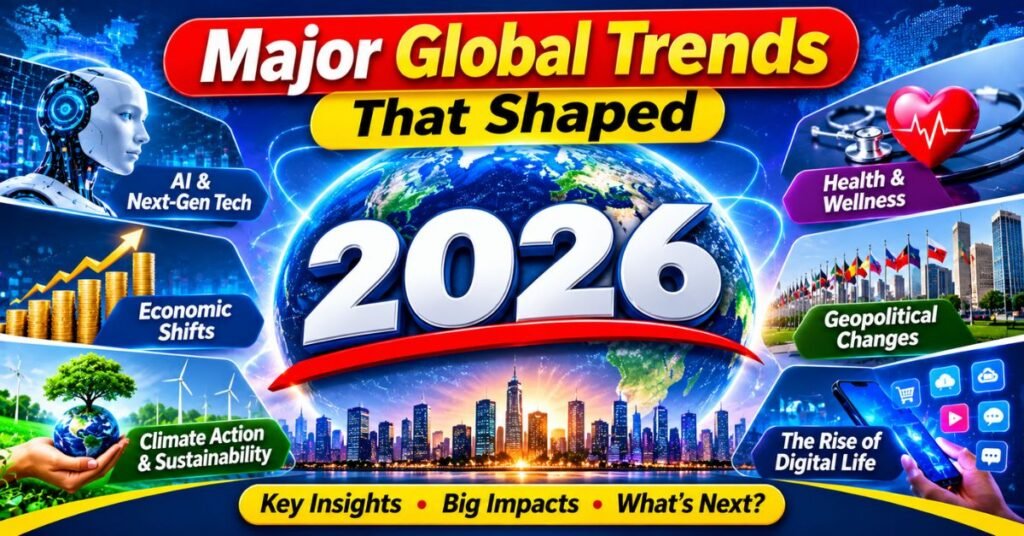
Several global trends and innovations tied the year together. AI moved from lab to daily tool. Clean energy kept growing. Space became crowded with new players. Trade politics shifted fast. These major changes in 2026 also touched population and climate. The UN estimated the world held about 8.2 billion people. Strong future developments in 2026 often came from outside the expected lists.
The table links each trend to its proof. It shows why forecasts based on single events often miss. Trends build slowly and then jump. You rarely see the jump coming. Still, patterns can guide smart decisions. Expected world events worked best when forecasters tracked money, policy, and technology together.
| Trend | Evidence from 2026 | Why it matters |
| AI adoption | Huge investment and new model launches | Changes jobs and products |
| Clean transport | Over 20 million EVs sold worldwide | Cuts oil demand |
| Trade shifts | New US tariffs in April | Alters prices and supply chains |
| Space delays | Artemis and Gateway slipped | Resets lunar timelines |
| Energy security | Baltic grid switch in February | Reduces Russian leverage |
How Accurate Were the Predictions for 2026?
Prediction accuracy varied by topic. Policy and calendar items fared best. The Baltic grid switch happened. Windows 10 support ended. Lunar eclipses occurred in March and September. Technology spending forecasts proved too small. Future Timeline Space and health targets proved too bold. Looking at 2026 predictions compared with actual events, you see a pattern. Fixed dates beat breakthrough dates. The scorecard below shows a sample.
| Prediction | Likelihood | Outcome |
| Baltic States leave Russian grid | 70% | Happened in February |
| Windows 10 support ends | Not stated | Happened in October |
| AI investment reaches $200 billion | 70% | Exceeded |
| Foldable shipments reach million | 80% | Missed (about 20 million) |
| Artemis Moon landing | 70% | Missed |
| ISA finalizes deep sea mining rules | 60% | Missed |
| ETIAS launches | 80% | Delayed |
| Hepatitis C eradicated | Not stated | Missed |
Why do forecasts miss? Timelines slip. Budgets change. Politics intervenes. Some claims, such as nickel running out entirely, were never realistic. The accuracy of past future forecasts reminds you to treat likelihood scores as guides. Historical forecasts and outcomes show the same lesson year after year. Use any long-term global outlook as a map and not a promise.
See Also: E Hall Pass Complete Guide to Features, Benefits, and Student Safety
Frequently Asked Questions
What were the most important predictions for 2026?
The most important predictions for 202 covered AI investment, Moon missions, clean energy growth, and rising cybercrime costs. AI and electric vehicles beat expectations. Space missions and some health goals fell behind schedule.
Which technology trends were predicted for 2026?
Technology and AI predictions for 202 included AI-driven revenue, smart glasses, foldable phones, autonomous cars, and vast connected-device networks. AI and smart glasses delivered. Foldables and self-driving car share lagged.
What were the major economic predictions for 2026?
Global economic forecasts for 202 pointed to growth in AI services, secondhand luxury, ESG investing, freelance work, and crypto finance. AI and resale held up well. ESG and freelancer dominance did not.
How can I compare predictions with actual events?
Start with the original forecast and note its date and target. Then check official sources such as NASA, the IEA, and the UN population data. Mark each claim as achieved, delayed, or missed. That simple habit sharpens your own future forecasting.
Conclusion
The year 2026 proved that forecasts work best as signposts. AI, electric cars, and clean energy raced ahead. Space missions, medical breakthroughs, and some policy goals slipped. Together these Future Timeline 2026 show how technology and politics shape the future in unpredictable ways. That’s the main takeaway from every honest look back.
So what’s next? Keep reading forecasts with curiosity and a healthy dose of doubt. Track the trends instead of chasing single bold claims. Which 2026 prediction surprised you most? Share your thoughts and keep watching how the next year unfolds.