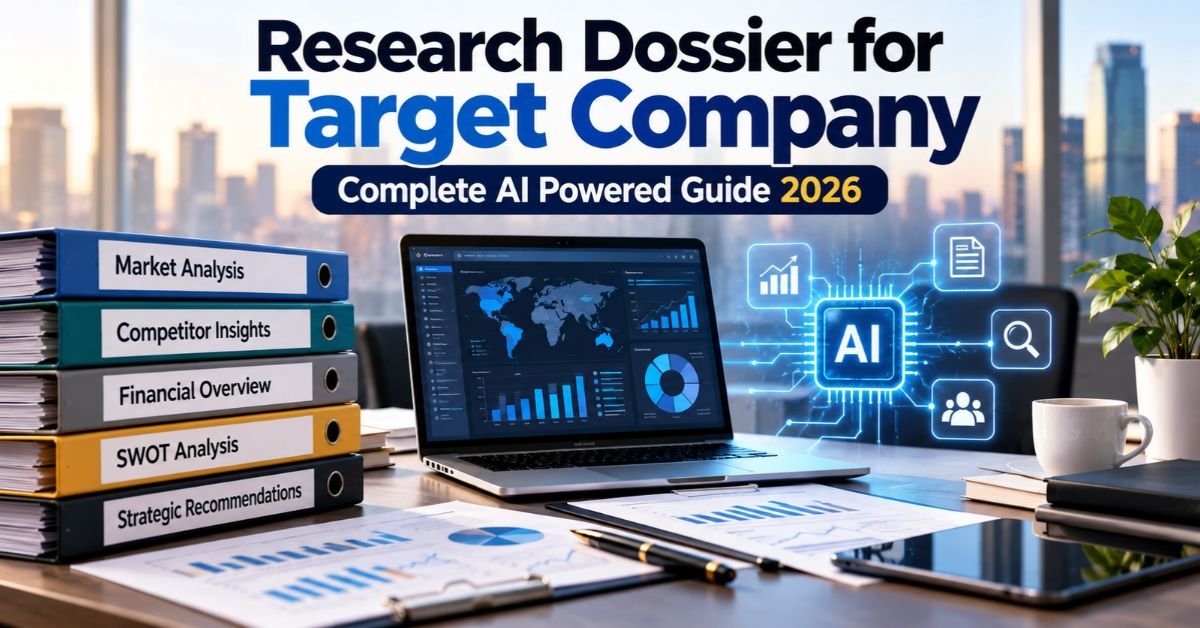
Research Dossier for Target Company Essential Guide to Smarter Business Research in 2026
Picture this. You walk into a big meeting, shake hands, and realize you know almost nothing about the other side. Awkward. Risky too. A Research Dossier for Target Company fixes that problem fast. It gathers the facts you need on one organized page set, so you can act with confidence.
This guide shows you how to research a target company from start to finish. You’ll learn what goes inside a company research report, where to find solid data, and how AI can speed up the work. You’ll also get a ready template and a copy-and-paste prompt.
What Is a Research Dossier for a Target Company?
A target company research dossier is a structured file about one business. It covers the company overview and background, the people in charge, the money, the market, and the risks. Think of it as a business intelligence report built for a single decision. Sales teams, investors, and buyers all use one before they make a move.
A good dossier does more than list facts. It turns scattered notes into clear insight. That’s the heart of corporate intelligence. In 2026, AI-powered company research makes the first draft much faster. Humans still check the facts and decide what matters.
Research Dossier vs. Company Profile
A company profile analysis gives you a quick snapshot. It shows the name, location, size, and main products. A corporate research dossier goes much deeper. It adds evidence, risks, and clear next steps. The table below shows the gap.
| Feature | Company Profile | Research Dossier |
| Depth | Light summary | Deep analysis |
| Purpose | General awareness | Specific decision |
| Evidence | Often missing | Sources and dates included |
| Risks | Rarely covered | Clearly flagged |
| Next steps | None | Recommended actions |
Common Business Use Cases for Company Research
Many teams run company background research for different reasons. Sales reps use company research for sales prospecting to learn a buyer’s goals. Investors need business research for investors before they commit cash. Procurement teams check suppliers. Founders study rivals. Even job seekers use a short dossier to prep for interviews. The goal changes but the method stays the same.
Why Is a Target Company Research Dossier Important?
A company’s website tells a polished story. It rarely tells the whole story. A target company analysis digs under the surface. It can reveal shaky finances, a weak product, or a hidden gem that most people overlook. That’s why smart teams research first and talk second.
A shared dossier also keeps everyone on the same page. Sales, finance, and legal teams then work from the same facts. Nobody repeats work. Nobody argues over whose numbers are right. Strategic business decision-making gets faster and calmer.
Benefits for Business Intelligence and Decision-Making
Good research powers data-driven decision-making. It cuts guesswork. It helps you price deals better and spot trouble early. A solid business investigation report can even save you from a bad partnership. Here’s a short example of how that plays out.
Illustrative case study: A mid-size shipping firm planned to sign a long contract with a young software vendor. A quick dossier showed three things. The vendor had no audited accounts. Its main investor had just exited. Two key engineers had left. The shipping firm asked for a shorter trial instead. Six months later the vendor shut down. The trial cost little. The full contract would have cost a fortune.
How AI Improves Company Research
Automated research tools can scan filings, news, and job pages in minutes. They summarize long reports and compare rivals side by side. This is where research dossier for target company using AI shines. You get a fast first draft and a clear map of what’s missing. Tools for AI-generated business research reports also help you spot patterns across many sources. Speed is the big win. Judgment still belongs to you.
AI Research Limitations and the Need for Human Verification
AI can sound sure while being wrong. It may mix up two companies with similar names. It may quote old numbers as if they’re fresh. It can even invent a source. That’s why fact-checking and source verification must follow every AI draft. Open each link. Match each figure to the original filing. Treat the AI as a quick intern. Treat yourself as the editor.
Essential Components of a Company Research Dossier

Wondering what to include in a company research dossier? Ten building blocks cover almost every case. Each one answers a different question about the business. Together they form a full target business evaluation.
You don’t always need every block at full depth. A quick sales brief may need only a few. A pre-acquisition company assessment needs all ten. The table below gives a fast map.
| Component | Main Question It Answers |
| Overview and business model | What does the company do? |
| Leadership and ownership | Who runs it and owns it? |
| Products and technology | What does it sell? |
| Financials and funding | Is it stable? |
| Market and competitors | Where does it stand? |
| Hiring and news | Is it growing? |
| Reputation | What do people say? |
| Legal and compliance | Is it clean? |
| Risks and opportunities | What could go wrong or right? |
| Executive summary | What should you do next? |
Company Overview and Business Model
Start with the basics. Record the legal name, website, headquarters, founding year, and industry. Then explain the business model and revenue streams. Does the firm sell subscriptions, products, or services? Who pays? How often? This section sets the stage for everything else. Strong company overview and background notes also name the main customers and the problem the firm solves.
Leadership, Ownership, and Organizational Structure
Next, find out who makes the calls. Note the CEO, founders, board members, and senior managers. Check their past roles and any recent changes. Good company ownership research also shows who holds the shares. Study the leadership and organizational structure too. A founder-led startup decides quickly. A large group may spread power across many departments. This is the heart of company ownership and leadership research.
Products, Services, and Technology
Describe what the firm sells and how it stands apart. A solid products and services analysis covers features, pricing, and customer benefits. Note the tech stack and any patents too. Separate proven features from marketing claims. A software firm may win on automation. A factory may win on speed and quality. Always say which claims you’ve verified.
Financial Performance, Funding, and Business Stability
Money tells a lot. Good company financial analysis looks at revenue, profit, cash flow, and debt. Review financial statements and funding history when you can find them. If you’re wondering how to analyze a company’s financial health, watch trends over several years. Rising sales mean little if costs rise faster. For how to analyze a company’s financial performance, note the reporting date and currency. If data is missing, write “undisclosed.” Never write “zero.”
Market Position, Industry Trends, and Competitor Analysis
A firm never operates alone. Study its market position and industry trends first. Then run a competitor research analysis. If you wonder how to evaluate a company’s competitors, compare products, prices, regions, and customer groups. Look at competitors and market share with care. Always name the source of any share estimate. A clear company market positioning analysis shows where the target wins and where it feels pressure. An industry analysis report adds the wider context.
Hiring Activity, Growth Signals, and Recent News
Job posts act like a crystal ball. A burst of hiring in one area hints at a new push. Layoffs hint at trouble. Recent news adds more clues, such as new partners, launches, or funding. Track these signals over time. They fuel your company performance evaluation and show real business growth opportunities before rivals notice them.
Reputation, Customer Reviews, and Public Perception
People talk. Listen carefully. Review customer reviews and brand reputation across many places. One angry post proves little. A repeated complaint across many sources proves a lot. Check how the firm responds to criticism too. Calm, fast fixes build trust. Silence or denial does not. Add dates and sources to every finding.
Legal, Regulatory, and Compliance Risks
Legal checks protect you from nasty surprises. Review legal and regulatory compliance records, including licenses, court cases, and sanctions lists. Confirm you’ve found the right legal entity first. Similar names cause real mix-ups. Never call an allegation a proven violation. Also never assume a company is clean just because you found nothing. For big deals, bring in a lawyer for deeper business due diligence.
Business Risks, Red Flags, and Growth Opportunities
Now pull the findings together. Many readers ask how to identify business risks. Look for heavy debt, falling sales, key-person dependence, and legal trouble. List risk factors and red flags with a rating for each. Then list the upside, such as new markets or strong tech. This balanced view forms a real business risk assessment and a sound corporate risk and opportunity assessment.
Executive Summary and Recommended Next Steps
End with a short summary that busy readers can use alone. State the key points, the main risks, and what to do next. Good executive summary preparation keeps this page to one screen or less. Add confidence labels like high, medium, or low. Then share research findings and recommendations in plain words. Offer research-backed business recommendations that match the goal you set at the start.
Best Sources for Target Company Research
Strong research starts with strong sources. Use reliable data sources first. Then add outside views to test the company’s claims. This mix of primary and secondary research keeps your picture balanced.
Not every source deserves equal trust. Official records beat rumors. Fresh data beats stale data. The table below ranks common source types. It’s a handy guide to reliable sources for company research.
| Source Type | Best For | Trust Level |
| Official filings and registries | Facts, finances, legal status | High |
| Company website and reports | Official claims and strategy | Medium |
| Reputable news and trade media | Context and events | Medium to high |
| Job boards | Growth signals | Medium |
| Patent databases | Technology claims | High |
| Reviews, forums, social media | Public mood | Low to medium |
Official Company Websites and Investor Relations Pages
Start at the company’s own site. Annual reports, press releases, and investor decks live there. They show how the firm wants to be seen. That’s useful but one-sided. Treat these pages as claims to test. Then check them against independent records.
Business Registries and SEC EDGAR Filings
For listed US firms, SEC EDGAR is a goldmine. It holds annual and quarterly reports. For UK firms, try Companies House. The global database OpenCorporates also helps with registrations. These records suit company background checks for businesses and give a firm base for how to verify company information.
Reputable News Outlets and Industry Publications
Trusted news adds outside views. Industry magazines explain trends better than a press release can. Always check the publish date. Old news can mislead. Read more than one outlet on big stories. That habit helps with corporate intelligence gathering and keeps you honest.
Job Postings, Hiring Announcements, and Company Updates
Job boards and career pages reveal plans. A firm hiring data scientists may be building new AI tools. A firm hiring in a new country may be expanding. Save screenshots with dates. Postings vanish quickly. They make great proof for your corporate strategy research.
USPTO, Google Patents, and Technology Research Sources
Do the tech claims hold up? Search USPTO and Google Patents to find out. Patents show what a firm has actually protected. Filing trends also hint at future products. This step is vital for tech-heavy targets.
Review Websites, Forums, and Social Media
These sites show raw public feelings. They’re noisy. Some reviews are fake. Others are outdated. Look for patterns across many posts rather than single stories. Use them to guide questions. Never use them as final proof.
How to Evaluate Source Credibility and Reliability
Ask four quick questions. Who wrote it? When was it written? Does another source agree? Does the writer gain from the message? Strong citations and source credibility protect your report. They also protect your reputation. A source that fails these checks should stay out of the final file.
How to Build a Research Dossier for a Target Company
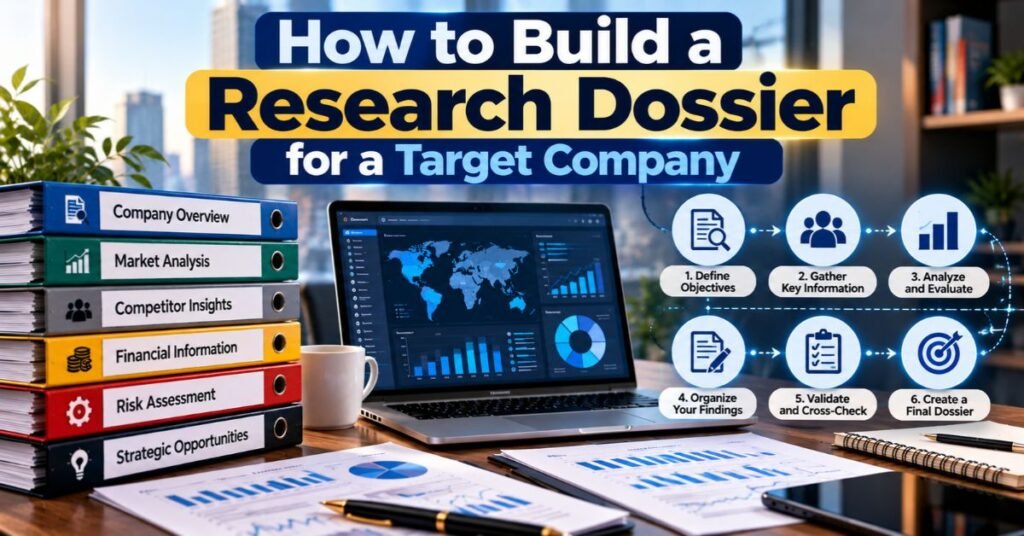
Curious about how to create a research dossier for a target company? Follow a repeatable path. This step-by-step company research process works for small and large projects alike. It also forms a simple company research methodology you can reuse.
Eight steps cover the whole job. You can finish a light version in an afternoon. A deep business due diligence review may take weeks. The steps stay the same. Only the depth changes. This is also the core business intelligence research process.
See Also: TheStripesBlog Com Contact Guide Email Phone and Official Details
Step 1: Define the Research Objective
Ask one question first. What decision will this dossier support? A sales brief needs different facts than a buyout review. Write the goal in one sentence. List the key questions too. A clear goal keeps the report sharp and short.
Step 2: Identify the Target Company
Confirm exactly which company you mean. Many firms share similar names. Check the legal name, country, and registration number. Note parent companies and subsidiaries as well. Skipping this step causes the most painful errors.
Step 3: Create a Standardized Research Outline
Build a set outline before you collect data. Use the ten components above. A fixed layout makes different dossiers easy to compare. A good company research template also saves time on every future project. It acts as your target company evaluation framework.
Step 4: Collect Information from Reliable Sources
Now gather the facts. Begin with official records. Add news, patents, and hiring data next. Take notes as you go. Mark which items come from the company and which come from outsiders. This is the practical side of primary and secondary research.
Step 5: Record Evidence, Dates, and Citations
Log every finding with its source, date, and link. Good evidence collection and documentation lets anyone retrace your steps. It also makes research report updates much easier later. If you’re unsure how to verify company data and research citations, start with this log. Note reporting periods for every number.
Step 6: Verify Facts and Cross-Check Important Claims
Check every key claim with a second source. Official filings can confirm a revenue figure. News can confirm a leadership change. Use the old saying: “Trust, but verify.” When sources disagree, record the conflict. Never hide it. Rate your confidence as high, medium, or low.
Step 7: Analyze Findings, Risks, and Opportunities
Now ask what the facts mean. Does the data support the goal? Weigh strengths against weaknesses. Tie each risk to evidence. Keep guesses clearly labeled. This stage drives company analysis for investment decisions and other research-backed business recommendations.
Step 8: Prepare the Final Report and Update Schedule
Write the summary first. Follow with the detailed sections. Follow a clear company research report format: summary, findings, risks, recommendations, and sources. Date the report. Then set a refresh plan. Fast-moving firms may need monthly checks. Stable ones may need only yearly updates.
How to Create a Target Company Research Dossier Using AI
AI changes the pace of research. Tasks that once took days now take hours. Yet speed alone doesn’t make a good report. The best results come from teamwork between tools and people.
The winning recipe is simple. Let AI collect and draft. Let humans verify and judge. This mix gives you AI-powered company research you can trust. It also frees your time for real analysis.
Choose the Right AI Research Tools
Pick tools that show their sources. Fresh data matters too. Look at privacy rules before you upload anything sensitive. Many AI tools for company analysis exist. Some browse the web. Others plug into financial databases. Match your business intelligence tools to your goal and budget.
Generate the Dossier Section by Section
Don’t ask for everything at once. Request one section at a time. Start with the overview. Move on to leadership, finances, and so on. Short tasks give cleaner answers. They also make errors easier to spot. Each section then slots neatly into your template.
Verify AI-Generated Facts and Citations
Open every link the AI gives you. Make sure the page really says what the AI claims. Match numbers to original filings. Watch for mixed-up company names. Delete anything you can’t confirm. This step turns a rough draft into a reliable file.
Use AI to Identify Patterns, Risks, and Business Opportunities
AI shines at spotting patterns. It can compare ten years of filings in seconds. It can flag odd shifts in hiring or sales. Ask it to list possible risks and openings. Then test each idea against real evidence. That’s how you get a sharper corporate risk and opportunity assessment.
Research Dossier for Target Company Practical Template
A ready template saves hours. It also keeps your work consistent. The layout below suits most projects. Trim it for quick jobs. Expand it for big ones. Think of it as a flexible target company research dossier template.
Light versions may run two or three pages. Deep versions can fill dozens. Always match the length to the decision. A longer report isn’t always a better one. A company research dossier template works best when you adapt it to your goal.
See Also: Pappedeckel The Ultimate Guide to Meaning, Uses, and Benefits 2026
| Section | What to Record |
| Company identity | Legal name, website, registration, HQ |
| Business overview | Industry, model, products |
| Leadership | Executives, founders, owners |
| Financials | Revenue, profit, debt, funding |
| Market analysis | Trends, segments, reach |
| Competitors | Rivals, strengths, weaknesses |
| Reputation | News, reviews, concerns |
| Legal and compliance | Licenses, cases, sanctions |
| Opportunities | Partnerships, sales angles |
| Risks | Verified concerns |
| Sources | Links, dates, periods |
| Recommendations | Next steps, open questions |
Company Information and Business Overview
Fill in the identity facts first. Add the website, headquarters, industry, and founding year. Describe the business model in two or three sentences. List main products and key customer groups. Keep each entry short and sourced.
Financial, Market, and Competitive Analysis
Record revenue, profit, debt, and funding rounds with dates. Add market size and growth trends. Then build a small rival table with prices, products, and reach. This section feeds your market research report view of the target. Mark every estimate clearly as an estimate.
Risk Assessment and Key Findings
List each risk with its source and a confidence label. Group them as financial, legal, operational, or reputational. Add the big strengths beside them. This balanced block forms the core of your business risk assessment. It helps readers see the full picture fast.
Recommendations and Next Steps
Close with clear actions. Say whether to proceed, pause, or dig deeper. Name open questions that still need answers. Add the review date. Strong recommendations tie back to the original goal.
Copy-and-Paste AI Prompt for a Company Research Dossier
Vague prompts give vague answers. A clear AI prompt for target company research gives you structure, sources, and honesty. It tells the AI what to cover and how to behave. That’s the secret to useful output.
Change the brackets to fit your case. Add your goal, region, and time frame. You can also paste the template headings below the prompt. Run it section by section for better accuracy.
Ready-to-Use Target Company Research Prompt
Paste the text below into your AI tool and fill in the brackets.
Act as a business research analyst. Build a research dossier for [Company Name], website [URL], based in [Country]. My goal is [sales prospecting / investment screening supplier check acquisition review]. Cover these sections one at a time: company overview and business model, leadership and ownership, products and technology, financial performance and funding, market position and competitors, hiring and recent news, reputation and reviews, legal and compliance, risks and opportunities, and an executive summary with next steps.
Use only reliable sources such as official filings, company reports, and reputable news. Give a source link and date for every key fact. Label each finding with high, medium, or low confidence. If data is missing, write “unavailable” instead of guessing. Confirm you have the right legal entity before you start. Finish with open questions I should verify.
Common Mistakes to Avoid When Preparing a Company Dossier
Even smart teams slip up. Most errors come from rushing. Some come from trusting one source too much. A little care prevents nearly all of them.
The costliest mistake is treating silence as safety. No public record doesn’t mean no risk. Another is trusting AI output without checking. The table below lists common errors and quick fixes. Use it as a final target company due diligence checklist.
| Mistake | Quick Fix |
| Relying only on the company website | Add independent sources |
| Using old data without dates | Log every date and period |
| Treating estimates as audited facts | Label estimates clearly |
| Mixing up similar company names | Confirm the legal entity first |
| Trusting AI without checks | Verify every figure and link |
| Assuming no news means no risk | Write “unavailable,” not “safe” |
| Padding the report with filler | Keep only decision-ready facts |
Who Should Use a Target Company Research Dossier?
Many roles gain from this tool. Anyone who must judge a business before acting can use it. The depth should match the stakes. A small outreach email needs a short brief. A major deal needs far more.
The dossier doesn’t replace expert advice. It prepares you for it. You’ll ask better questions and waste less time. That makes every later conversation sharper.
Investors and Financial Analysts
Investors use dossiers to screen ideas before formal review. A clear file shows growth, debt, and leadership quality at a glance. It supports how to identify risks before investing in a company. It also speeds up early rounds of business research for investors.
Business Development and Sales Teams
Sales teams use a company research dossier for business development to learn buyer goals and pain points. They spot decision-makers and tailor their pitch. A short brief can lift reply rates sharply. Prepared reps sound like partners rather than pushy strangers.
Consultants, Researchers, and Entrepreneurs
Consultants turn dossiers into client-ready reports. Researchers use them to keep evidence tidy. Entrepreneurs use them to study rivals and test new markets. A shared format also helps teams compare many targets fairly.
See Also: 11+ MagFuseHub Com Complete Guide to Its Content Features and Benefits
Frequently Asked Questions
How to write a research dossier?
Set a clear goal first. Then gather facts from official and independent sources. Organize them under fixed headings such as overview, leadership, finances, market, risks, and sources. Verify key claims. Finish with a short executive summary and clear next steps.
What is an example of a dossier?
A sales team might build a five-page dossier on a prospect. It would include the company overview, key contacts, tech stack, recent news, and buying signals. An investor’s version would add deeper finances and legal checks.
How to prepare a dossier?
Define the decision it must support. Pick the right company entity. Use a template to collect facts. Log every source with a date. Cross-check the big claims. Analyze risks and chances. Then write and date the final report.
How do I format a dossier?
Open with an executive summary. Follow with short sections using clear headings. Use tables for finances and competitors. Place sources at the end. Add confidence labels and a review date. Keep sentences simple and the layout clean.
Conclusion
A strong target company research dossier turns scattered facts into clear action. It covers the business, the people, the money, the market, and the risks. With reliable sources and careful checks, it supports smarter strategic business decision-making.
AI makes the work faster. People make it trustworthy. Define your goal, use the template and prompt above, and verify every key fact. Then update the file as things change. That habit gives you a lasting edge in any deal.