
SFM Conpile The Complete Beginner’s Guide to Model Compilation 2026
You drag a shiny new character into Source Filmmaker. Instead of a hero you get a purple-and-black blob. Sound familiar? Almost every animator has been there. The fix is a step called SFM compile. This beginner guide to SSFM Conpile shows you how to turn raw 3D files into working Source Filmmaker assets. You’ll meet the tools and the files. You’ll also learn how to fix the errors that trip up newcomers. Grab a coffee and let’s get started.
What Is SFM Compile and How Does It Work?
So, what is SFM compile? It’s the process of turning raw 3D data into files that Source Filmmaker can read. Your mesh, skeleton, and textures start in a tool like Blender. Source Filmmaker (SFM) can’t open those files directly. It runs on the Valve Source Engine, and that engine expects its own formats. SFM model compilation is the bridge between the two worlds. Think of it as baking a cake. Your mesh and textures are the ingredients. The QC script is the recipe. The compiler is the oven. The finished compiled MDL files are the cake.
How SFM compilation works is simple once you see the chain. You export a mesh as an SMD or DMX file. You write a script that describes the model. Then a compiler reads that script and builds the final files. This is the heart of Source engine model compilation. The flow below shows the whole Source Filmmaker model compilation process at a glance.
3D model (Blender) → SMD / DMX export → QC script → Studiomdl compiler → MDL + VVD + VTX + PHY → SFM
Why Is SFM Compile Important for Source Filmmaker?
Without compiling, SFM custom models simply don’t exist. SFM ships with a limited set of characters and props. Everything else comes from the community or from your own hands. SFM model creation lets you build unique heroes, villains, and sets. It also lets you shape details like hitboxes, physics, and skins. A good compile gives you full control over how a model looks and moves.
Compiling matters for another reason too. It makes SFM Conpile possible for the whole community. Creators share Source Filmmaker assets on sites like the Steam Workshop and many fan hubs. You can only use them if you know how to place and test compiled files. Learn this skill once and a huge library opens up. Your SFM animation models will also run smoothly instead of crashing your scene.
Essential Tools and Software for SFM Compile
The good news first: most Source engine tools are free. You don’t need a pricey studio suite. Tools required for SFM compilation fall into four groups. You need a compiler and a friendly front end. You also need a 3D editor and a texture converter. The table below sums up the core kit.
| Tool | Main job | Cost | Skill level |
| Studiomdl | Builds the final model files | Free (comes with SFM) | Medium |
| Crowbar | Friendly compiler window and decompiler | Free | Beginner |
| Blender | Modeling, rigging, exporting | Free | Beginner to advanced |
| VTFEdit | Converts images to VTF textures | Free | Beginner |
Pick one tool per stage and you’ll avoid overwhelm. Many beginners try five programs at once and get lost. Start small and add tools as your needs grow. The Source SDK also holds helpful extras. You can read more on the Valve Developer Community site.
Source Filmmaker and Studiomdl
The Studiomdl compiler is Valve’s own command-line program. It ships with Source Filmmaker, so you already own it. How to use Studiomdl compiler is easy to explain. You point it at a QC file and it reads every instruction inside. Then it builds the model and writes the output files. It prints a log as it works. That log is your best friend when something goes wrong. Some older tools wrap it in a window, like GUIStudioMDL. You can read the official notes on the Studiomdl page.
Crowbar for Model Compilation
Crowbar is the favorite Crowbar model compiler for newcomers. It wraps Studiomdl in a clean window with buttons. You pick your QC file and choose Source Filmmaker as the game setup. Then you press compile and watch the log. Crowbar can also decompile existing models back into source files. That helps you learn how other creators build theirs. You can grab it from the Crowbar GitHub page.
Blender for 3D Model Preparation
Blender is the go-to editor for Blender SFM models. It’s free and it has a huge community. A free add-on called Blender Source Tools adds SMD and DMX export. With it you can model, rig, and export in one place. This makes preparing 3D models for Source Filmmaker much simpler. You get a clean path from sculpt to SFM model exporting.
Other Tools for Texture and File Conversion
Textures need their own tools. VTFEdit turns PNG or TGA images into Valve’s texture format. It also helps you make the matching material files. SFM texture conversion is a small step with big results. A text editor like Notepad++ also helps for editing QC and VMT files. An image editor such as GIMP can resize and clean your artwork first.
Key Files and Formats Used in SFM Compile
Before you compile anything, learn the file types. Source engine model file formats may look scary at first. Each one has a clear job. Some come from you. Others come from the compiler. The table below gives you a map.
| Format | Full name | Role | Made by |
| SMD | Studio Model Data | Mesh, skeleton, animation | You (export) |
| DMX | Data Model Exchange | Advanced mesh and facial data | You (export) |
| QC | Model configuration script | Tells the compiler what to do | You (text file) |
| VTF | Valve Texture Format | The image itself | You (convert) |
| VMT | Valve Material Type | Material settings | You (text file) |
| MDL | Model file | Main compiled model | Compiler |
| VVD | Vertex data | Vertex information | Compiler |
| VTX | Model optimization data | Rendering and LOD data | Compiler |
| PHY | Physics data | Collision shape | Compiler |
Keep this table handy as you work. Models and maps use different files, so don’t mix them up. A model builds into compiled MDL files and their companions. The BSP format belongs to maps only. Mixing these two ideas is a common beginner mistake.
SMD and DMX Model Files
SMD model files are simple text files that hold a mesh, a skeleton, or an animation. They’re easy to export and widely supported. The DMX model format is newer and more flexible. It handles advanced rigs and facial flex data better. Many creators use SMD for props and DMX for faces. Either way, you must export one of them before compiling. Blender does not feed raw FBX files to the compiler.
QC Configuration Files
A SFM QC file is the blueprint for your model. It’s plain text with short commands. It sets the model name and the mesh files. It also lists materials, animation sequences, and hitboxes. Creating QC configuration files is easier than it sounds. You can learn the full command list on the QC reference page. One wrong line can stop the whole compile.
VTF and VMT Texture Files
A VTF file holds the picture. A VMT file tells the engine how to use that picture. Together they make a material. The VMT points to the VTF through a path. If that path is wrong you get pink textures. Keep texture resolution in a power of two such as 512 or 1024. That avoids odd conversion problems.
MDL Compiled Model Files
The MDL file is the main output of your compile. It sits beside a few helper files. The VVD file stores vertex data. The VTX files hold model optimization data. The PHY file stores physics. Together they form the full model. SFM needs all of them in the same folder to load the asset.
SFM Compile Process Step by Step Guide for Beginners
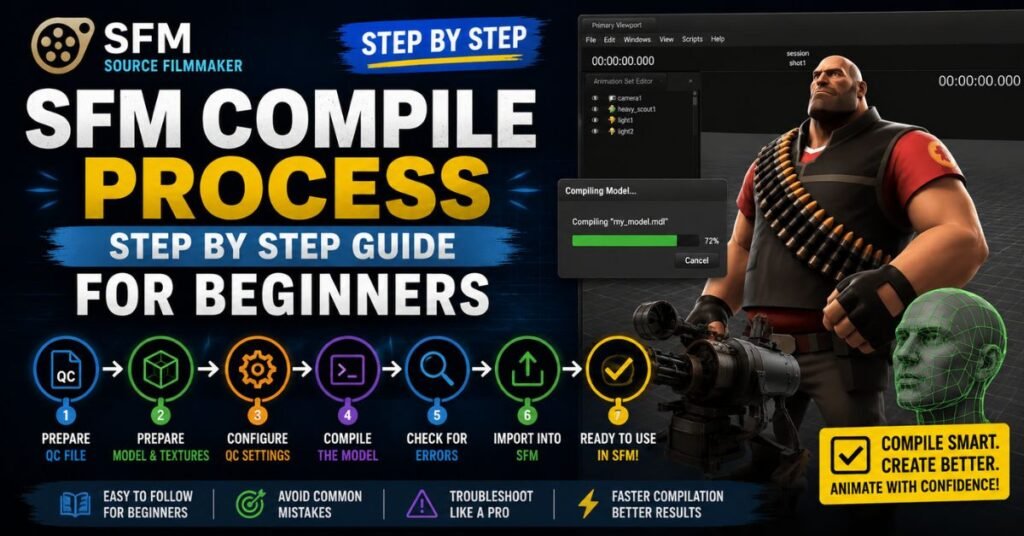
Ready to try it? This SFM compile tutorial walks you through the whole path. It answers how to compile models in SFM with a clear seven-step order. A small prop may take under an hour. A full character can take a weekend. Follow the steps in order and don’t skip ahead. Each one builds on the last.
Here’s the quick version. Prepare the model. Export it. Convert the textures. Write the QC file. Run the compiler. Test the result. Fix what breaks and repeat. You’ll loop through steps 5 to 7 many times. That’s normal. Even pros recompile dozens of times. This also works as an SFM compile tutorial for beginners 2026 for anyone starting fresh.
Step 1: Prepare Your 3D Model
Start in Blender and clean your mesh. Remove hidden faces and stray vertices. Apply all transforms so scale reads as one. Check the skeleton setup next. Name your bones clearly and keep the hierarchy simple. Add bone weighting so the mesh bends the right way. Good animation rigging now saves hours later. This is the heart of preparing 3D models for Source Filmmaker.
Step 2: Export the Model to SMD or DMX
Now export the work. This is exporting models from Blender to SMD using the Source Tools add-on. Choose SMD for simple props. Choose DMX when you need facial flexes. Export the reference mesh first. Then export any animation files separately. Keep your folders tidy so the QC file can find everything. This covers how to convert SMD files for Source Filmmaker from a Blender project.
Step 3: Convert and Configure Textures
Textures come next. Converting textures for Source Filmmaker means turning images into VTF files. Open VTFEdit and import your PNG or TGA. Save it as a VTF in your materials folder. Then write a VMT file for each material. This is your material configuration step. Here’s a tiny example for how to fix pink textures in Source Filmmaker later: the $basetexture line must match your folder path exactly.
See Also: Jim Taiclet and Martin Scorsese 5 Surprising Facts Explained 2026
“VertexLitGeneric”
{
“$basetexture” “models/mycreator/hero/hero_body”
}
Step 4: Create and Configure the QC File
This step covers how to create a QC file for SFM models. Open a text editor and write a few short commands. You’ll name the model and list the mesh. You’ll also set the material folder and one idle sequence. This is QC file scripting at its simplest. Mistakes here cause invalid QC commands errors.
$modelname “mycreator/hero.mdl”
$bodygroup “body” { studio “hero_ref.smd” }
$cdmaterials “models/mycreator/hero/”
$sequence idle “hero_idle.smd” loop fps 30
$surfaceprop “flesh”
Step 5: Run the Studiomdl Compiler
Time to build. Here’s how to compile models using Crowbar. Open Crowbar and go to the Compile tab. Choose your QC file. Pick Source Filmmaker as the game setup. Press Compile and watch the log. If you prefer the command line you can run Studiomdl directly with the QC path. The tool then writes your files. This is real model compilation in action. For deeper reading on how to use Crowbar to compile SFM models, visit its GitHub page.
Step 6: Test the Compiled Model in SFM
Next comes model testing inside SFM. This answers how to install compiled models in SFM. Copy your files into the usermod folder of Source Filmmaker. Keep the models and materials folders in the right places. Then open SFM and look in the model browser. That’s SFM model installation in a nutshell. Knowing how to test compiled models also means checking size, textures, and posing. Move a few bones and look for stretching.
Step 7: Fix Errors and Recompile Your Model
Expect some bumps. Read the log from the top and fix the first error first. Many later errors vanish once the first one is gone. Change one thing at a time and recompile. This habit keeps your SFM model troubleshooting clean. It’s also the best way to learn how to fix SFM compile errors for good.
Common SFM Compile Errors and How to Fix Them
Almost everyone meets SFM compilation errors at some point. Don’t panic. Most trace back to paths, names, or scale. The table below lists the usual suspects and quick fixes. Use it as a cheat sheet for common Source Filmmaker compilation problems.
| Symptom | Likely cause | Quick fix |
| Pink-black checkerboard | Wrong material path | Match $cdmaterials to your folder |
| Model stretches or collapses | Missing or bad bones | Recheck names and weights |
| Giant or tiny model | Scale mismatch | Fix scale in Blender or QC |
| Model not found | File in wrong folder | Move files to the right path |
| Compiler stops with error | Bad QC line or missing file | Read the log and fix line one |
Think of the log as a detective’s notebook. It tells you where the trail goes cold. Work through one clue at a time. You’ll solve the case faster that way.
Pink and Black Checkerboard Texture Problems
This is the classic one. Resolving pink and black checkerboard textures starts with the material path. The engine can’t find your VMT or VTF file. Open the QC file and check $cdmaterials. Then check the $basetexture line in the VMT. Both paths must match the real folder tree. This also covers fixing missing model textures in general. The fix is nearly always a path or a missing file.
Missing Bones and Broken Skeletons
Bone trouble makes a model twist into odd shapes. Start by checking bone names. Valve rigs use set names for many parts. Then check that every bone has weight data. A model without a proper skeleton may refuse to animate. This is the main idea behind fixing missing bones in SFM models. It’s also how to troubleshoot missing bones in SFM models step by step. Compare your rig to a working one when you feel stuck.
Model Scaling and Alignment Issues
Scale trouble is easy to spot. Your model appears huge or tiny. Sometimes it doesn’t appear at all. Source uses its own units, and about 16 units equal one foot. Check your Blender scale and your export settings. You can also use the $scale command in the QC file. Make sure the model faces the right way and sits at the origin.
Missing Files and Incorrect File Paths
Many failures come from file path configuration mistakes. A single wrong slash can break the build. Avoid spaces and odd characters in folder names. Use forward slashes in QC and VMT files. These are missing dependencies in the classic sense. The compiler can’t find a mesh or a sequence file. Keep everything in one organized project folder to stay safe.
Studiomdl Compiler Crashes and Failed Builds
A compilation failure can feel dramatic. Yet the cause is often small. Scroll to the first error line in the log. It usually names the file or command at fault. This is how to fix Studiomdl compilation errors in practice. Check limits too. Source has a bone cap near 128 per model. Overly heavy meshes can also cause trouble. Fix one issue and run the compile again.
Best Practices for Successful SFM Conpilation
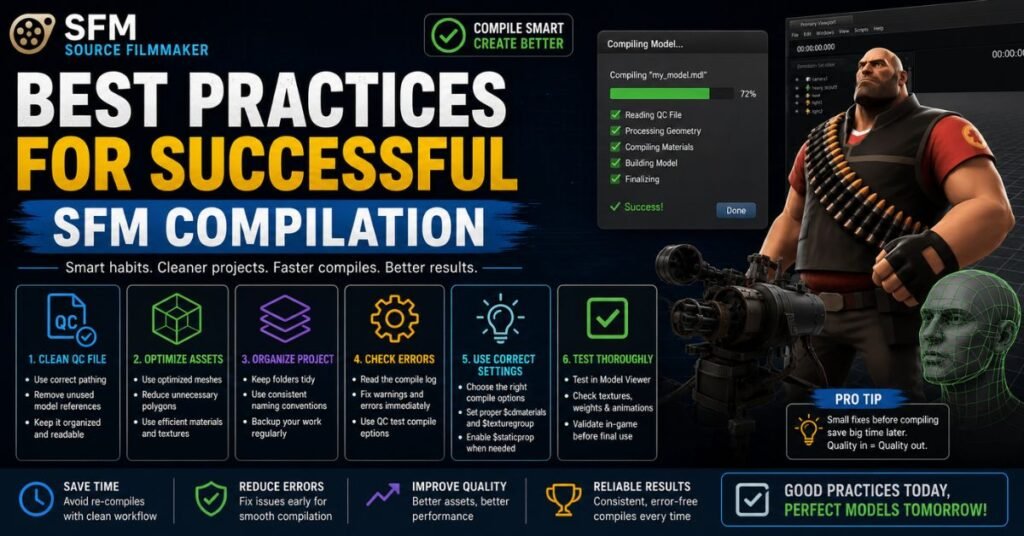
Good habits beat clever tricks. A tidy workflow prevents most problems before they start. These Source Filmmaker compile habits cost almost nothing. Yet they save hours of frustration. Treat each project like a small workshop. Keep tools in their place and label everything.
The best tip is to test early and test often. Compile a rough version first. Check it in SFM. Then add detail in small steps. A broken tiny model is easy to fix. A broken giant one is not. This slow-and-steady approach is also the best form of SFM model optimization for beginners.
See Also: SFM Compile The Ultimate Beginner’s Guide to Model Compilation 2026
Organize Model and Texture Directories
Use one main folder per project. Inside it keep subfolders for meshes, textures, and QC files. Mirror that layout in your materials folder. This makes paths short and easy to remember. Clear names help a lot too. Try hero_ref.smd instead of final_final2.smd.
Check QC File Settings Before Compilation
Read your QC file once before every compile. Check the model name and the mesh names. Confirm the material path and the sequence names. Look for typos in command words. A two-minute check can prevent a ten-minute headache. Keep a simple template and reuse it for each new project.
Maintain Proper Model Scale and Bone Structure
Use a reference model to check size. A default SFM character works well. Keep bone names consistent across every file. Don’t rename bones after you export animations. That breaks the link between the rig and the motion. Stable bone structure also keeps your SFM animation models easy to pose.
Test Models Before Using Them in Animations
Never trust a model until you test it. Load it in a blank scene. Add a light and a camera. Pose the arms and legs through their full range. Check faces and hands for stretching. Fix problems now rather than after you animate a full shot.
Advanced SFM Compile Techniques and Optimization
Once your first model works, you can level up. Advanced SFM model compiler skills give you more polish. You can add skins and extra body parts. You can improve materials and cut waste. These tricks turn a basic model into a pro-grade asset. They also help you learn how to optimize custom SFM models.
The key is to change one thing at a time. Compile after each change. Keep backups of working versions. That way you can always roll back. A small experiment is a safe experiment.
Custom Model Configuration
Bodygroups let you swap outfits or hair on one model. Skins let you change a material set. Attachments add points for weapons or hats. A physics model gives you proper collisions. All of these live in the QC file. Careful model compatibility planning also helps. Keep rigs similar if you want to share animations between models.
Improving Texture and Material Quality
Better materials make a model pop. Add a normal map for fine surface detail. Use a specular or phong setting for shiny skin or metal. Watch your texture resolution though. A 4096 texture looks lovely but costs memory. Many creators stick with 1024 or 2048 for characters. Balance beauty with speed.
Reducing Model Complexity and Compile Time
Heavy models slow everything down. Polygon optimization is the cure. Remove hidden faces and tiny details nobody will see. Use normal maps instead of dense geometry. You can also add level-of-detail meshes for distant shots. Simple models compile in seconds. Complex ones may take several minutes. Lean models also render faster in your scenes.
Reusing and Updating Compiled Models
You don’t have to start from zero each time. Save a QC template for each model type. Use Crowbar to decompile your own old models for edits. Keep a version number in your file names. When you update a model, recompile and replace the old files. Always check licenses before you reuse work from other creators.
SFM Compile Tools and Workflow What Beginners Should Know
Here’s the full picture. Your SFM model compiler workflow runs from Blender to Source Filmmaker. You model and rig in Blender. You export to SMD or DMX. You convert textures in VTFEdit. You write a QC file. Then you compile with Crowbar or Studiomdl. Each tool has a single job. That clarity keeps beginners calm.
A simple setup is enough to start. Install SFM, Blender with the Source Tools add-on, Crowbar, and VTFEdit. Bookmark the Valve Developer Community and the Crowbar page. Make a practice folder and try a simple cube as your first prop. Small wins build confidence fast. Then move on to full characters.
Here’s a short example scenario. Imagine a beginner named Sam who builds a simple crate. The first compile shows pink textures. Sam checks the log and sees the material path is wrong. A one-line fix in the QC file solves it. The second compile works. Sam learns more from one small error than from a long video.
See Also: Online PlayMyWorld Games, Features, Safety & Latest Gaming Updates 2026
SFM Compile vs. Source 2 Compilation Key Differences
The difference between SFM and Source 2 is bigger than it looks. SFM runs on the older Source engine. It uses SMD or DMX meshes, QC scripts, and MDL output. Source 2 games use a different pipeline. They rely on tools like ModelDoc with VMDL files and compiled files such as vmdl_c. Materials use VMAT instead of VMT. The two systems do not swap files freely.
This matters if you want to use newer Valve games. A QC file will not work in the Source 2 toolset. Textures and rigs also need new setup. As far as public information shows, SFM itself stays tied to the original engine. The table below compares the two sides.
| Feature | SFM (Source) | Source 2 |
| Mesh export | SMD, DMX | DMX, FBX and others |
| Script | QC file | ModelDoc (VMDL) |
| Model output | MDL, VVD, VTX, PHY | Compiled vmdl_c |
| Material | VMT and VTF | VMAT and compiled textures |
| Works in SFM | Yes | No |
Frequently Asked Questions
Do I Need Coding Experience to Use SFM Compile?
No, you don’t. A QC file is just plain text with short commands. You copy a template and change a few names. Most beginners feel comfortable after a few hours. Basic comfort with folders and file names helps more than any coding skill.
How Long Does SFM Compilation Usually Take?
Simple props compile in seconds. Detailed characters with many sequences can take a few minutes. Model size, animation count, and physics all change the time. Trim extra polygons to speed things up.
What File Formats Does SFM Compile Generate?
The compiler builds an MDL file plus helper files. You’ll usually see VVD, VTX, and PHY files beside it. Some projects also create ANI files for animation data. All of them must stay together in the same folder.
Can I Compile a Model Without a Skeleton?
Yes, for simple props. A static prop still needs a single root bone. Blender Source Tools can add it for you. The QC file may also use a static prop setting. Characters need a full skeleton to pose and animate.
Why Does My Model Not Appear in Source Filmmaker?
The files are probably in the wrong folder. Check that the MDL and its helper files sit in the usermod models path. Confirm that the compile finished without errors. Then restart SFM and refresh the model browser. Also check your model path in the QC file.
Is Crowbar Better Than Studiomdl for Beginners?
Crowbar is easier to use since it has a window and a clear log. It actually runs Studiomdl behind the scenes. So you use both at once. Most beginners start with Crowbar and learn the command line later.
Can I Use Models From Other Games in SFM?
Sometimes you can. Models from other Source games can be decompiled with Crowbar and recompiled. Models from other engines need conversion first. Always check the license and the creator’s rules before you share or sell anything.
Does SFM Compile Support Source 2 Games?
No. SFM compile fits the original Source engine pipeline. Source 2 uses different tools and file types. Newer games like Half-Life: Alyx need their own workflow.
Final Thoughts
You now know the whole path from mesh to finished asset. Prepare the model. Export it to SMD or DMX. Convert the textures. Write the QC file. Compile with Crowbar or Studiomdl. Test it in SFM and fix what breaks. Each loop makes you faster. That’s the real secret behind every great SFM compile.
So start small. Compile a simple prop today. Celebrate when it shows up in your scene. Then try a character tomorrow. Every pro animator began with a pink checkerboard. You’ll be turning out polished SFM custom models before you know it. Happy animating.