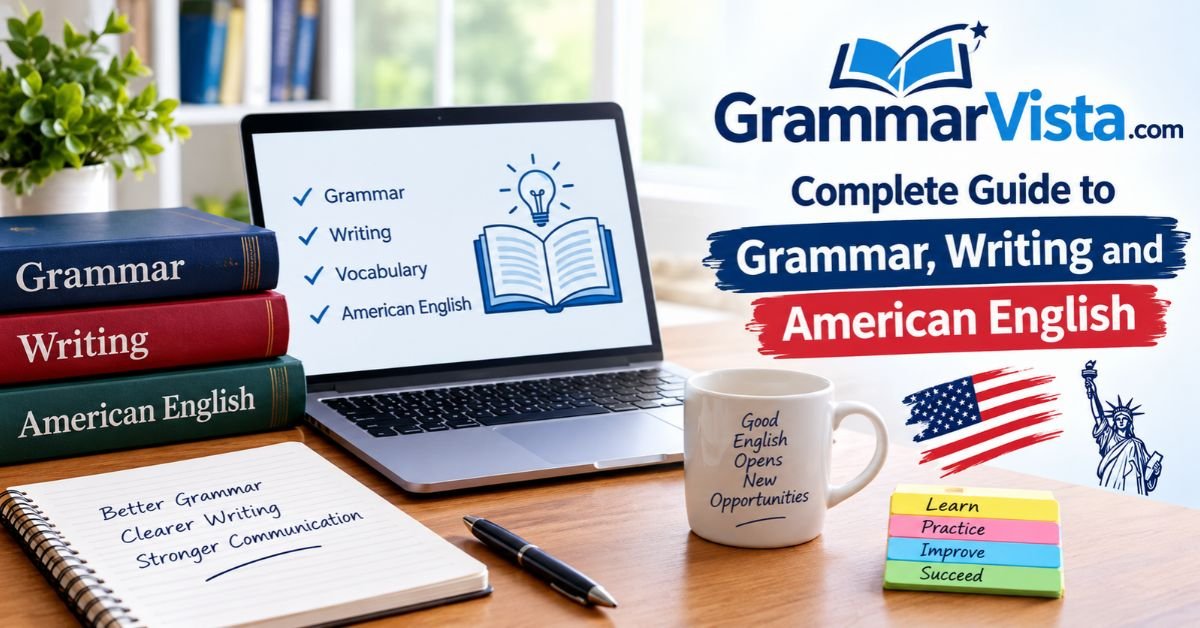
12+ GrammarVista Com USA Complete Guide to Grammar Writing and American English
You’ve just typed a sentence. Something feels off. Is it its or it’s? That tiny doubt slows down writers every single day. GrammarVista.com USA speaks to exactly that moment. The GrammarVista Com USA offers English grammar guide content on punctuation, vocabulary, possessives, and sentence structure. Read on for the full picture. You’ll learn what the site offers and how American English works. You’ll also pick up simple habits that sharpen your English writing improvement from day one.
What Is GrammarVista.com USA?
GrammarVista.com USA points to GrammarVista.com and its American-English-focused writing resources. It isn’t a separate U.S.-only site. The homepage lists categories such as Grammar, Punctuation, Compound Words, Possessives, and Sentence Structure. Think of it as a grammar learning platform for readers who want quick and clear answers. Students, workers, and bloggers all search for this kind of help.
A fair GrammarVista.com review stays honest. The homepage also carries posts on unrelated subjects such as business, health, and gardening. So treat the grammar pages as the core value. Check each page for freshness before you rely on it. That habit protects your writing accuracy and readability no matter which site you use.
GrammarVista.com USA at a Glance
The table below shows the main areas a reader can explore. Each row links a topic to a real writing need. Scan it to find your starting point.
| Topic | What It Covers | Why It Matters |
| English Grammar | Verbs, nouns, pronouns, clauses, and agreement | Builds accurate sentences |
| Punctuation | Commas, apostrophes, colons, and quotation marks | Prevents confusing meaning |
| Vocabulary | Definitions, synonyms, and contextual usage | Sharpens word choice |
| Sentence Structure | Fragments, run-ons, and sentence patterns | Makes writing easy to read |
| Possessives | Apostrophes and ownership forms | Stops common errors |
| Compound Words | Open, closed, and hyphenated forms | Improves spelling |
| American English | U.S. spelling and conventions | Helps you reach U.S. readers |
| Professional Writing | Emails, reports, and workplace messages | Creates a polished image |
| Academic Writing | Formal tone, transitions, and clarity | Strengthens assignments |
| Everyday English | Common phrases and confusing words | Eases daily communication |
Pick the row that matches your goal. A student might start with academic writing. A job seeker might jump to professional writing. Everyone benefits from the punctuation and commonly confused English words rows. These topics show up in almost every document you’ll ever write.
What Can You Do on GrammarVista.com?
A visit to the GrammarVista website can serve several goals. You can study rules and compare similar words. You can also learn why a sentence works. Some third-party pages describe a browser-based checker on the site. The homepage doesn’t show one clearly. Confirm the current GrammarVista.com features before you plan your workflow around them.
Even without a live tool, the site works as a digital writing assistant of sorts. It teaches the reasoning behind each fix. That reasoning builds written communication skills that stick. The four sections below show how each type of help can support your writing.
Grammar and Spelling Checks
A spelling and grammar checker scans your text for slips you’ve stopped seeing. Strong tools offer spelling error detection and grammatical error identification in one pass. They flag typos and wrong verb forms. They also flag missing apostrophes. An online grammar checker saves time on long drafts. A sentence structure checker and a punctuation checker add extra layers. If the GrammarVista grammar checker is live when you visit, test it on a short paragraph first. Compare its flags with the rules you’ve learned. Any grammar checking tool works best when you understand each suggestion. Use English grammar checker online options as helpers rather than judges.
Writing Clarity and Word Choice
Clear writing respects the reader’s time. A writing clarity tool points out long phrases and vague words. It nudges you toward contextual word choice. That means picking the word that fits the moment. Take the phrase “at this point in time.” The word “now” does the same job. Good vocabulary improvement often means cutting rather than adding. Concise writing techniques also help your lexical choice. Short and specific words win almost every time. Your reader never has to decode your message.
Readability and Word Count
Readability measures how easily a reader moves through your text. A word count helps you hit length goals for essays and posts. Sentence length matters too. Most readers handle sentences of about fifteen to twenty words with ease. Longer ones slow them down. Work on sentence clarity and readability by mixing short and medium sentences. This readability improvement keeps readers engaged. Check your count after you edit. Trimming often lifts quality without losing meaning.
Grammar Explanations and Writing Feedback
A fix without a reason teaches nothing. Grammar feedback and explanations turn a correction into a lesson. You see the rule and then the example. Next time you spot the pattern yourself. That’s the core promise of GrammarVista English grammar content. It aims to explain the “why” behind American usage. This is one of the main GrammarVista.com benefits. Strong grammar learning resources do the same. They help you prevent errors instead of only repairing them.
How to Use GrammarVista com Step by Step
Learning how to use GrammarVista.com is simple. The flow below fits any grammar resource or tool. It also shows how GrammarVista.com works in practice. You read a rule or run a draft. You review feedback. Then you apply it.
Think of the process as automated proofreading plus human judgment. A grammar correction tool catches patterns fast. You decide what fits your voice. Follow the five steps in order for the best results.
Open GrammarVista.com
Start at grammarvista.com in any modern browser. Browse the Grammar category or use the search box. Look for the topic that matches your question. If you want a checker, look for a tool link and read its notes. Bookmark pages you plan to revisit. A short visit often answers a single doubt. Longer sessions suit English language learning goals.
Enter or Paste Your Writing
If a checker is available, paste one section at a time. Short chunks give cleaner feedback. Remove odd formatting first. Keep the original draft saved elsewhere. Never paste private or sensitive text into any online tool without reading its privacy page. That rule protects you everywhere. A tidy input leads to a tidy review.
Check Grammar and Spelling
Run the check and read every flag. Don’t accept changes blindly. Ask a quick question for each one. Does this match what I mean? Look especially at spelling consistency. Pick one style such as American spelling and stay with it. Tools miss correct words in the wrong place. Your eye still matters.
Review Suggestions and Explanations
Read each explanation before you click. Notice repeat patterns. Maybe you forget commas after openers. Maybe you mix up tenses. Write those patterns down. This turns automated language correction into a real lesson. You’ll make fewer of the same slips next time. That’s real grammar error prevention.
Proofread Your Writing Manually
Finish with your own eyes. Read the text aloud. Listen for stumbles and repeated words. Then read it backward by sentence to catch typos. These manual proofreading techniques find errors that software skips. A tool can’t judge tone or intent. You can. This last pass lifts proofreading accuracy more than any other step.
Why Grammar Matters in Everyday Communication
Grammar isn’t just a school subject. It keeps every message clear. An email, a resume, and a text all depend on it. Strong English language proficiency helps you get your point across the first time. Weak grammar forces readers to guess. Guessing breeds mistakes.
Think of grammar as road signs for your ideas. Without them readers get lost. Good sentence construction shows who does what and when. Consider “Let’s eat, Grandma” and “Let’s eat Grandma.” One comma saves the day. The next three sections show how grammar protects clarity and trust.
Improving Clarity and Readability
Clear grammar lets readers move quickly. Look at this sentence: “The manager told the employee he needed to improve.” Who needs to improve? The word he could mean either person. Rewrite it: “The manager told the employee, ‘You need to improve your performance.'” Now no one has to guess. Good clarity in written communication removes doubt before it starts. Fix pronouns first. Then check word order. These small edits make long documents far easier to scan.
Building Professional Credibility
Readers judge you by your writing. One typo is forgivable. A pile of them isn’t. Compare “Hi, we recieved you’re request. We will of replied soon” with “Hi, we received your request. We’ll reply soon.” The second version sounds trustworthy. Solid professional writing skills build that trust. They matter in applications and proposals. They matter in customer messages too. Here’s a short example scenario. Maya applies for two similar jobs. Her first resume has three small errors and gets no reply. She fixes them and sends the second resume. An interview invitation follows. Your results may vary. Still, clean writing never hurts.
Preserving Meaning and Avoiding Misunderstandings
Word placement changes meaning. Look at “Only Sarah completed the report.” It means nobody else did. Now try “Sarah only completed the report.” It suggests she did nothing else with it. Finally read “Sarah completed only the report.” It says she finished the report but nothing more. One tiny word shifts the whole message. This is why effective written expression needs careful placement. Read your sentence twice. Ask whether it says exactly what you intend.
Understanding American English Grammar
English changes from country to country. Spelling, vocabulary, and style all vary. Readers who search for GrammarVista.com USA often want American English grammar rules in particular. These rules guide writing for a U.S. audience. They cover spelling and punctuation. They also cover everyday word choice.
The core grammar stays the same across regions. The surface details differ. Following American English conventions helps you sound natural to U.S. readers. It also keeps your style consistent. Consistency matters more than which style you pick. These American writing standards apply to blogs and business documents alike.
American English vs. British English
Neither style is better. They simply serve different audiences. The table below shows common British English differences you’ll see in daily writing. Strong American English spelling habits begin with these pairs.
| American English | British English |
| color | colour |
| center | centre |
| favorite | favourite |
| traveling | travelling |
| defense | defence |
| apartment | flat |
| elevator | lift |
| vacation | holiday |
| gasoline | petrol |
| truck | lorry |
| sidewalk | pavement |
Choose one style per document. Mixing them looks careless. If your readers live in the United States, pick American forms. If they live in the United Kingdom, switch. Your linguistic conventions should always match your audience.
Spelling Differences: Color vs. Colour
American English drops the u in many words. You write color, favorite, and neighbor. British English keeps it as in colour, favourite, and neighbour. The sound stays the same. Only the spelling shifts. A quick memory trick helps. American spelling is shorter. Run a final search for -our endings if you write for U.S. readers. That one pass catches most slips.
Spelling Differences: Center vs. Centre
American English ends many words in -er. British English uses -re. So you get center, meter, and theater in the United States. You see centre, metre, and theatre in the United Kingdom. Names are the exception. A proper name such as a theatre company may keep its own spelling. Always copy official names exactly.
Date Formats and American Usage
Americans write the month first. So 10/25/2026 means October 25, 2026. Many other countries write the day first. That same string would confuse them. A date like 04/05/2026 shows the risk. It means April 5 in the United States and 4 May in the United Kingdom. For global readers, spell out the month. Write “October 25, 2026” and nobody misreads it.
American English Punctuation Rules
American style places periods and commas inside closing quotation marks. For example: She called the plan “promising.” Colons and semicolons go outside. The serial comma, also called the Oxford comma, is common in American writing. It appears before the last item in a list. These punctuation conventions keep text tidy. Many British writers handle quotation marks differently. Pick one system and hold it throughout a document.
Common American English Expressions
Idioms add color to speech. Americans often say “touch base” when they mean make brief contact. “Heads up” means a quick warning. “Ballpark figure” means a rough estimate. “Piece of cake” means something easy. Use idioms sparingly in global writing. Readers who are still building English language proficiency may not know them. A plain phrase often travels better. Aim for natural-sounding English that everyone can follow.
Essential English Grammar Rules
Every complex sentence rests on a few basic parts. Learn them once and the rest gets easier. This English grammar guide section works well as grammar practice for beginners. It also refreshes advanced writers. The parts of speech form your toolkit. Nouns, verbs, adjectives, adverbs, and pronouns each do a job.
Good language mechanics come from knowing those jobs. You don’t need to memorize every rule. You need to recognize patterns. The sections below cover the essentials. Read them in order or jump to what you need.
Nouns and Their Types
A noun names a person, place, thing, or idea. Examples include student, Chicago, computer, and freedom. Nouns anchor every sentence. Without them nothing happens. Two splits matter most. One divides common from proper nouns. The other divides singular from plural. Master both and your English composition gets stronger right away.
Common and Proper Nouns
Common nouns name general things. Words like city, teacher, and company qualify. Proper nouns name specific ones. New York, Harvard University, and Jennifer are good examples. Proper nouns take capital letters. Common nouns don’t unless they start a sentence. This simple rule fixes many capitalization slips in resumes and emails.
Singular and Plural Nouns
A singular noun means one. A plural noun means more than one. Most plurals add -s or -es. Irregular nouns break the pattern. Learn them as pairs.
| Singular | Plural |
| child | children |
| person | people |
| mouse | mice |
| woman | women |
| foot | feet |
| tooth | teeth |
Correct plurals support noun and pronoun agreement later in the sentence. If the noun is plural the pronoun must match.
Verbs and Verb Tenses
Verbs show actions, states, and events. They also show time. Good verb conjugation means choosing the right form for each subject and time. Writers who keep verb tense consistency guide readers smoothly through a story or report. Switching tenses without reason confuses them. Check each paragraph for sudden jumps. Then ask whether the time really changed.
Present, Past, and Future Tenses
The three basic tenses mark when something happens. Simple forms cover most needs. Perfect forms add detail about completion.
| Tense | Example |
| Present | She works in Boston. |
| Past | She worked in Boston. |
| Future | She will work in Boston. |
| Present perfect | She has worked there for five years. |
| Past perfect | She had worked there before moving. |
| Future perfect | She will have worked there for ten years by 2030. |
Match the tense to the timeline. Stay with it unless the story moves. This habit protects verb tense consistency across long documents.
Adjectives and Adverbs
Adjectives describe nouns. A detailed proposal tells you more than a proposal. Adverbs describe verbs, adjectives, or other adverbs. She answered quickly and The task was extremely hard both use adverbs. Many adverbs end in -ly. Some don’t. Words like fast and well break the pattern. Look at the job a word does in the sentence. Endings can mislead you. Strong choices here lift your writing tone and style.
Pronouns and Clear References
Pronouns replace nouns. He, she, they, it, and who save you from repeating names. They only work if the reader knows the target. Weak pronoun reference clarity causes confusion. Take “When Sarah talked to Emily, she was frustrated.” Who felt frustrated? Rewrite it: “Sarah felt frustrated when she talked to Emily.” The fix takes seconds. Scan for it, this, and they during every edit. Each one needs a clear partner.
Subject-Verb Agreement
A singular subject takes a singular verb. A plural subject takes a plural verb. The student writes. The students write. The trouble starts when extra words sit between them. In “The list of available courses is online,” the subject is list. In “The quality of these products has improved,” the subject is quality. Core subject-verb agreement depends on finding the true subject. These subject-verb agreement rules solve most cases. Cross out the phrase between the subject and verb. Then read the sentence again.
Sentence Structure and Complete Sentences
A complete sentence has a subject and a predicate. It also expresses a full thought. “The conference begins tomorrow” qualifies. “Because the conference begins tomorrow” doesn’t. Solid syntax and sentence structure keeps readers oriented. A sentence structure checker can flag many problems. Your own review still counts. The next three parts cover the main trouble spots.
Sentence Fragments
A fragment looks like a sentence but leaves the thought unfinished. “Although the results were encouraging.” What happened next? Add the missing piece: “Although the results were encouraging, the researchers wanted more tests.” That’s sentence fragment correction in action. Writers sometimes use fragments on purpose in ads or fiction. In essays and business writing they usually hurt. Fix them.
Run-On Sentences
A run-on joins two complete thoughts without proper links. “The deadline is Friday we need to finish today” runs together. You have three clean fixes. Use a period. Use a semicolon. Or add a conjunction with a comma: “The deadline is Friday, so we need to finish today.” That’s run-on sentence correction at its simplest. Choose the fix that fits the mood of your piece.
How to Fix Incomplete and Incorrect Sentences
Use a quick routine for sentence correction. First find the subject. Then find the verb. Next check that the thought feels finished. Finally scan for agreement and punctuation. If a sentence still sounds off, split it in two. Short sentences are easier to repair. This process also fits any editing and proofreading workflow. Run it on every draft until it feels automatic.
English Punctuation Rules Explained
Punctuation shows how ideas connect. A comma can pause a thought. A colon can open a list. An apostrophe can show who owns something. Learning English punctuation rules gives you control over rhythm and meaning. A punctuation checker can help. You still need to understand the logic.
Good punctuation conventions also support spelling consistency and tidy formatting. They make a page look professional. The next sections cover commas, apostrophes, semicolons, colons, and the mistakes that trip people up most.
Read More: TechTrendery Com USA Complete Guide to Features Topics Safety And Credibility 2026
How to Use Commas Correctly
Commas cause more doubt than any other mark. The rules below cover the most common uses. Learn these and you’ll solve most daily questions. Apply the comma usage rules below one at a time. Don’t try to memorize all of them in one sitting.
Commas in Lists and Introductory Phrases
Use commas to separate items in a list: “We bought notebooks, pens, folders, and markers.” The last comma before and is the Oxford comma. It prevents mix-ups. “I thank my parents, Taylor Swift, and Abraham Lincoln” lists three parties. Drop the last comma and the sentence suggests something silly. Add a comma after an introductory phrase too: “After the meeting, we returned to the office.” This pause helps readers follow the structure.
Commas Between Independent Clauses
When two full clauses join with and, but, or, nor, for, so, or yet, standard grammar guides advise a comma. Example: “The weather improved, but the roads stayed dangerous.” The comma marks the break between two complete thoughts. Many modern writers skip it when clauses are very short. Style guides differ. Check the guide your school or employer follows. Purdue OWL offers free reference pages.
Apostrophes and Contractions
Apostrophes do two jobs. They show possession and they replace missing letters. Strong apostrophe usage prevents some of the most visible errors in writing. The two parts below split those jobs. Get them right and your text instantly looks sharper.
Possessive Apostrophes
To show ownership add an apostrophe and s to most singular nouns. Maria’s laptop and the company’s policy both work. For plural nouns that end in s, add only the apostrophe. The teachers’ lounge serves several teachers. Irregular plurals add ‘s, as in children’s books. Check the owner first. Then place the mark. This order solves nearly every case.
It’s vs. Its
It’s means “it is” or “it has.” Its shows possession. “It’s going to rain” uses the contraction. “The company changed its policy” shows ownership. Here’s a fast test. Replace the word with “it is.” If the sentence still makes sense, use it’s. If not, use its. This tiny trick ends one of the most common common grammar mistakes for good.
Semicolons and Colons
A semicolon joins two closely linked complete clauses. “The presentation begins at nine; everyone should arrive early.” It also separates complex list items that already contain commas. A colon introduces an explanation or list. “She packed three things: a notebook, a charger, and her passport.” The words before the colon should form a full thought. Use both marks sparingly. Too many make writing feel heavy.
Common Punctuation Mistakes to Avoid
Comma splices top the list. They join two full sentences with only a comma. Next comes the stray apostrophe in plurals. Writers wrongly type apple’s for more than one apple. Third, many forget quotation mark rules. Fourth, they overuse exclamation points. A strong grammar correction tool flags several of these. Still, read your text slowly. Check each mark and ask what job it does. If it has no job, remove it.
Read More: Deshoptec Com Review 2026 What It Is Is It Safe and How It Works
Possessives and Compound Words in English
Two small topics cause outsized trouble. One is possessive nouns and pronouns. The other is compound word formation. Both affect spelling and meaning. Both appear in everyday messages. A quick review pays off fast.
Possessives show who owns what. Compounds merge words into new ideas. Language also changes over time. A hyphenated word from years ago may now be one word. Check a current dictionary such as Merriam-Webster when unsure.
Singular and Plural Possessives
For most singular nouns add ‘s. That gives the student’s notebook and James’s computer. Some style guides allow James’ instead. Pick one style and stay consistent. For regular plurals ending in s, add the apostrophe alone. So you get the students’ assignments and the employees’ benefits. Ask one question first. Is there one owner or many? That answer tells you where the mark goes.
Irregular Plural Possessives
Some plurals don’t end in s. Words like children, women, and people fall in this group. Treat them like singular nouns and add ‘s. That makes children’s books, women’s clothing, and people’s opinions. Never write childrens’. That form doesn’t exist in standard English. Spot the plural first. Then add the right ending.
Possessive Pronouns
Possessive pronouns never take apostrophes. The set includes mine, yours, his, hers, ours, theirs, and its. “The final decision is theirs” is correct. “The final decision is their’s” is not. Contractions look similar. You’re means “you are” while your shows ownership. Remember this rule and you’ll dodge a popular error.
Closed, Open, and Hyphenated Compound Words
Closed compounds form one word. Examples are website, notebook, and keyboard. Hyphenated compounds use a hyphen as in well-known and part-time. Open compounds stay separate. High school and post office are samples. Context can change the form. Compare “She has a full-time position” with “She works full time.” Before a noun the hyphen links the pair. After the verb it isn’t needed. When in doubt consult a current dictionary.
Commonly Confused English Words
Some words sound alike or look alike. That’s why commonly confused English words trip up even skilled writers. Spellcheck rarely catches them because each form is a real word. Context decides which one fits. Learn the pairs below and you’ll avoid many embarrassing slips.
These commonly confused words in English appear in emails, essays, and ads every day. Build a personal list of the ones you miss. Review it before you hit send. Each short section gives you a rule and an example.
Their vs. There vs. They’re
Their shows possession: “Their house is nearby.” There points to a place or says something exists: “Put the package there.” They’re is a contraction of “they are”: “They’re arriving tomorrow.” Test by expanding. If “they are” fits, use they’re. If the word shows ownership, use their. Otherwise choose there.
Your vs. You’re
Your shows ownership: “Your appointment is confirmed.” You’re means “you are”: “You’re scheduled for Monday.” Say the full phrase in your head. If “you are” works, the contraction is right. If not, use your. This check takes two seconds. It protects your credibility in every email.
Affect vs. Effect
In most daily writing affect is a verb meaning to influence: “The weather affected our plans.” Effect is usually a noun meaning a result: “The new policy had an unexpected effect.” Exceptions exist. Effect can mean to bring about, as in “effect change.” Those cases are rare. Use the verb-noun rule first and you’ll be right most of the time.
Then vs. Than
Then relates to time or sequence: “Finish the report, then email it.” Than compares two things: “This option is cheaper than the old one.” Ask yourself whether you’re comparing. If you are, pick than. If you’re ordering events, pick then. Mixing them is a very common typo.
Compliment vs. Complement
A compliment is praise: “She complimented his talk.” A complement completes or pairs well with something: “The sauce complements the meal.” Remember that complement shares the e sound of complete. That link helps many people. Check your sentence. Does it praise or does it finish something?
Advice vs. Advise
Advice is a noun: “She gave me useful advice.” Advise is a verb: “I advise you to review the contract.” The spelling gives a clue. The c in advice matches the c in ice, which is a noun. The s in advise matches the s in rise, which is a verb. Use that trick when you hesitate.
Could Have vs. Could Of
The correct phrase is could have. Writers often type could of because the spoken contraction could’ve sounds the same. “I could have finished earlier” is right. “I could of finished earlier” is wrong. The same fix applies to would have and should have. Use the contraction could’ve in casual writing if you like. Never write of there.
Fewer vs. Less
Use fewer for items you can count: fewer customers and fewer mistakes. Use less for amounts you can’t count one by one: less traffic, less water, and less time. Everyday speech bends this rule. Formal writing keeps it. Ask whether you could put a number in front of the noun. If yes, choose fewer.
How to Improve Vocabulary and Choose Better Words
A big vocabulary doesn’t mean big words. It means the right word at the right time. Strong vocabulary development starts with context and curiosity. Mark Twain once noted that the gap between the almost right word and the right word is a large matter. His point still stands. Precision wins.
Steady vocabulary improvement also boosts lexical choice in every setting. You’ll sound clearer in an email and more persuasive in a report. The next three sections show how to build that skill step by step.
Read More: BackToFrontShow Pricing 2026 Plans Costs Features & Honest Review
Understanding Words Through Context
Dictionaries give meaning. Context gives flavor. Look at cheap and inexpensive. Both mean low cost. Yet “the hotel was inexpensive” sounds neutral or positive. “The hotel was cheap” may hint at poor quality. That shift shows why contextual vocabulary matters. Learn new words inside full sentences. Notice who uses them and where. Over time you’ll feel the shade of each one.
Choosing Precise and Appropriate Vocabulary
Replace vague words with exact ones. “The meeting was bad” says little. Was it unproductive, tense, disorganized, or confusing? Each option paints a different picture. Match the word to your reader as well. A friend may enjoy slang. A client likely prefers plain and polite phrasing. Good word choice supports English language proficiency and builds trust. Keep a small notebook of strong replacements for weak words like good, bad, and thing.
Avoiding Vague and Repetitive Words
Repeated words tire readers. So do vague ones. “They did some things to improve the system” tells nothing. “The developers simplified checkout and fixed several payment errors” tells everything. Scan drafts for filler such as very, really, and stuff. Swap in stronger terms or delete them. Watch for the same word three times in a paragraph. A thesaurus helps. Check each new word in context before you use it.
Formal vs. Informal English Writing
Correct English isn’t one fixed style. The right tone depends on audience and purpose. Mastering formal and informal English lets you move between settings with ease. Good formal writing conventions suit contracts and research papers. Casual tone suits friends and social posts.
Your writing tone and style should match the moment. A wrong tone can harm a message even if the grammar is perfect. Ask a simple question first. Who will read this and what do they expect? The table shows how one idea changes across levels.
| Level | Example |
| Informal | Hey, just checking if you got my email. |
| Neutral professional | Hi, I wanted to check whether you received my previous email. |
| Formal | I am following up to confirm whether you received my previous message. |
When to Use Informal Language
Informal English fits friends, family, and relaxed teams. It uses contractions, short phrases, and friendly openers. It works well in chat messages and social posts. It can also warm up a blog. Avoid it in legal documents or first contact with senior leaders. Keep it clean even when casual. Typos still hurt. Friendly doesn’t mean sloppy.
Writing in a Neutral Professional Tone
Neutral tone sits in the middle. It’s polite and clear without stiffness. Most workplace emails belong here. Use full sentences and common words. Add contractions if they feel natural. Skip slang and heavy jargon. This tone suits most business correspondence and shows strong professional communication skills. When you’re unsure, choose neutral. It rarely backfires.
When Formal English Is Appropriate
Formal English suits official letters, academic papers, legal notices, and applications to institutions. It avoids contractions and slang. It favors complete sentences and careful structure. Yet formal doesn’t mean complicated. “Kindly be advised that we are in receipt of your correspondence” sounds stiff. “We received your message” is formal enough and clearer. Aim for dignity with simplicity.
How to Write Better Professional Emails
Email still runs the working world. Strong professional email writing saves time and builds respect. A clear message gets faster replies. A muddled one gets questions. Good business correspondence follows a simple pattern. You state the topic, make the request, and close politely.
Short and direct beats long and fancy. Use plain words. Use short paragraphs. Review your message before sending. These habits support professional communication skills at every career stage. The five sections below break the process into easy steps.
Write a Clear and Relevant Subject Line
A subject line is your first impression. “Hello” tells the reader nothing. “Updated Project Timeline – August 20” tells everything. Include the topic and any date or action. Keep it short enough to read on a phone. Avoid all capital letters and avoid vague words like “Quick question.” Readers decide in seconds whether to open. Give them a reason.
Explain Your Purpose Early
Put your reason for writing in the first line. “I’m writing to confirm the revised delivery date for the August campaign” works well. Busy readers don’t want to dig. Context can follow after the opening. Place the main point first. Then add details. This order respects time and reduces back-and-forth.
Make Requests Specific and Actionable
Vague requests get vague replies. “Please let me know” leaves everything open. “Please confirm by Thursday whether the revised schedule works for your team” gives a clear task and deadline. Name the action, the person, and the date. If you need several things, number them in the email. A clear ask earns a clear answer.
Use Natural, Professional Language
Skip stiff phrases. Instead of “Kindly be advised that we are in receipt of your aforementioned correspondence,” write “Thank you for your message. We received your request and are reviewing it.” The second version is shorter and warmer. Natural wording shows confidence. Use please and thank you where they fit. Avoid slang and avoid long chains of nouns. Read the draft aloud and fix anything that sounds robotic.
Review Email Grammar and Tone
Before sending, run one last check. Look at names, dates, and attachments. Scan for typos and wrong words. Reread the tone. Could any line sound harsh? A spelling and grammar checker helps with the first pass. Your own review catches the rest. Pause for ten seconds before you hit send. That pause prevents most regrets.
Grammar Rules for Academic Writing
School and research demand precision. Strong academic writing grammar helps your ideas stand out. It doesn’t require fancy words. It requires clean structure and careful logic. Meeting academic writing standards also means citing sources and keeping a formal tone. For citation help, see the APA Style site.
Good academic communication values clarity above all. Compare “Due to the fact that a considerable number of individuals demonstrated an inability to complete the questionnaire” with “Because many participants did not complete the questionnaire.” The second wins. These rules support academic writing grammar across essays, theses, and reports.
Define Important Terms Clearly
Define any term your reader might read differently. Do it the first time it appears. A short phrase often works: “Burnout, defined here as long-term work stress, affects retention.” Then use the term the same way throughout. Switching meanings confuses readers and weakens arguments. Clear definitions also help classmates and graders follow your logic.
Maintain Clear Pronoun References
Words like it, this, they, and which can point to many things. In research writing, vague pointers cost marks. Compare “This increased costs” with “This policy change increased costs.” The second names the cause. When a pronoun might be unclear, repeat the noun. Short clear writing beats clever writing in school.
Use Transition Words Correctly
Transitions show how ideas connect. They guide readers from one point to the next. Pick them for logic rather than habit. Too many make writing feel mechanical. Use the table as a quick reference and match each word to your real relationship between ideas.
| Purpose | Common Transitions |
| Addition | furthermore, additionally, moreover |
| Contrast | however, nevertheless, in contrast |
| Cause and effect | therefore, consequently, as a result |
| Examples | for example, for instance, specifically |
Transitions for Addition
Words like furthermore, additionally, and moreover add another point to the same idea. “The program lowered costs. Moreover, it improved morale.” Use them when the new idea supports the last one. Don’t stack them in every sentence. Variety keeps your tone natural.
Transitions for Contrast
However, nevertheless, and in contrast signal a shift. “The test was short. However, it was difficult.” Place however at the start of a sentence with a comma after it. Avoid using it to join two clauses with only a comma. That error creates a comma splice.
Transitions for Cause and Effect
Therefore, consequently, and as a result link a cause to its outcome. “Sales dropped. As a result, the team cut costs.” Make sure a true cause exists. Don’t use these words to force a link that isn’t there. Readers notice false logic quickly.
Transitions for Examples
For example, for instance, and specifically introduce an illustration. “Several habits help. For example, you can read aloud.” Follow the transition with a real sample. A good example makes an abstract idea concrete and memorable.
How to Make Any Sentence Clearer
Some sentences confuse even their authors. A simple five-step method can rescue them. These self-editing techniques work for essays, emails, and posts. They also build lasting habits for English writing development. Repeat the steps until they feel automatic.
Here’s a sample sentence: “The implementation of several new workplace procedures designed to improve communication between departments has resulted in delays.” It’s long and heavy. Follow the steps below and watch it shrink into something readable.
Step 1: Identify the Main Message
Ask what you truly want to say. For the sample the message is simple. New procedures caused delays. If you can’t state the point in one short line, the sentence won’t work yet. Spend a moment here. It saves time later.
Step 2: Find the Subject and Verb
Locate the core. In the sample, implementation is the subject and has resulted is the verb. Everything else is extra. Knowing the skeleton lets you test each added phrase. Does it help the reader or bury the point? Trim what doesn’t help.
Step 3: Remove Unnecessary Words
Cut filler. “At this point in time, we are currently in the process of reviewing the application” becomes “We are reviewing the application.” Same meaning. Half the words. These concise writing techniques make text sharper. Hunt for phrases like due to the fact that and in order to. Most can shrink.
Step 4: Replace Vague Expressions
Swap general words for specific ones. “They did some things to improve the system” is empty. “The developers simplified checkout and fixed payment errors” is clear. For the sample, try “New procedures meant to improve teamwork have delayed projects.” Specific language gives readers real information and boosts sentence clarity and readability.
Step 5: Read the Sentence Aloud
Your ear catches what your eye misses. Listen for awkward rhythm and repeated words. Notice where you run out of breath. If a sentence tires you out, split it. Reading aloud also exposes missing words. This habit takes seconds and improves nearly every draft.
Common English Grammar Mistakes to Avoid
Skilled writers still slip. Knowing the usual traps helps you dodge them. Smart grammar error prevention starts with awareness. Track your own repeat errors. Fix the pattern once and you’ll fix dozens of future mistakes.
The mistakes below cause the most damage in real writing. Each one is easy to fix once you spot it. Review them before important deadlines. Pair them with a proofreading tools pass for the best results.
Misplaced Modifiers
A modifier should sit next to what it describes. “Walking through the parking lot, the rain soaked my jacket” suggests the rain was walking. Fix it: “While I was walking through the parking lot, the rain soaked my jacket.” Put the described noun right after the opening phrase. Check every sentence that opens with an -ing phrase. That’s where most slips hide.
Incorrect Verb Tense Changes
Tense shifts confuse readers when no time change exists. “She entered the room and looks at the screen” mixes past and present. Fix it: “She entered the room and looked at the screen.” Stay in one tense unless the timeline truly moves. Good verb tense consistency keeps stories and reports steady. Scan your verbs in each paragraph.
Unnecessarily Long Sentences
A long sentence isn’t wrong by default. Trouble starts when too many ideas fight for attention. Break the monster into two or three. Each one should carry a single main point. Readers will thank you. Varied length also keeps rhythm lively. Mix short punchy lines with longer flowing ones.
Incorrect Word Usage
Some mistakes use real words in the wrong place. Affect for effect is one. Then for than is another. A spelling and grammar checker may miss these. Slow reading and a trusted dictionary catch them. Keep the list of commonly confused English words nearby. Update it every time you notice a new slip.
Punctuation and Agreement Errors
Missing commas, stray apostrophes, and mismatched verbs rank high on the list. “The group of students are late” breaks agreement because the subject is group. Check every verb against its true subject. Then check every mark of punctuation. These two passes fix a surprising number of errors. They also strengthen grammatical accuracy across all your writing.
A Practical English Editing and Proofreading Checklist
Editing works best in stages. Trying to catch everything at once fails. A clear English proofreading checklist keeps you focused. It also builds a repeatable editing and proofreading workflow. Use it for blog posts, school work, and business files.
The table below summarizes each pass. Follow the order from big picture to small details. Pair your own review with proofreading tools for extra safety. Combine software with manual proofreading techniques to boost proofreading accuracy.
| Pass | Focus | Key Questions |
| Meaning | Big ideas | Is the main point clear? |
| Structure | Order and flow | Do paragraphs follow logic? |
| Grammar | Verbs and agreement | Do subjects match verbs? |
| Punctuation | Marks and spelling | Are commas and apostrophes correct? |
| Vocabulary | Word choice | Are any words vague or repeated? |
| Final | Typos and format | Are names, dates, and spacing right? |
Review Meaning and Clarity
Start with the big picture. Ask whether the main idea is obvious. Check for missing details. Look for any line a reader might misread. Make sure each paragraph has one clear job. Fix these problems first. Polishing grammar on a confusing draft wastes time.
Check Sentence Structure
Next, study the flow. Look at paragraph order and transitions. Spot repeated points. Break up long sentences. Check that each sentence is complete. Strong flow keeps readers moving. This pass improves effective written expression more than most small fixes.
Verify Grammar and Verb Tenses
Now examine the nuts and bolts. Check agreement, tense, pronouns, fragments, and run-ons. Read slowly. Mark each verb and match it with its subject. Confirm tenses stay steady. A tool can speed this up. Your judgment finishes the job.
Correct Punctuation and Spelling
Scan commas, apostrophes, colons, quotation marks, and periods. Then check spelling, including names. Keep one style, such as American spelling. Run a punctuation checker if you have one. Remember that spellcheck misses real words used wrongly. Read slowly to catch those.
Improve Vocabulary and Word Choice
Hunt for vague, stiff, or repeated words. Replace them with precise ones. Make sure the vocabulary fits your reader. Cut jargon that outsiders won’t know. Trim filler. This pass shapes tone. It also lifts natural-sounding English.
Complete the Final Proofreading Review
Finish with a last look. Check typos, missing words, capital letters, spacing, and formatting. Print the page or change the font to see it fresh. Read it aloud once more. Then step away for a short break. Fresh eyes catch more. Send only when you feel confident.
Is GrammarVista.com Free and What Are Its Limitations?
Many readers ask about cost before they try any tool. The question is fair. Details on GrammarVista.com pricing aren’t clearly listed on the homepage. One third-party article says the core checker is free. Treat that as unconfirmed. Visit the site for current terms. Plans can change.
Every tool has gaps. Understanding GrammarVista.com limitations keeps expectations realistic. No checker replaces human judgment. Think of it as a helper rather than an editor. The sections below look at costs, blind spots, and the value of your own review.
Understanding Potential Costs and Free Features
The reading content on the site appears open to anyone. Third-party pages also mention GrammarVista.com free features such as a browser-based checker. Verify them yourself. Check for hidden limits on length or daily use. Read the privacy policy before pasting any text. Compare what you find with other online English learning tools. A free option is only useful if it fits your needs.
What GrammarVista May Not Detect
Software struggles with tone, humor, and cultural context. It may miss a correct word in the wrong place. It can’t judge whether your argument works. It may suggest changes that fit rules but flatten your voice. Regular writing quality assessment by a human reader covers these gaps. Treat each suggestion as advice. You make the final call.
Why Manual Proofreading Still Matters
Even the best tool can’t read your mind. Manual review catches meaning errors, odd phrasing, and tone slips. It also builds your skill. Each fix you make teaches you something. Use software for speed and your own eyes for judgment. This blend gives the best writing accuracy assessment and keeps your voice intact.
Who Can Benefit From GrammarVista.com?
Grammar help matters to almost everyone who writes. The GrammarVista website suits many groups. Each group faces its own challenges. Understanding them helps you pick the right lessons first. Good grammar learning resources adapt to those needs.
Whatever your goal, steady practice pays off. Pair reading with short daily writing. Use these language learning strategies to speed up progress. The sections below describe four main groups. Find yours and start there.
Students and Academic Writers
Students juggle essays, lab reports, and exams. Grammar mistakes can cost marks. Clear topics like agreement, transitions, and punctuation matter most. Learning why a fix works brings lasting gains. It beats copying a correction. Students also gain from vocabulary notes and sample sentences. Combine study with practice to build real confidence.
English Language Learners and Beginners
Learners often know basic rules but struggle with natural usage. Articles, prepositions, tenses, and phrasal verbs cause the most trouble. Real examples help far more than abstract rules. Start with grammar practice for beginners. Focus on nouns, verbs, and simple punctuation. Then add vocabulary and idioms. These steps support English language learning and help you grow your English language proficiency.
Job Seekers and Professionals
Resumes, cover letters, and emails shape first impressions. Small errors can raise doubts. Clear writing signals care and skill. Professionals also draft reports, proposals, and updates. Better grammar saves time and prevents confusion. Build professional writing skills by reviewing tone, structure, and clarity. A short checklist before sending can make a real difference.
Bloggers, Writers, and Content Creators
Writers care about voice as well as correctness. Grammar should support style rather than flatten it. Bloggers also need strong flow and tidy formatting. Short sentences, clear headings, and varied rhythm help readers stay. Use guidance on punctuation, readability, and word choice to refine drafts. Your personality still shines. Good grammar simply helps it come through.
How to Improve English Grammar Over Time
Grammar skill grows slowly and steadily. You don’t need to learn every rule at once. Small daily habits work better than rare marathons. A good plan blends reading, writing, and review. These habits support English writing development for the long haul.
Consistency beats intensity. Ten minutes a day can change your writing in a few months. Track your progress and celebrate small wins. The five habits below make a solid base for any learner.
Read High-Quality English Content Regularly
Reading shows you how skilled writers build sentences. Pick news sites, well-edited books, and trusted guides. Watch how they open topics, link paragraphs, and use punctuation. Notice their verbs. Over time good patterns start to feel natural. Reading also grows your vocabulary without extra effort.
Maintain a Personal Grammar Mistake List
Most people repeat the same few errors. Write yours down. Maybe you mix its and it’s. Maybe you forget agreement in long sentences. Review the list before each writing task. Cross off items as you master them. This focus makes study efficient and keeps common grammar mistakes from returning.
Practice Rewriting Sentences
Take a wordy sentence and tighten it. “We made the decision to postpone the meeting because of the fact that several people were unavailable” becomes “We postponed the meeting because several people were unavailable.” Do three of these a day. Rewriting trains your ear for clean, compact sentence construction. It also strengthens your instinct for rhythm.
Learn Vocabulary in Context
Learn words in groups that go together. For decision, note make a decision, reach a decision, final decision, and difficult decision. These pairings show how English really works. Add each new phrase to a note app. Use it in a sentence the same day. Real use cements memory.
Review and Apply Grammar Feedback Consistently
Feedback only helps if you use it. After each check, scan the notes and pick one lesson to apply. Next time, watch for that issue first. Ask a teacher or friend to review a short piece each week. Compare drafts to see growth. Steady review turns weak spots into strengths.
Frequently Asked Questions
What Is GrammarVista.com USA?
GrammarVista.com USA refers to GrammarVista.com and its American-English-focused writing resources. It covers grammar, vocabulary, punctuation, possessives, compound words, and sentence structure. It isn’t a separate U.S.-only website. Visit grammarvista.com for current content.
Is GrammarVista.com Useful for American English?
Yes. Readers writing for U.S. audiences can learn American spelling, punctuation, and usage there. The site’s focus on American English grammar rules helps writers stay consistent. Pair it with a current dictionary and a trusted style guide for the best results.
Can Beginners Use GrammarVista.com?
Yes. Beginners can start with nouns, verbs, punctuation, and commonly confused words. Then they can move on to sentence structure and vocabulary. Short examples make the rules easier to absorb. Practice a little every day.
Can Students Use GrammarVista.com for Grammar Practice?
Yes. Students can study agreement, punctuation, transitions, and word choice. They can also apply what they learn to essays and reports. Always follow your teacher’s style rules for formatting and citations. Use the site as a study aid rather than a shortcut.
Is GrammarVista.com Free to Use?
The site’s reading content appears open to visitors. Details on any checker or paid options aren’t clear on the homepage. Visit the site to confirm current terms. Read the privacy policy before you paste any text into an online tool.
Is GrammarVista.com Only for Students?
No. Professionals, job seekers, bloggers, teachers, and learners all benefit from clear grammar guidance. Anyone who writes can gain from better grammar learning resources. The right lesson depends on your goal.
Final Thoughts
Grammar isn’t a cage of rules. It’s a set of tools that help readers understand you. GrammarVista com USA offers a friendly path into those tools. Use it to check a rule, compare two words, or study how American English works. Combine it with reading, rewriting, and careful manual proofreading techniques. Together they sharpen written communication skills step by step.
Nobody knows every rule. Strong writers simply notice doubt and look up the answer. Then they apply it next time. Start small. Pick one habit from this guide and try it today. Your sentences will grow clearer. Your confidence will follow. And your readers will feel the difference.